Leaves on a StreamEmotional Fitness · ~3 min
About this template · Updated September 2026
The Personal Values Card Sort was created by W. R. Miller, J. C'de Baca, D. B. Matthews and P. L. Wilbourne at the University of New Mexico in 2001, and the university's Center on Alcoholism, Substance Abuse, and Addictions still hosts the original printable deck. The authors placed it in the public domain and say it may be copied, adapted and used without permission, which is why every card name and short description on this page appears exactly as printed. This page is an independent interactive version, with no affiliation to the authors or the university and no endorsement from either.
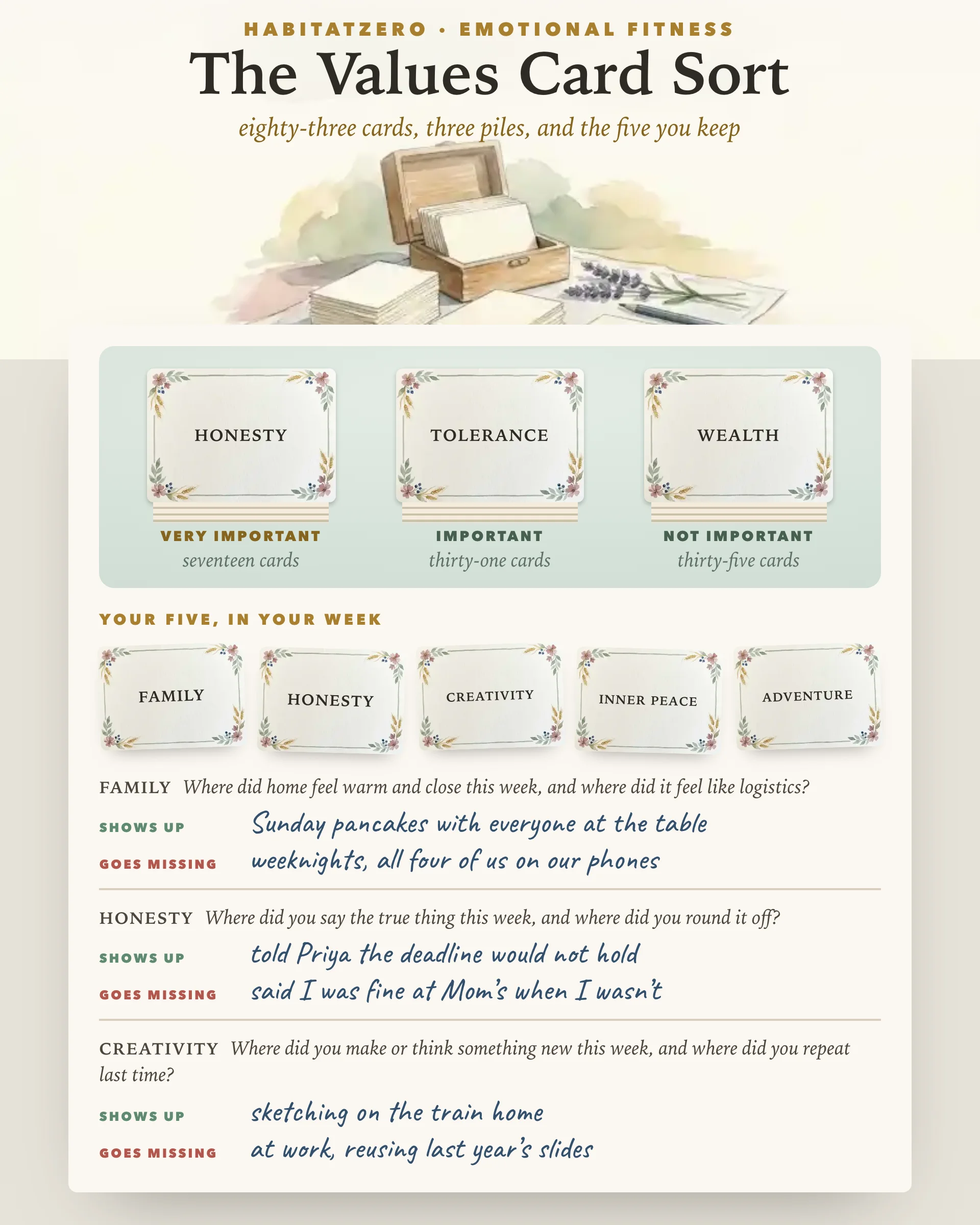
A list of eighty-three values makes it easy to tick half of them. Honesty, family, health, growth: it all sounds good, and nothing has to lose. A deck changes the question. Each card arrives alone and has to go somewhere, so you decide eighty-three separate times whether a value is very important to you, important, or not important. The not-important pile turns out to be as informative as the top one. Watching fame, tradition or excitement land there without a pang tells you something a checklist never asks.
The printed set holds eighty-three value cards, three header cards for the piles, and three blank cards marked Other Value for anything the authors left out. There is no scoring key and no norm table. The deck is built to start a conversation, with a counselor or with yourself, and nothing in it grades you.
The cards come up one at a time in a shuffled order. Tap a pile to deal the card there, or drag the card onto it. If one lands in the wrong place, take it back and it returns to the top of the deck. If a value you live by is missing, write it on a blank card; the three blanks wait at the bottom of the deck, which is where the printed set keeps them too.
When the deck runs out, your very important pile spreads across the table and you keep five. The hand refuses a sixth until you put one back, because the real work of a card sort is choosing between two things you care about. If fewer than five cards reached very important, or one belongs there after all, open the important pile and lift it up. The printed deck stops at three piles. Narrowing to five is this page's addition, made because a short hand is easier to carry into an ordinary week.
Then the page turns each kept card into a question about your last seven days. Honesty asks where you said the true thing and where you rounded it off. Family asks where home felt warm and where it felt like logistics. You answer in a few words: where the value showed up, and where it went missing.
The deck's first author, William R. Miller, co-wrote the original book on motivational interviewing with Stephen Rollnick, a history he and Gary Rose recount in their paper on a theory of the method. The card sort comes from the same University of New Mexico center, and the Motivational Interviewing Network of Trainers still shares it on its website. It is a conversation tool rather than a validated test, so treat what it shows you as a starting point, not a result.
The closest body of research is on values affirmation. In those studies people write briefly about personal values that matter to them, and a review by Geoffrey Cohen and David Sherman describes benefits for education, health and relationships that sometimes last for months. The findings are not uniform. When researchers reanalysed a 2010 classroom study of this kind, its headline result held up in only a small share of the reasonable ways to analyse the data. Read the evidence as encouraging for reflection, and as no promise of a particular outcome.
Sort the deck when a decision sets two good things against each other, at the start of a new job or a move, or when your weeks have been full and oddly empty. The five you keep also make useful material to bring to a coach or therapist. Priorities can move after a big change, and a second sort is a quick way to see whether yours did.
Once your five are kept, you can take them further. The Core Values Worksheet plots how fully you are living a short list on an ACT-style bullseye, and The Integrity Gap sets what you say matters against what one real week actually showed. Start with the cards, though. Five values you chose over seventy-eight others carry more weight than five you picked because they sounded right.
It is an exercise in which every card names one value, and you sort the stack by how much each one matters to you. Moving cards into piles forces a decision on each value, which is harder to dodge than circling words on a printed list.
W. R. Miller, J. C'de Baca, D. B. Matthews and P. L. Wilbourne released it at the University of New Mexico in 2001, with eighty-three value cards and three blank ones. The authors put the deck in the public domain, so anyone may copy, adapt and use it without asking.
Plan on ten to fifteen minutes for the deal if you go with first reactions. Choosing the final five often takes longer than the dealing, because that is where two values you care about have to compete for one place.
Treat them as a lens on an ordinary week. Notice where each one already has room and where it gets crowded out, then choose one small change for the value that goes missing most. Sort again after a big change, since the piles tend to move.
Yes. This page deals the whole deck on screen, so there is nothing to print or cut out. What you see here is a sample sort; open it in HabitatZero to deal your own and keep your five between visits, at no cost.
By the team behind Fabulous, the science-based self-care app used by over 30 million people.