
The Overwhelm Recovery ProtocolWellness & Routines · ~5 min
About this template · Updated September 2026
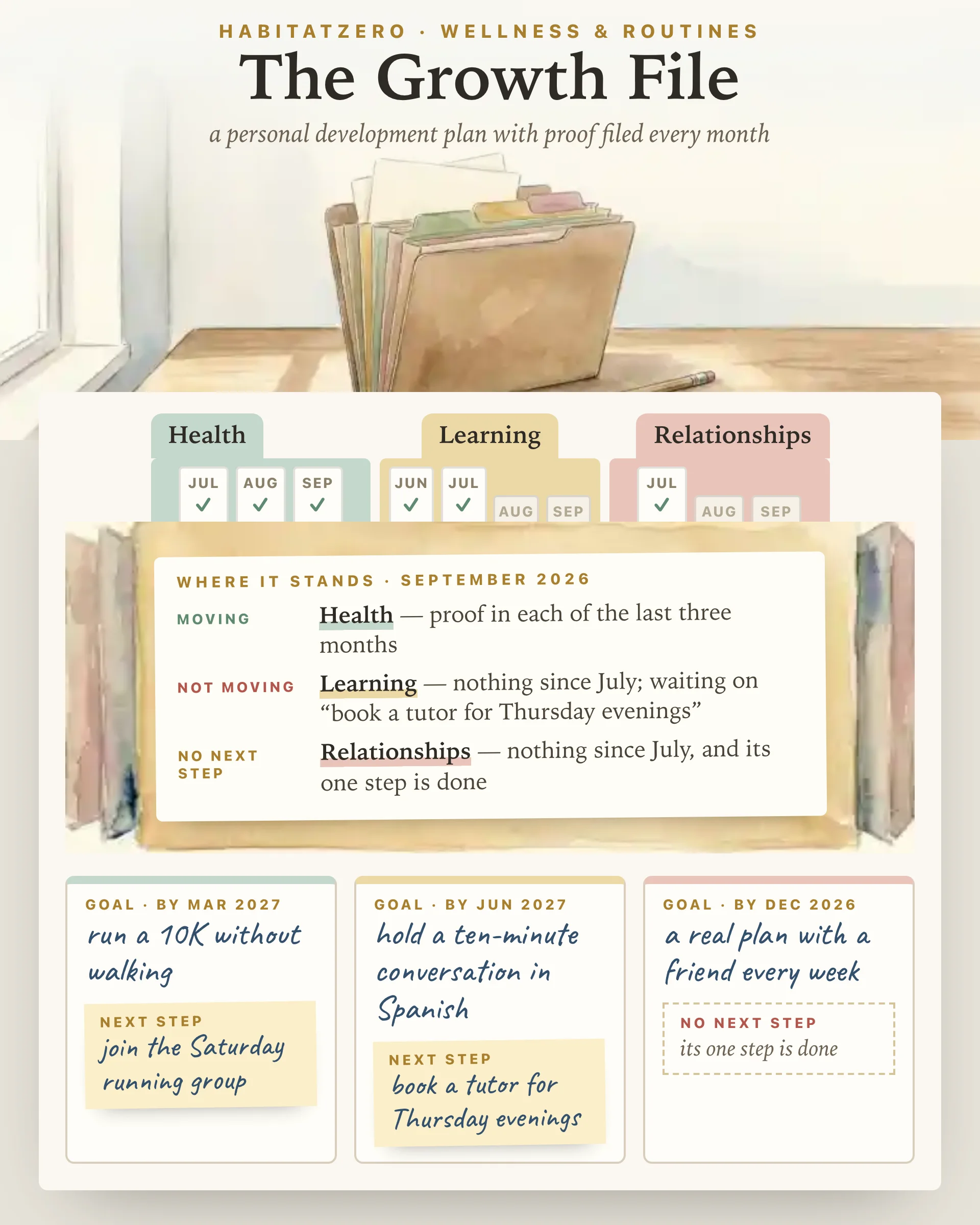
A personal development plan usually starts well. You write three ambitions on a form, maybe for a review at work, maybe on a quiet evening in January, and then the form goes in a drawer. When you open it months later, nothing on it tells you what happened. The ambitions were fine. What the plan lacked was a next move, and any record of whether things were changing.
This page is built around those two gaps. It works like an expanding file with a section for each area you want to grow. Every section holds a goal, a short list of steps, the support you are counting on and a month to aim for. Once a month you file one line of proof into each section, and the label on the front reads back which area is actually moving and which has nothing lined up next.
Most templates ask for the same five parts:
The review is where most plans quietly fail, so this file asks for it in the smallest possible form: one line of evidence per area per month.
Pick two or three areas to open. The chips cover a skill, health, work, relationships, learning and money, or you can name your own. Three is the most the file holds; spread your attention across six areas and it gets hard to see any of them move.
In each section, tap a suggested goal or write your own, then step the date to the month you are aiming for. Add up to five steps. The first one still open sits on a sticky note as the next step, and checking it off passes the note to the step after it. Name up to four kinds of support.
At the monthly check-in, write what moved in each section, in one line: "5K in thirty-one minutes," "ordered lunch in Spanish." If nothing moved, mark the month as nothing to show. An honest blank still counts as a check-in. Each filing stands a card up behind that section's tab, tall for proof and short for a blank month, so you can see at a glance which pocket is filling.
The label on the front does the reading for you. An area with proof this month or last is moving. An area whose last proof is older is not moving, and the label names the step it is waiting on, which is often the one you have been putting off. An area whose steps are all done, or were never written, is marked no next step, since nothing will happen there until you decide what comes next.
Switch the file to work mode and the chips change to workplace skills such as communication, leadership and presenting. Agree on the goals and dates in a one-on-one, then bring the file to the ones that follow. Each proof line is a specific example to talk through, and you can mark it as reviewed once you have. The label counts how many proofs you have discussed, turning a vague development talk into a short list of evidence.
Three findings sit underneath this design. Locke and Latham's thirty-five years of goal-setting research found that specific, challenging goals lead to better performance than vague ones such as "do your best," which is why every section asks for a goal someone else could check. A meta-analysis of 94 tests by Gollwitzer and Sheeran found that deciding in advance when, where and how you will act had a medium-to-large effect on reaching goals, which is the next step's job. And a 2016 meta-analysis of 138 studies found that monitoring progress toward a goal helps people reach it, with larger effects when progress was physically recorded or reported to someone else. The monthly proof line is that habit in its smallest form.
Be clear about the limits: those studies tested goal setting, planning and monitoring in many forms, not this page. A worksheet cannot do the practice for you, and a month with nothing to show is information about the plan, not a verdict on you.
Set the file up at a natural starting point: the new year, a new role, the week after a performance review. If you are unsure which areas to open, The Sailboat SWOT lets you weigh your strengths against your gaps first. If a goal is still fuzzy, sharpen it with the SMART Goals Worksheet. When one area grows into a project with owners and deadlines, give it a One-Page Action Plan.
Then come back once a month. One line per section is enough for the file to show where your growth is actually happening.
A personal development plan, often shortened to PDP, is a written plan for growing in a few chosen areas of your life or work. Each area gets a goal, the actions that will move it, the support you will lean on, a target date and a regular review of what has actually changed.
Most templates agree on the same five: a goal for each area, the actions you will take, the support or resources you need, a date to aim for, and a way to review progress. This file keeps the review honest by asking for one line of evidence per area every month.
A good goal names something another person could notice. Run a 10K without walking, hold a ten-minute conversation in Spanish and lead a project from kickoff to launch all qualify, because each one tells you what the proof will look like. Get fitter or be better at work do not, since nothing marks the day they are reached.
Switch the file to work mode, open two or three skills you want to build in your role, and agree on the goals and dates in a one-on-one. Bring the file to later one-on-ones: each monthly proof line is a concrete example to talk through, and you can mark it as reviewed once you have.
The filled-in file on this page is an example you can read through. Personalize it in HabitatZero to open your own sections, check in each month and watch the label change as your proof builds up. There is no charge for it.
By the team behind Fabulous, the science-based self-care app used by over 30 million people.


