ADHD Daily Task OrganizerFocus & ADHD · ~10 min
About this template · Updated September 2026
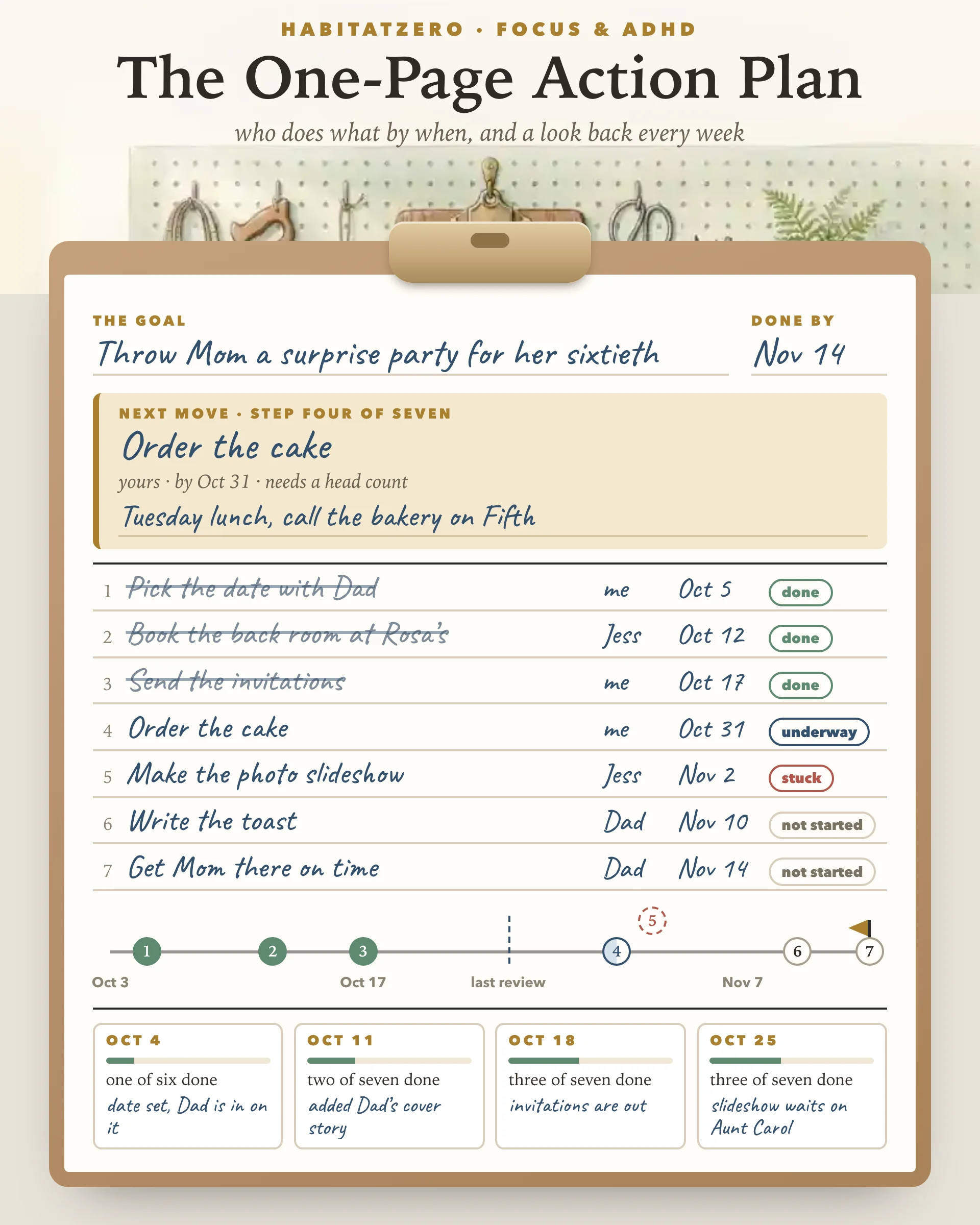
A goal with one step is a task. Once it has five steps, two other people and a deadline, it is a project, and projects stall in a familiar way: everyone agrees on the goal, nobody is sure what happens next, and the date arrives before the work does. An action plan template fixes that by putting every step on one page with a name beside it and a date on it.
This page is that template, drawn as a clipboard you fill in mostly by tapping, and it does what a printed form cannot: it hands you the next move, lines the dates up on a timeline, and keeps a weekly review.
The Community Tool Box, a free planning guide from the University of Kansas, says every action step should answer what will happen, who will carry it out, by when, and what resources it takes, and that a sound plan is complete, clear and current. The columns here follow that advice, with a status on each row: not started, underway, done or stuck.
Write every step as something you could do in one sitting, starting with a verb: "Call the bakery," not "cake." Give each one a single owner, too. A step that belongs to "us" tends to belong to nobody.
Eight steps still leave one question open: which one now? The card above the clipboard answers it with the step that is underway, or else the first one not started, passing over anything marked stuck so one blocked step does not freeze the plan.
Under it, the card asks when and where you will do it, which may be the most useful sentence you write. Psychologists call it an implementation intention, a plan shaped like "when this situation comes, I will do this." Peter Gollwitzer and Paschal Sheeran pooled 94 independent tests and found that forming one had a medium-to-large effect on reaching goals. They traced the effect to two things: the chosen moment becomes easier to notice, and the response to it becomes closer to automatic. If the step belongs to someone else, the card asks when you will check in with them instead, since that part is yours.
Expect your first dates to be optimistic. When Roger Buehler, Dale Griffin and Michael Ross asked students to predict when they would finish their senior theses, the average guess was about 34 days and the average actual finish was about 55, and only around three in ten were done by their own date. Researchers call the pattern the planning fallacy, and it can show up even in people who know their past projects ran late.
Two habits help. Add slack to any step you have never done before, and let the timeline check you: each dated step becomes a dot on a line running to the goal's flag, so a crowded week is easy to spot and a step dated after the goal gets called out early.
A plan nobody opens drifts out of date the first time something slips. Once a week, log a check-in: the page gathers what got done since the last one, what is stuck or late and what falls due in the next seven days, and you add one line about what changes.
This habit is well supported. In a meta-analysis of 138 studies, Benjamin Harkin and colleagues found that monitoring progress toward a goal made people more likely to reach it, and the effect was larger when progress was physically recorded or shared with others. Each review here saves how many steps were done that week as a short bar, so after a month you can see whether the plan is moving or only being rewritten.
The filled-in sample plans a surprise sixtieth birthday party in seven steps: pick the date with Dad, book the back room at the restaurant, send the invitations, order the cake, make a photo slideshow, write the toast, and get Mom there on time. Jess owns two steps, Dad owns two, and the rest belong to the planner. Four reviews in, three steps are done, the cake order is underway, and the slideshow is stuck waiting on old photos from an aunt. The timeline reading points out that three of the four open steps sit with other people, which is where this week's phone calls should go.
The print button lays the whole plan out on a single page, with blank ruled lines for steps you add by pen later. Clip it to a real board, or tape it where the household walks past.
If the goal itself is still fuzzy, sharpen it first with the SMART Goals Worksheet, then come back once it has a number and a date. If the plan is yours alone and the real risk is your own follow-through, the Goal Planning Worksheet spends more time on obstacles and if-then answers. For a goal measured in months, with milestones rather than errands, the Goal Planner walks it backward from the finish line.
It is a goal broken into concrete steps, where every step has one person responsible, a deadline and a note of what it takes to finish. Written down together, those steps turn an intention into a sequence you can work through and check against the calendar.
Start from one goal with a date on it. List the steps that get you there, each starting with a verb, and give every step a single owner, a due date and what it needs. Decide when and where the first step happens, then look at the plan once a week and move dates honestly when they slip.
The goal and its deadline, the steps in order, who owns each step, when each one is due, what each one needs, and a status for each. A dated review log is worth adding too, because it shows whether the plan is moving or only being rewritten.
The sample on this page plans a surprise sixtieth birthday party in seven steps, from picking the date with Dad to getting Mom to the restaurant on time. Jess and Dad each own two of the steps, and the stuck one, a photo slideshow, is waiting on old pictures from an aunt.
Yes to both. You can fill it in the browser at no cost, and the print button lays the plan out on one page with spare ruled lines for steps written by hand. Personalizing it in HabitatZero keeps your steps, dates and weekly check-ins saved for the next visit.
By the team behind Fabulous, the science-based self-care app used by over 30 million people.