Leaves on a StreamEmotional Fitness · ~3 min
About this template · Updated September 2026
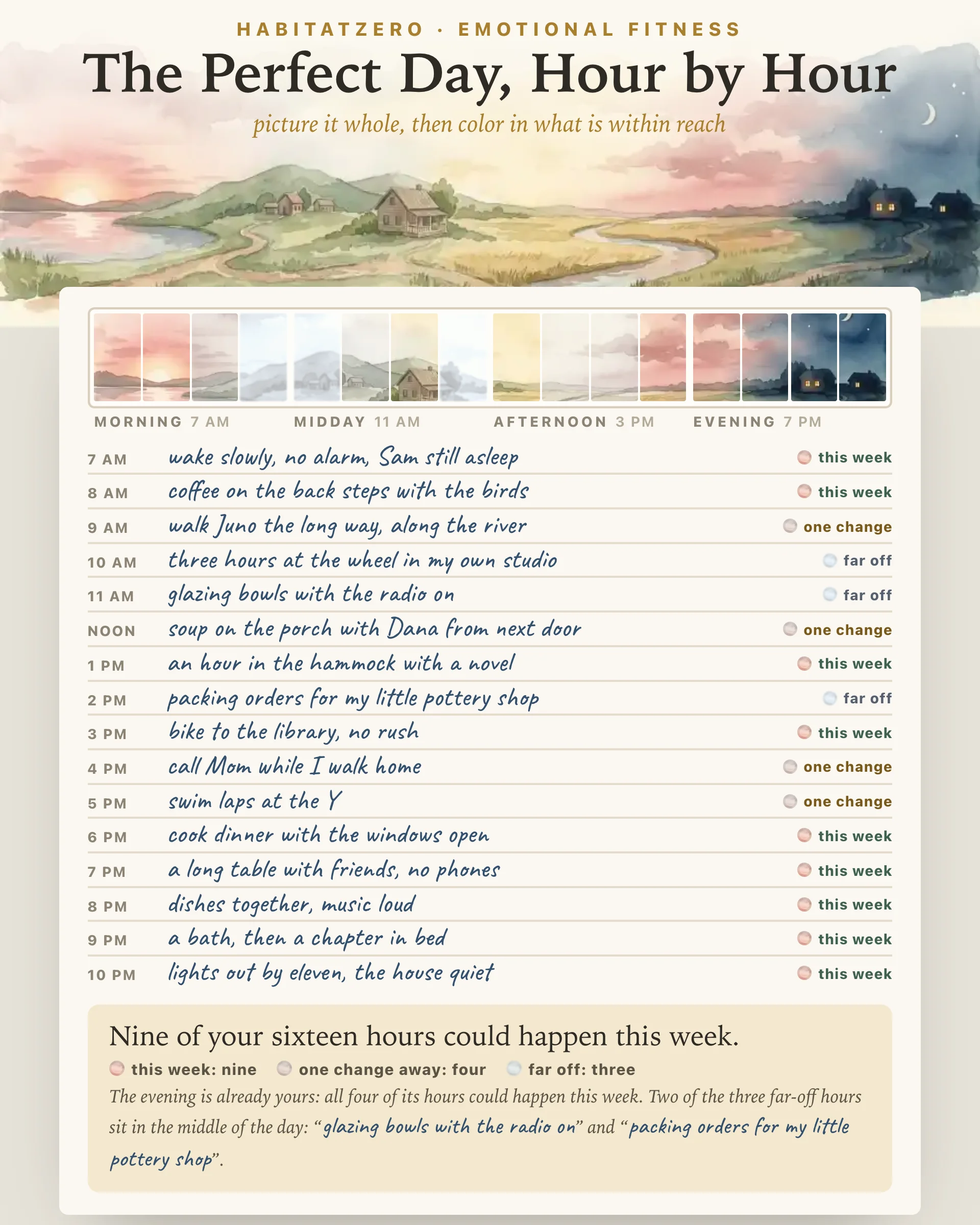
The perfect day exercise, in the form most people meet it today, is the one life coach and sociologist Martha Beck teaches under the name ideal day. In an August 2024 episode of the Huberman Lab podcast, she walked Andrew Huberman through it, and he told her it was one of the exercises that had a profound effect on his life. This page is HabitatZero's own interactive take on the idea, made independently: neither Beck nor Huberman had a hand in it or has endorsed it.
Picture one day in a life that fits you, set far enough ahead that it has had time to take shape. Beck suggests three or five years, whatever span lets you believe it could form. The day is not a vacation or a once-in-a-lifetime event. It is a typical day, lived the way you would choose to live it.
Start in bed, and listen before you look around. What do you hear? Who is breathing beside you, if anyone? Get up, go to the window and notice where you are: a city block, a small town, a coast. Then walk through the day in order: the first cup, the work and who shares it, lunch, the long afternoon, dinner, the last quiet hour.
Beck adds two cautions. Do it rested, because she found that worn-out people pictured little more than white rooms and white sheets. And keep logic out of the picturing: while the day is forming, you are not deciding what is realistic or manageable, only noticing who and what shows up.
The sheet gives you sixteen waking hours, counted from the hour you choose to wake. The other eight belong to sleep. Each hour takes one short line, in your own words or from a tapped suggestion, and the pen moves straight on to the next hour.
Across the top runs a painted day, sunrise on the left to a starry night on the right, cut into one panel per hour. A sketched hour shows up there in pencil.
When the whole day is written, the judging you held back gets its turn. Hold each hour up to this week and ask whether it could happen, as written, in the next seven days. Some hours need exactly one change first: asking for a later start on Fridays, packing a swim bag the night before. Others are far off, a studio you do not have yet or a town you do not live in. Hours you could live now are painted in full color, one-change hours in half color, and far-off hours stay faint.
Below the hours, the reading counts them, names the part of your day that is closest to real, and points to where the far-off hours gather. Every one-change hour becomes a next step: name the change, make it, and move that hour into color. The sheet counts the hours you moved that way. If you rewrite an hour, its old mark clears, since new words deserve a fresh look.
A lovely daydream can leave you with less drive rather than more. Across four experiments, Heather Barry Kappes and Gabriele Oettingen found that people led into positive fantasies about an idealized future came away with less energy, measured both physically and in their behavior, than people who pictured something else: a future they questioned, a negative one, or a neutral one.
What helps is setting the wish beside the present. In a set of experiments Oettingen published with colleagues in 2001, people who contrasted a desired future with their current reality committed strongly to goals they expected to reach and loosely to ones they did not. People who only fantasized, or only dwelled on the present, landed on a middling commitment either way. Holding each hour against this week is a small version of that contrast, done hour by hour.
As far as we could find, no published study has tested the perfect day exercise itself, and Beck says plainly that she does not know how or why it works. Its nearest relative with research behind it is the best possible self exercise. In Laura King's 2001 study, undergraduates who wrote about their best possible future self for twenty minutes on four days in a row reported a rise in well-being three weeks later, and found the writing less upsetting than writing about a trauma. That is a different exercise, tested on a small group of students. Treat the perfect day as a way to get clear on what you want, not as a proven treatment for anything.
It suits the quiet week at the end of December, the months before a move or a job change, and the restless stretch Huberman described, when a life that looks fine from outside keeps feeling slightly wrong. If one perfect day feels too narrow, The Odyssey Plan sketches three very different five-year lives side by side. For far-off hours that need years rather than a single change, The Life Map turns them into milestones. And if most of your reachable hours turn out to land on a Saturday, The Open Weekend helps keep that time yours.
It is a visualization and writing exercise. You picture one ordinary day in a life that suits you, a few years from now, from the moment you wake until lights out, and write it down in detail, because the details show what you actually want. This page works as an ideal day worksheet that also sorts every hour by how close it already is.
We could not trace it to one documented inventor. The version most people search for is the one life coach and sociologist Martha Beck teaches as the ideal day. She walked Andrew Huberman through it on his podcast in August 2024, where he called it the perfect day exercise and said it had a profound effect on his life.
Start in bed and move through the day in order. Notice what you hear, who is beside you, what you see from the window, what the work is and who shares it, and how the evening winds down. Keep it an ordinary day rather than a vacation, and do not cut anything for being unrealistic while you picture it.
No. HabitatZero built this page on its own, and it has no connection to Martha Beck, Andrew Huberman or Huberman Lab, none of whom reviewed or endorsed it. The hour-by-hour sorting and the painted day are additions of this page, not part of her method.
Not to look around: the page shows a finished sample day. To write your own sixteen hours, sort them, and come back a week later to color in the ones you reached, open the sheet in HabitatZero, which is free.
By the team behind Fabulous, the science-based self-care app used by over 30 million people.