Leaves on a StreamEmotional Fitness · ~3 min
About this template · Updated September 2026
Odyssey Plans were created by Bill Burnett and Dave Evans, who teach design at Stanford and wrote the book Designing Your Life. The Designing Your Life site keeps a short guide to Odyssey planning alongside their original worksheet. The page you are on is our own interactive take on the exercise, built separately: Burnett, Evans, their company and Stanford University had no hand in it and have not endorsed it.
Most planning starts by choosing the one right future and working backward from it. The Odyssey Plan skips that step on purpose: you sketch three different versions of the next five years, give each a fair hearing, and only then ask which deserves a small test. The goal is not prediction. It is to stop treating a single plan as the only road you have.
Each prompt is built to pull you away from the plan already in your head.
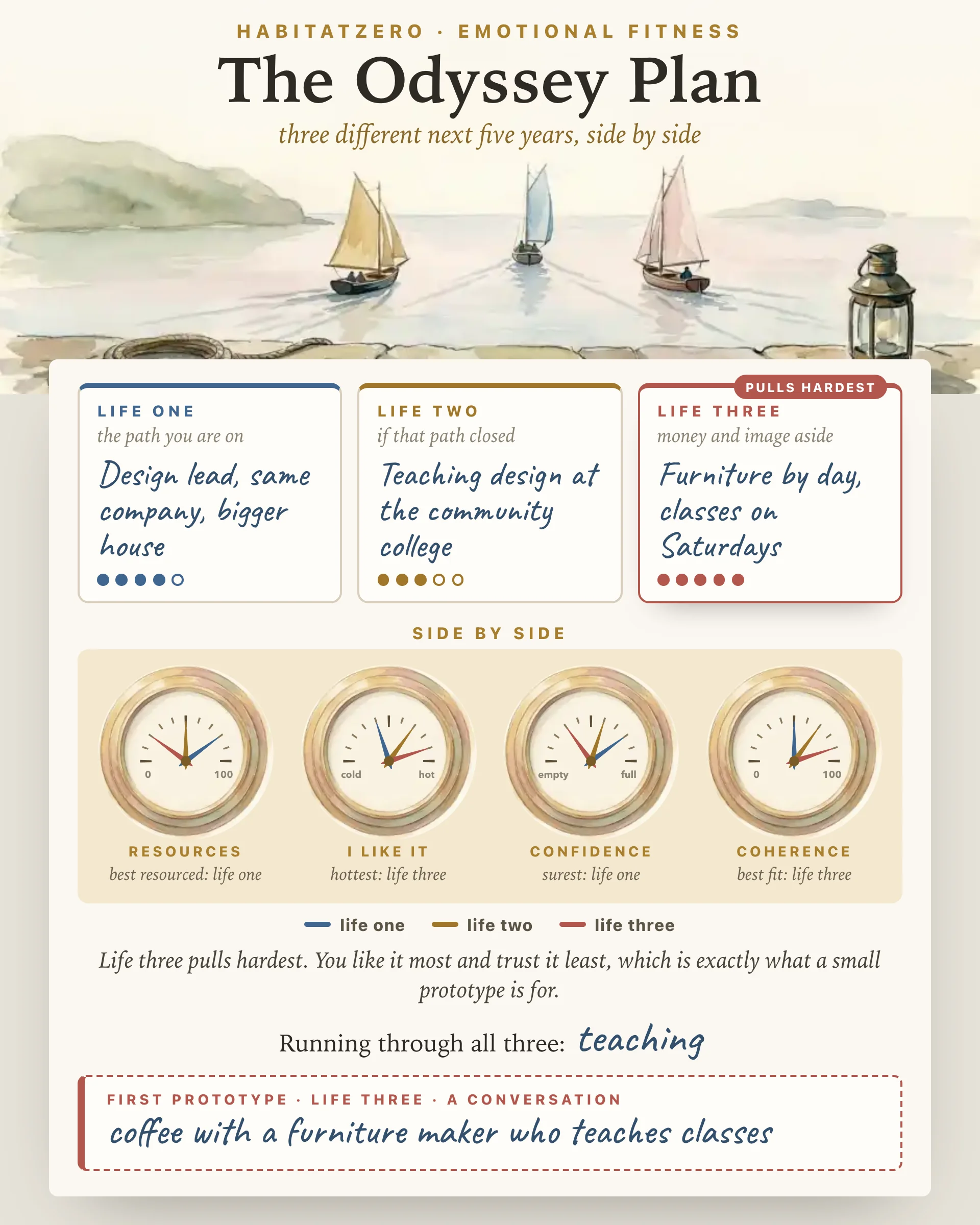
Every life gets a six-word title, a timeline that includes things outside work (a move, a child, a long trail), two or three questions it raises, and four gauges. Resources asks whether you have the time, money, skills and contacts to pull it off. I like it runs from cold to hot. Confidence asks how sure you are that you could make it work. Coherence asks whether the plan makes sense with who you are and what you believe.
The three lives sit at the top as cards, each wearing the sail color of one boat in the painting. Open one and it unfolds below: its prompt, a title line that counts your words toward six, five years to fill by hand or with a tapped suggestion, four brass dials you set by tapping along the arc or with the arrow keys, the threads it would be made of, and its questions. A life holds five threads and three questions at most, so each plan stays small enough to read at a glance.
Underneath, a panel lays all three needles on each gauge, names which life runs hottest and which is best supplied, and writes one line about the gap that matters most, such as a life you love but do not yet trust yourself to pull off. It also finds the thread: anything you named in all three lives, even though they were meant to differ. In the worked example, a product designer weighs a promotion, community college teaching and a furniture workshop, and teaching turns up in all three.
When one life pulls hardest, the page offers a first prototype for it, either a conversation with someone already living it or a short experience of it yourself, and hands you that life's questions as the agenda. Mark it tried when it is done, then come back and move the gauges.
We could not find a controlled trial of the Odyssey Plan itself, so treat it as a well-used design exercise rather than a proven intervention. Two ideas underneath it do have research behind them.
The first is possible selves. Psychologists Hazel Markus and Paula Nurius described possible selves in 1986 as the selves people think they might become, hope to become or are afraid of becoming, and argued that these images work as incentives, selves to approach or avoid. Writing three lives down makes those images concrete enough to look at.
The second comes from design research at Stanford. In one experiment, novice designers who made several web ads in parallel before getting feedback ended up with ads that performed better and varied more, and they gained more confidence than designers who refined one ad at a time. That study was about banner ads, not careers, so take it as an analogy for sketching three lives before committing to one.
Neither line of work tells you which life to choose. The gauges are your own readings on a given day, and they will move. That is exactly why the exercise asks for a prototype before a decision.
It fits the moments when one plan has started to feel like a trap: a graduation, a layoff, a restless third year in the same role, a move you keep postponing. Sketch all three lives in one sitting, even if the third feels silly, then run the smallest prototype you can find and let what you learn move the needles.
If the coherence dial is hard to set because you are not sure what you value, start with the Core Values Worksheet. Once one life clearly wins, the Life Map turns it into milestones at one, three and five years, with a first step for this month.
It is an exercise from Designing Your Life, the book by Bill Burnett and Dave Evans, where you sketch three genuinely different versions of your next five years instead of betting everything on a single plan. Each version gets a short title, a timeline, a few questions and four gauges.
The first is the path you are already on. The second is what you would do if that path suddenly disappeared. The third is the life you would pick if money were covered and nobody's opinion of you counted.
Resources asks whether you have the time, money, skills and contacts to pull it off. I like it runs from cold to hot. Confidence asks how sure you are that you could make it work, and coherence asks whether the plan fits who you are and what you believe.
It comes from the Designing Your Life approach that Burnett and Evans teach at Stanford, where Burnett directs the Life Design Lab. This page is a separate version made by Fabulous, with no tie to them or to the university.
The example on this page shows three finished lives and how the comparison reads them. To sketch your own three and keep them between sittings, open the template in HabitatZero, where it saves on its own and costs nothing.
By the team behind Fabulous, the science-based self-care app used by over 30 million people.