The Overwhelm Recovery ProtocolWellness & Routines · ~5 min
About this template · Updated September 2026
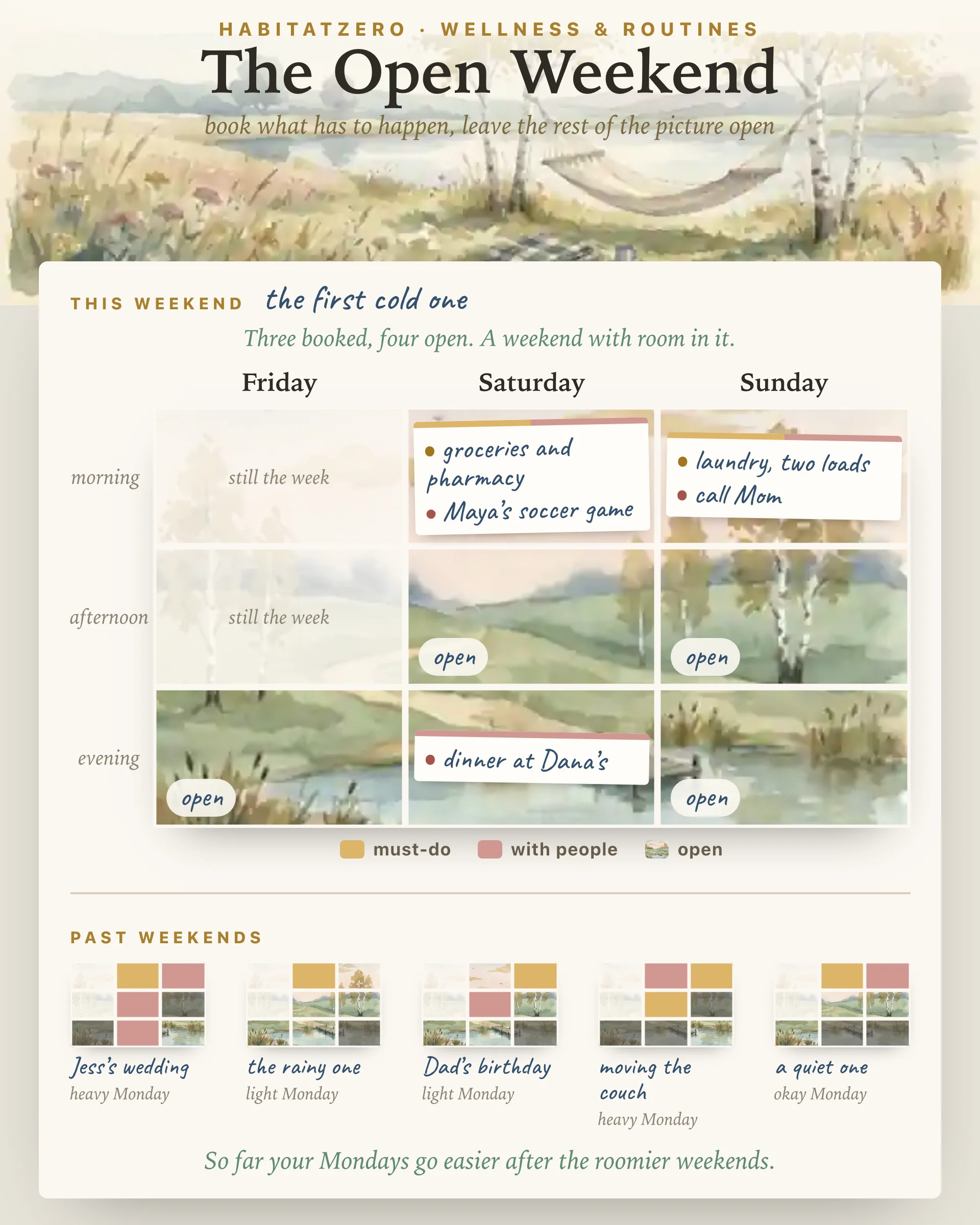
Most weekend planners are built like a second work week. There is a column for Saturday, a column for Sunday, and every line waits for a task. Fill them in and the weekend is organized, and also gone: by Sunday night the errands are done and you are still tired, because the one thing a weekend is for never made it onto the page.
This weekend planner template starts from the other end. Every part of the weekend begins open, shown as a piece of a painted view, and you only cover what is already spoken for.
The weekend is laid out in seven parts: Friday evening, then morning, afternoon and evening on Saturday and on Sunday. Friday morning and afternoon are grayed out as still the week, because a plan that pretends the weekend begins at breakfast on Friday mostly makes Friday feel like a failure.
Tap a part and decide what kind of thing lives there. A must-do is an errand or chore that has to happen: groceries, laundry, the oil change. A plan with people is time you have promised to someone: brunch, a soccer game, a call home. Each booked part gets a paper slip pinned over the painting, gold for must-dos and rose for people, and a single part holds two things at most.
Four booked parts is the ceiling. Once four are taken, the page turns down a fifth and asks you to fold the new errand into a part that is already busy, or to clear something first. That guarantees at least three pieces of the picture stay uncovered. They are not gaps in the plan. They are the rest of your weekend.
Under the grid sits a short maybe list: a nap, the farmers market, a long walk. It carries no times, on purpose, and holds four ideas at most.
When the plan looks right, print it. Booked parts print as slips and open parts print with a few ruled lines, so the paper version still works with a pen. Printed before you book anything, it makes a plain weekend planner printable for the fridge.
It is tempting to treat free time as whatever the plan leaves behind. Across thirteen studies, Gabriela Tonietto and Selin Malkoc found that scheduling a leisure activity made it feel less free-flowing and more like work, and people enjoyed it less, both while looking forward to it and while doing it. The useful part is the remedy they tested: planning the same activity roughly, with no set start or end time, removed the effect. That is why nothing on this page asks for a clock time, and why the maybe list is a list rather than a schedule.
The must-dos earn their cap too. Following 87 emergency service workers across a weekend, Charlotte Fritz and Sabine Sonnentag found that nonwork hassles and low social activity over the weekend predicted more burnout and poorer well-being afterward. A later study that tracked 229 people from before a weekend into the next workweek linked relaxation, mastery, control and detachment during the weekend to how they felt at the end of it and through the days that followed. Neither study claims that an empty Saturday fixes anything. Both suggest that what fills a weekend shows up again on Monday.
Some evening early in the week, switch to look back. Tap each part you left open: once if it stayed open, again if a chore or a work email crept in. Then say how Monday felt, heavy, okay or light, and file the weekend. It joins a shelf of small cards, each one a tiny copy of that weekend's picture.
From the third weekend you file, the shelf starts comparing. It separates the roomier weekends, where three or more parts really stayed open, from the fuller ones, and reports in plain counts how Monday felt after each kind. It may tell you your Mondays go easier after the roomier weekends, or that they look about the same either way. Either answer comes from your own weekends rather than a rule.
There is good reason to run that experiment on yourself. In three preregistered experiments, Colin West, Cassie Mogilner and Sanford DeVoe asked some people to treat an ordinary weekend like a vacation, and those people came back on Monday happier: more positive feelings, fewer negative ones and greater satisfaction. The authors say plainly that they could not fully rule out participants guessing what was expected of them. Your shelf is a smaller, more personal version of the same test.
Plan on Thursday night or Friday afternoon, before the weekend fills itself in. If Sunday evenings tend to arrive with a knot in them, the Sunday reset checklist handles that landing, and closing the week first with a weekly review keeps loose ends from following you into Saturday. For the five days after, the printable weekly planner holds the week's top three.
Some weekends will be full whatever you do, because weddings and moving days happen. Look back on those anyway: a heavy Monday after a packed weekend is not a failure, just one more card showing what your weekends cost you.
Three things: what must get done, the time you have promised to other people, and time with nothing on it at all. Most weekend printables only make room for the first two. Here the third gets its own space, and at least three of the seven parts always stay free.
Yes. Book your parts and print, and the page comes out with your slips on it and a few ruled lines in every open part, ready for a pen. Printed without filling anything in, it doubles as a blank Friday-to-Sunday sheet for the fridge door.
It is. The filled-in example on this page shows the whole thing working. Booking your own weekend, keeping a shelf of past ones and getting the Monday comparison all happen inside HabitatZero, and joining costs nothing.
Less than feels safe. In one line of research, putting leisure on the calendar at a fixed time made it feel more like work and less enjoyable, while planning it loosely did not. So this page stops at four booked parts out of seven and never asks for a clock time.
Monday is where a weekend shows what it did for you. Studies of recovery from work tie what people do on their days off to how they feel in the week that follows. Filing a few weekends lets you see whether that holds for you, in your own counts.
By the team behind Fabulous, the science-based self-care app used by over 30 million people.