The Overwhelm Recovery ProtocolWellness & Routines · ~5 min
About this template · Updated July 2026
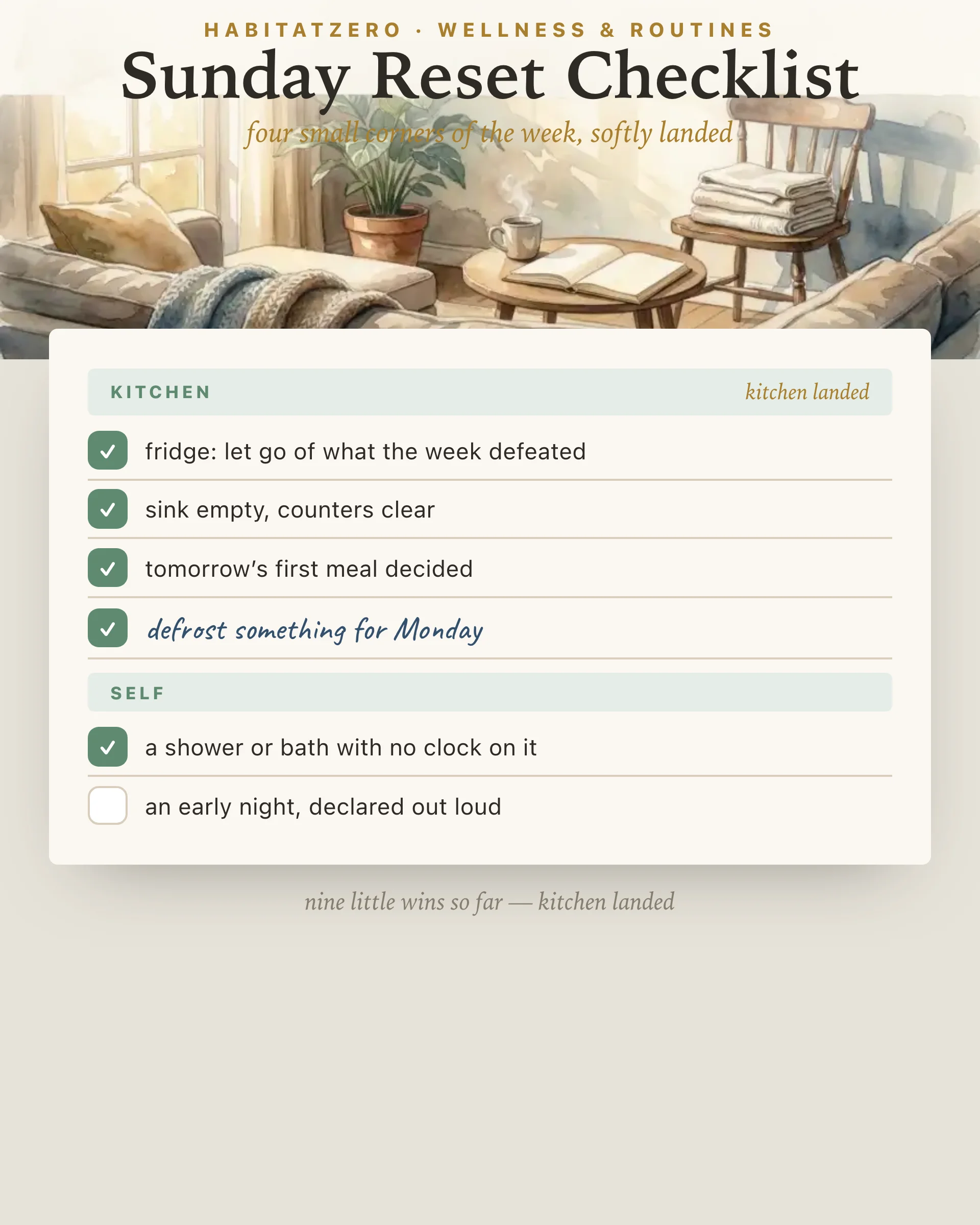
Sunday evening has a particular hum. The weekend is technically still on, but some part of you has already left for Monday — auditing the fridge, the laundry, the calendar, the version of you that has to get dressed in nine hours. A Sunday reset checklist exists to answer that hum with something kinder than dread and smaller than a deep clean: four little corners of the week, touched lightly, in about an hour.
The internet's version of the Sunday reset has quietly inflated into a five-hour production — full house clean, meal prep for seven days, a self-care sequence with a shopping list. If that is your idea of a good Sunday, enjoy every minute. But a reset that costs the whole day just moves the exhaustion from Monday to Sunday, and the first skipped week ends the ritual.
This checklist is deliberately sized in minutes. Sixteen small ticks across four sections — home, kitchen, self, the week ahead — plus one blank line in each section for the thing only your home knows about. A ten-minute sweep of the flat surfaces. The fridge relieved of what the week defeated. Tomorrow's first meal decided, not cooked. Every item passes the same test: could you do it tired, with music on, without negotiating with yourself first?
Half of them ticked is a successful reset. The sheet says so out loud, because a checklist that only celebrates completion teaches you to stop opening it.
It would be easy to make a Sunday reset entirely about the house, and most versions do. This one gives the self a full quarter of the sheet: an unhurried shower, clean sheets if it's the week for them, ten minutes of something that is only yours, an early night declared out loud — declared, because a bedtime spoken to another human being survives the evening better than one privately hoped for.
This isn't garnish. Occupational health researchers who study how people recover from work weeks find that the restorative part of a weekend — the detachment, the low-key mastery, the sense of control — is what actually replenishes the energy the next week spends. A Sunday spent entirely on chores technically prepares the house and quietly skips the person. Ticking the self section is how the hour stays honest about what it's for.
The final section is five quiet minutes of looking forward: glance at the calendar and name the fullest day, decide the first morning's clothes, cancel or shrink one thing, put the bag by the door.
There is good reason to do this on Sunday specifically. Behavioral research on temporal landmarks shows that the start of a week works as a natural fresh-start line — motivation reliably rises just after the boundary. The week-ahead ticks are how you spend that rise before Monday's inbox does. Naming the fullest day matters more than it looks, too: a hard Wednesday you saw coming on Sunday is a plan; the same Wednesday discovered on Wednesday is a crisis.
And the one thing canceled, moved, or shrunk check is the most quietly radical line on the sheet. Almost every overloaded week contains one commitment that was optional all along. Sunday is when you can still decline it gracefully.
The four custom lines are where the checklist stops being generic — sweep the porch, defrost something for Monday, charge the headphones. One line per section, no more; the moment a custom line needs a whole afternoon, it belongs on a plan, not a reset.
Then let the ritual get boring, in the best way. Same hour, same music, same sixteen ticks. If your mornings need the same gentle structure the reset gives your Sundays, the morning routine checklist runs the day's first hour on the same philosophy, and the wind-down routine does the evening. For the deeper cleaning passes the reset deliberately doesn't attempt, a printable cleaning checklist holds the room-by-room version.
The week is coming either way. An hour on Sunday decides whether it arrives at a house mid-hum — or lands, softly, on a person who already met it.
A short, repeatable list that lands the week softly: a few small home and kitchen tasks, a little deliberate care for yourself, and a five-minute look at the week ahead. It is the antidote to two bad Sunday defaults — doing nothing and dreading Monday, or deep-cleaning for five hours and starting the week exhausted.
An hour is plenty, and a half-hearted twenty minutes still counts. Every item on this checklist is sized in minutes on purpose: ticking eleven of sixteen boxes and stopping is a successful reset, not a failed one. The list restarts fresh every Sunday either way.
Because the reset is for the week, and you are in the week. Research on how people recover from work finds that genuinely detaching and doing something restorative on the weekend is what protects energy for the days after — a Sunday spent only on chores skips the part that helps most. The self ticks keep the hour honest.
The thing your home always needs that no generic list knows about — sweep the porch, defrost something for Monday, charge the headphones. One line per section keeps it a reset instead of a project list; if a line needs more than a few minutes, it belongs on a plan, not here.
Yes. Tick it on the page and it saves as you go, resetting whenever you clear it — or print it and keep a paper copy wherever your Sunday afternoon happens.
By the team behind Fabulous, the science-based self-care app used by over 30 million people.