
The Overwhelm Recovery ProtocolWellness & Routines · ~5 min
About this template · Updated November 2026
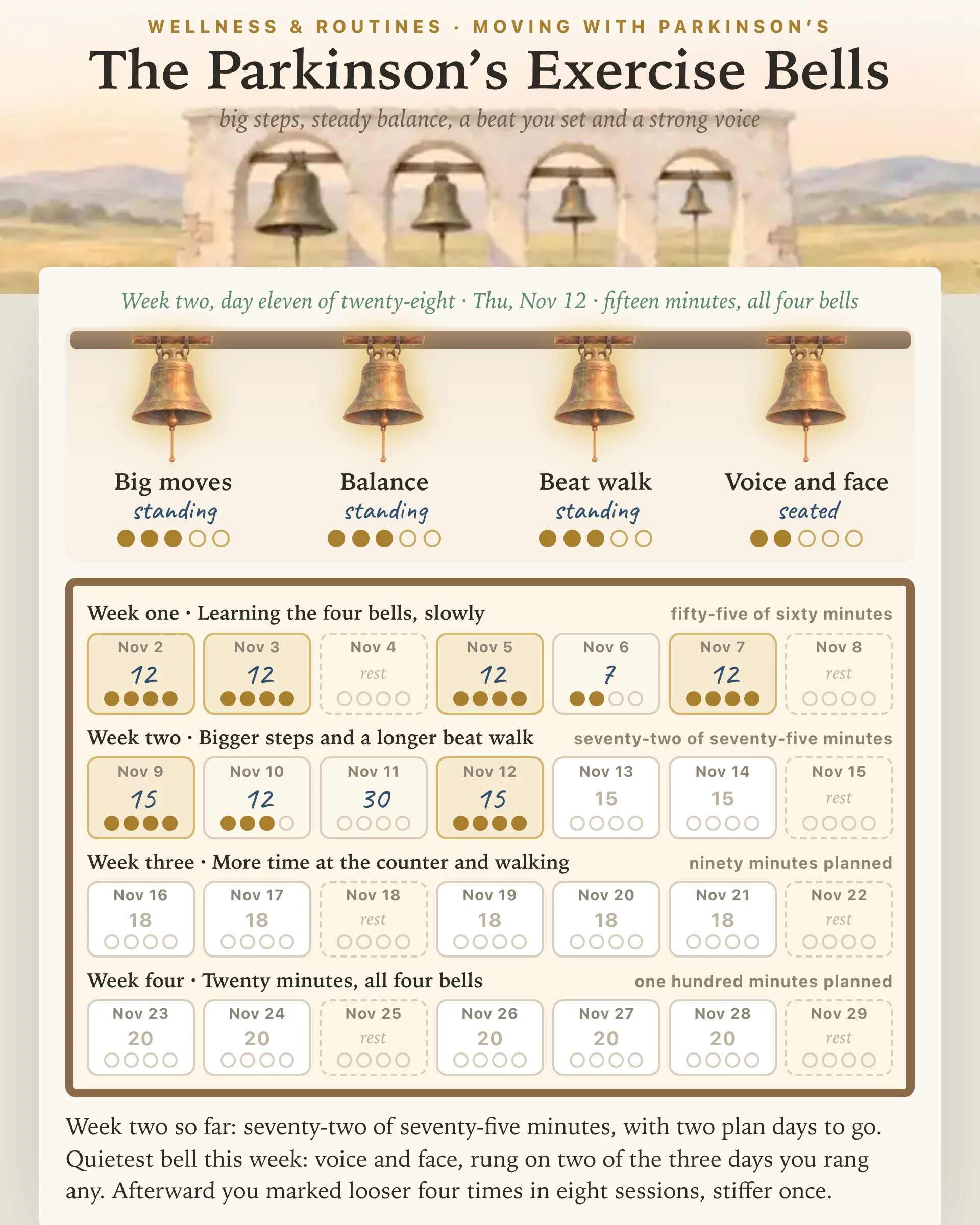
This page is a movement practice log for people living with Parkinson's. It sits beside the care you already have: your neurologist manages the condition and its medicines, and a physical therapist can fit moves to how your body works today. Here you get a short daily routine, a timer you can trust, and a record of what you did to bring to those appointments.
The routine has four parts, drawn as four bronze bells in a row. Each has a standing and a seated version, chosen per bell, so a shaky morning can mean seated balance work while the rest stays standing.
Pick standing or seated under each bell, then tap ring today's bells. The timer moves through the four parts in order, a new move each minute, and reads the real clock, so a phone that locks mid-session neither loses nor invents minutes. A bell rings only once its whole part has run to the end; skipped time is left out, and a session stopped early keeps whole minutes only. If balance feels off partway, sit for the rest switches every remaining part to seated.
Underneath, a four-week board fills day by day with your minutes and a gold dot for each bell rung. The plan starts at twelve minutes, three per bell, on five days a week, and grows to twenty by week four. The reading compares the week with its plan and names the bell you rang least. After each session you can mark how moving felt and write a short note; two sessions in a row marked unsteady bring a plain suggestion to stay seated and talk to your care team.
The largest summary is a 2024 Cochrane network meta-analysis of 154 randomized trials with 7,837 people, mostly with mild to moderate Parkinson's and no major memory or thinking problems; the average trial had about fifty people. Compared with no exercise, most types improved movement symptoms and quality of life, measured up to six weeks after a program, with little difference between types. It cannot tell you what happens over years, and people with advanced disease were mostly not studied.
On falls, a 2022 Cochrane review pooled twelve trials with 1,456 people in the mild to moderate stages and found that exercise probably cuts the rate of falls by about a quarter. That is a group average from trials with some risk of bias; it does not promise that you will fall less, and the reviewers were unsure about fall-related fractures.
The American Physical Therapy Association's 2022 clinical practice guideline gives strong recommendations for aerobic exercise, strength training, balance training, walking practice and external cues such as rhythm. Its authors say the best dose is not settled, that most of the evidence comes from early and middle stages, and that gains fade once exercise stops.
The beat walk borrows from cueing research. A 2018 review of 50 studies with 1,892 participants found that rhythmic sound cues went with faster walking and longer strides. Those studies used sound; this page's beat is silent, so you carry it in your own voice, which doubles as voice practice.
None of this shows that exercise slows, stops or reverses Parkinson's, and this page makes no such claim. The voice warm-ups are practice, not speech therapy; if your voice has grown quiet or hard to follow, ask your neurologist about a referral to a speech-language pathologist.
Check with your neurologist or physical therapist before you start, especially if you have fallen, feel dizzy when you stand up, have had a joint replaced, or live with a heart or blood pressure condition. Keep a sturdy counter or chair within reach for every standing part, and if your feet tend to freeze, practice with someone nearby. Choose a time when your medication is working well. Stand up slowly, stop if anything hurts, and sit down at once if you feel faint.
Use it on plan days, ideally at the same hour, and bring the board to your next appointment so your care team sees what you did rather than what you remember. For more balance work at the counter, The Balance Ladder climbs through supported moves rung by rung. For a fully seated session, try The Chair Circuit, and for slow, flowing movement there is a gentle tai chi practice.
Reviews pooling many trials find that most kinds of regular exercise help movement and quality of life compared with none, with little difference between kinds. Physical therapy guidance points to a mix of aerobic work, strength, balance, walking practice and cues such as a steady beat. The best plan is one your physical therapist fits to you and that you keep doing.
This page makes no claim that exercise slows, stops or reverses Parkinson's. The reviews it cites measured symptoms, walking, balance, falls and quality of life over weeks to months, not the course of the condition. Keep taking the treatment your neurologist prescribes, and treat movement practice as a partner to it.
With sensible care, most people can practice at home: stay beside a sturdy counter or chair, have someone nearby if your feet freeze or you have fallen, choose a time when your medication works well, and rise slowly from sitting. Ask your neurologist or physical therapist first, and stop if anything hurts or you feel faint.
A steady rhythm gives each step an outside cue to follow. A review of 50 studies with 1,892 people linked rhythmic sound cues with faster walking and longer strides. The beat on this page is silent, so you say it out loud as you go, which also exercises your voice.
No single dose has been agreed. The 2022 US physical therapy guideline leaves the amount to your therapist and notes that gains fade once exercise stops. This plan starts at twelve minutes on five days a week and grows to twenty by week four, so it stays small enough to keep up.
By the team behind Fabulous, the science-based self-care app used by over 30 million people.


