
Leaves on a StreamEmotional Fitness · ~3 min
About this template · Updated September 2026
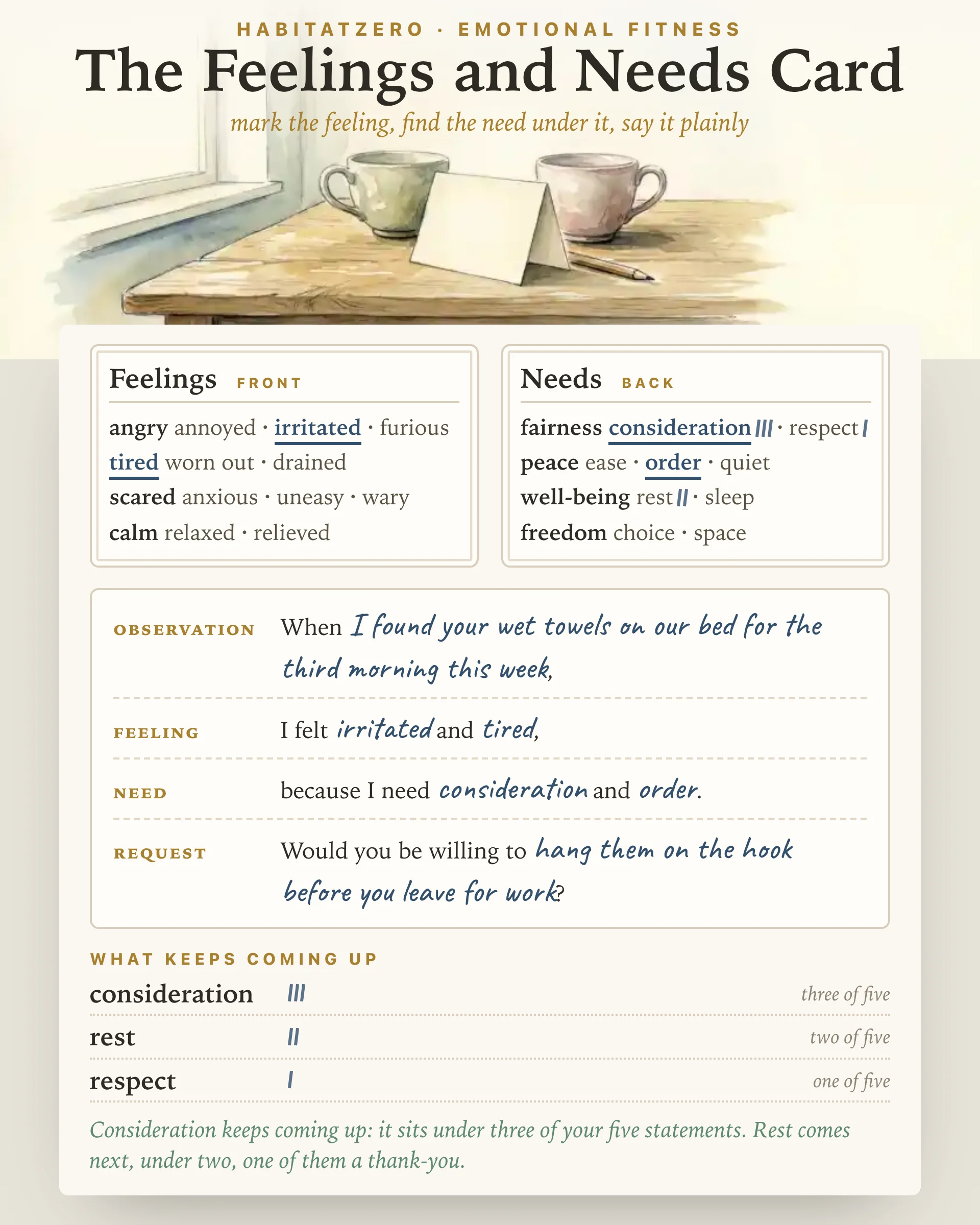
Nonviolent Communication, or NVC, is the work of Marshall B. Rosenberg (1934–2015), a clinical psychologist who founded the Center for Nonviolent Communication in 1984. His method has you say four things in order: what you observed, what you feel, what you need and what you would like to ask for. CNVC offers its own four-page Feelings and Needs Inventory as a free download. The lists on this card were written and grouped separately for this page. Fabulous made the card on its own; it has no tie to CNVC, which has neither reviewed it nor put its name to it.
Rosenberg did not sort emotions into good and bad. He sorted them by what they report: some feelings turn up when a need is being met, others when it is not. The front of the card keeps that split, with about a hundred feeling words in fifteen families.
Needs sit on the back because they sit underneath. In NVC a need is something every person shares, like rest, safety or respect, and it never names a particular person or action. Wanting your partner to text back is a strategy; the need under it might be reassurance or connection. The difference matters, because a strategy can be refused while a need can usually be met in more than one way.
Mark a feeling and turn the card over: the back shades the needs people often find under it. The shading is a hint, not a rule. The same frustration can come from a need for fairness on Monday and a need for rest on Thursday.
When a need is not met. Scared: afraid, anxious, nervous, worried, uneasy, wary, panicky. Angry: annoyed, irritated, frustrated, exasperated, resentful, furious. Sad: hurt, disappointed, discouraged, heartbroken, gloomy, heavy-hearted. Tense: stressed, overwhelmed, on edge, restless, jittery, frazzled. Tired: worn out, drained, weary, exhausted, burned out, sluggish. Lonely: isolated, distant, detached, numb, homesick. Confused: puzzled, torn, unsure, lost, bewildered, hesitant. Embarrassed: ashamed, guilty, self-conscious, awkward, mortified, regretful. Longing: envious, jealous, wistful, nostalgic, pining.
When a need is met. Glad: happy, pleased, delighted, cheerful, amused, joyful. Calm: relaxed, relieved, content, at ease, settled, serene. Close: warm, tender, loving, friendly, trusting, open. Grateful: thankful, touched, moved, appreciative. Hopeful: encouraged, optimistic, confident, proud, expectant. Energized: excited, eager, curious, inspired, refreshed, playful.
Needs. Well-being: rest, sleep, food, movement, touch, shelter, comfort. Safety: security, stability, predictability, reassurance, trust, protection. Connection: belonging, closeness, companionship, affection, warmth, intimacy, community. Understanding: to be heard, to be seen, to matter, acceptance, empathy, appreciation. Fairness: consideration, respect, cooperation, support, mutuality, equality. Freedom: choice, space, independence, privacy, spontaneity. Honesty: authenticity, integrity, openness, clarity, self-respect. Meaning: purpose, contribution, growth, learning, competence, creativity, progress, hope. Peace: ease, harmony, order, beauty, quiet, balance. Play: fun, humor, joy, adventure, celebration, discovery.
An observation is what a camera would have caught. "You never help around here" is a verdict; "the dishes from Sunday dinner were still in the sink on Monday night" is an observation. Evaluations slip in through small words: always, never, lazy, rude, too, should, on purpose. The card's camera check flags them as you write. It knows a few dozen such words and nothing about your life, so reread the sentence yourself.
The front of the card holds a related trap: words that sound like feelings but describe what someone did, such as ignored, rejected or used. Tap one to see what people often feel underneath, and the needs that tend to travel with it.
A request names one thing the other person could do, soon enough to picture, and leaves room for a no. Without that room it is a demand. The card flags asks like "stop doing that" or "be more respectful," because both leave the other person guessing what to do. A good first request is often "Would you be willing to tell me what you heard me say?" If everything you marked came from the met half, the fourth part becomes a thank-you, because NVC uses the same parts to name what someone did that helped.
Every statement you keep adds a mark to the back of the card. After a few, the needs that keep coming up rise to the top, and that pattern often says more than any single sentence.
The evidence is thin. A 2024 scoping review of NVC in health care work found seven studies with 185 participants between them, and only two were experiments. A trial that randomly assigned 312 French medical students found the group given two and a half days of NVC training rated its own empathy slightly higher three months later, while task-based empathy tests did not move. Nothing shows the four parts can mend a relationship on their own, so treat the card as practice in noticing and speaking plainly.
Reach for it before a conversation you keep postponing, after one that went badly, or alone when a feeling will not settle. When no word fits, The Feelings Wheel has finer shades. For a full disagreement, the Conflict Resolution Worksheet covers cooling down and repair, and when anger is doing all the talking, The Anger Iceberg looks at what sits beneath it.
Needs every person shares whatever their culture or situation, such as rest, safety, connection, understanding, fairness, freedom, honesty, meaning, peace and play, each with more precise words beneath it. A need never names a particular person or action. Wanting a partner to text back is a strategy; the need under it might be reassurance or connection.
Rosenberg grouped feelings by whether a need is being met. Relieved, grateful and content turn up when one is; anxious, frustrated and lonely turn up when one is not. This card keeps that split, with about a hundred words in fifteen families.
Observation, feeling, need and request. An example from the card: when I found your wet towels on our bed for the third morning this week, I felt irritated and tired, because I need consideration and order. Would you be willing to hang them on the hook before you leave for work?
A word that sounds like a feeling but really describes what you believe someone did to you, such as ignored, rejected or judged. Under ignored, people often find hurt or loneliness and a need to matter. The card lists ten of these words and shows what tends to sit beneath each one.
You can read both lists and the filled card here without signing up. Marking your own card, keeping statements and watching the tally grow happens in HabitatZero, which costs nothing.
By the team behind Fabulous, the science-based self-care app used by over 30 million people.


