Reading JournalStudy & Learning · ~4 min
About this template · Updated September 2026
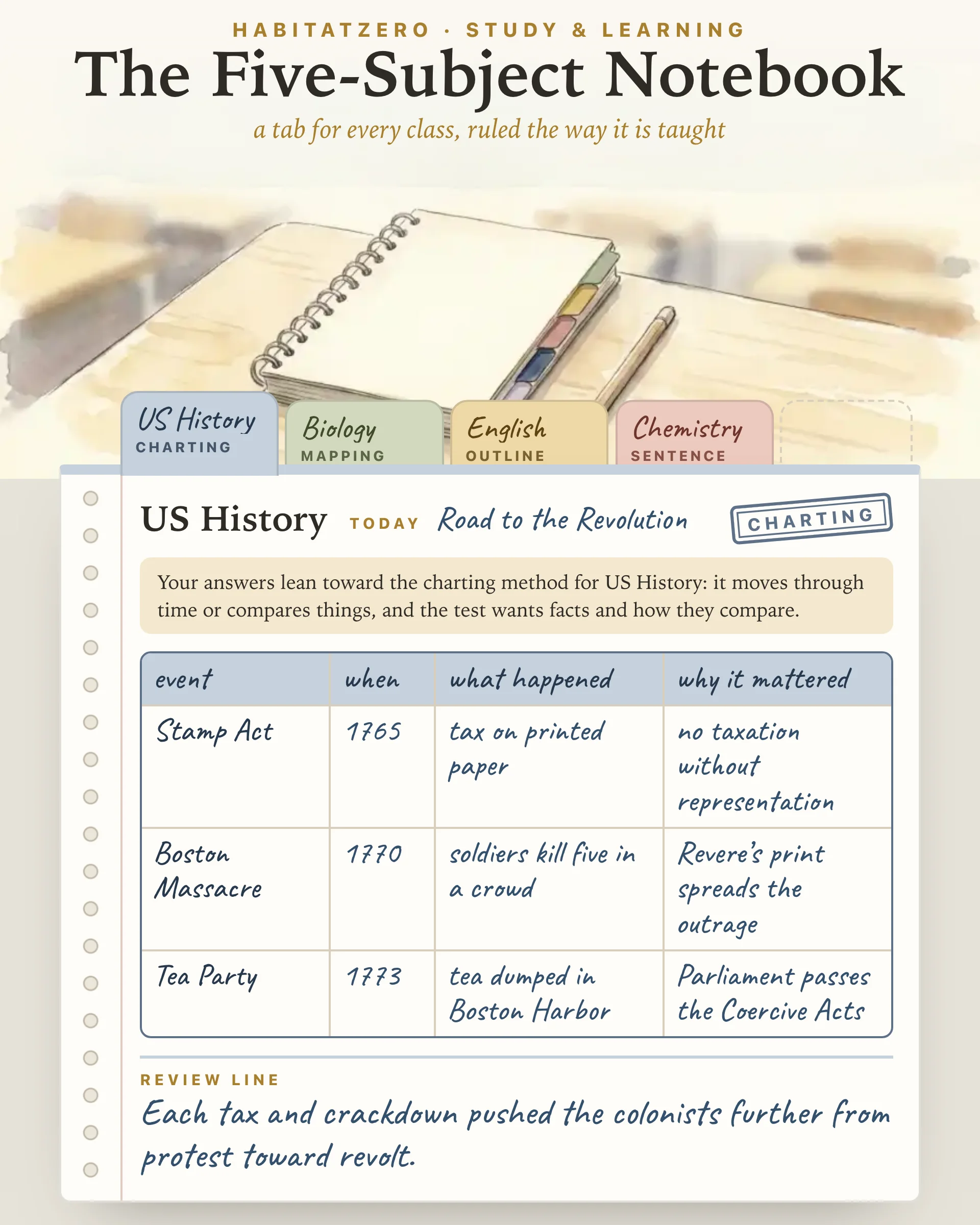
Many students settle on one way of taking notes around middle school and use it for everything. But classes are not shaped alike. A history lecture marches through dates and weighs causes. A biology lecture keeps circling back to how one process feeds the next. A chemistry class races from one worked problem to another. One style of page fits one of those and fights the other two.
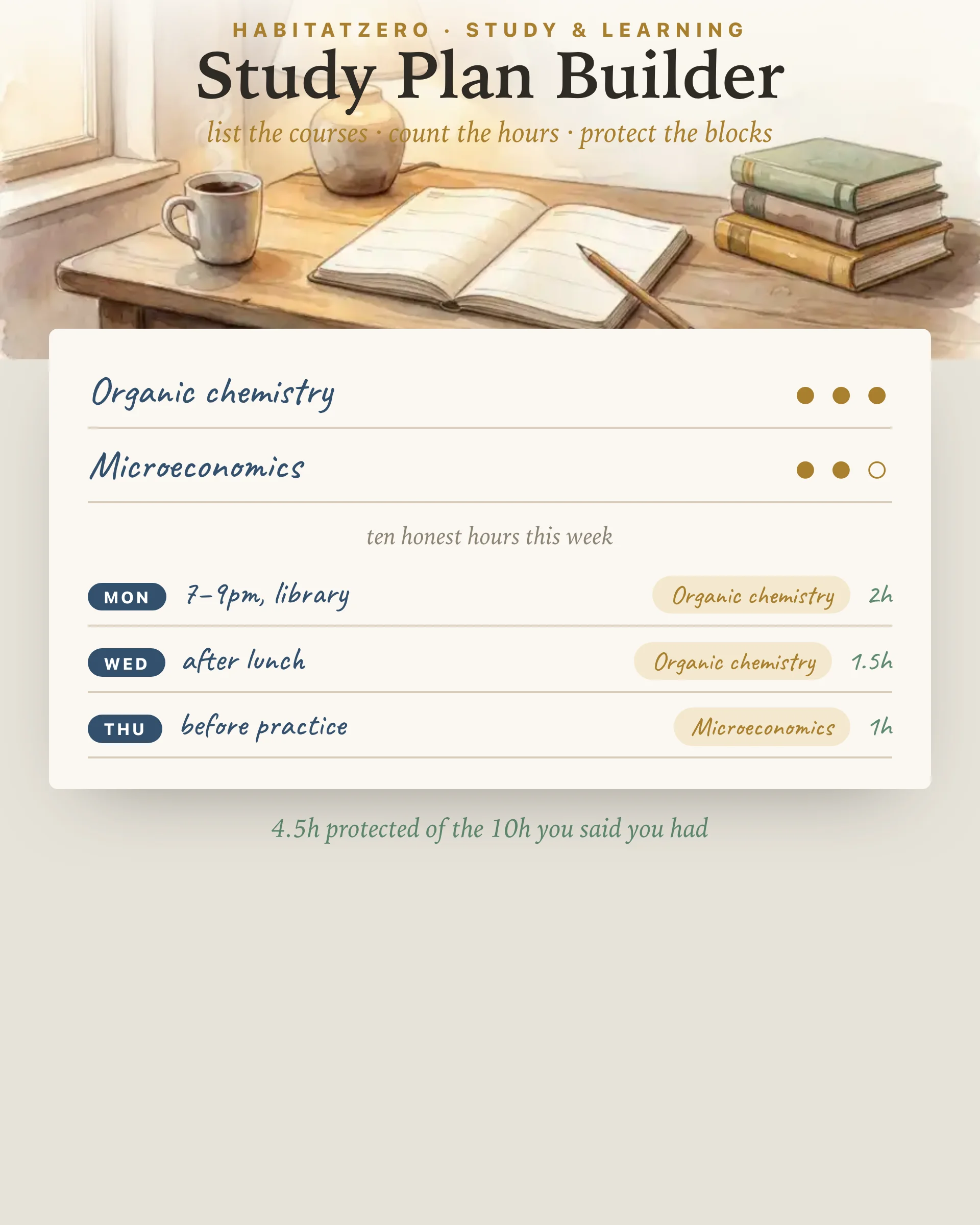
This notebook gives each class its own tab and rules each page for the way that class is actually taught.
College learning centers usually teach these five side by side, and the descriptions and advice on when each earns its place follow the University of Tennessee at Chattanooga's guide to common note-taking methods.
Tap a class onto a tab and its page asks three things: how the class is taught, what its tests ask for, and how fast it moves. Each answer adds weight to whichever methods the guide above favors for that situation. A class that moves through time, with tests built on comparisons, comes out as charting; one whose big ideas link up comes out as mapping. The page stamps the method on the tab and names the answers that pushed it there.
The wording is careful on purpose: your answers lean toward a method. It is a first guess, so you can answer again or pick another method with one tap. The line above the tabs gathers every class into one sentence, so you can see which method goes with which class.
Write a line, then add it as a point, a detail, a row, a cell or a branch, depending on the ruling. Behind every ruling, your notes are kept as points with up to three details each, so switching methods redraws the same notes in a new shape instead of losing them. Try a sentence-method page as a chart and the empty cells show exactly where the facts never got grouped.
A page holds twelve points with up to three details under each, and hitting that ceiling usually means the lecture covered two topics that deserve two pages.
The matching rules did not come out of trials that put history students on charts and biology students on maps. They come from learning centers that have watched many students take notes, so treat them as seasoned advice, not settled science.
What the research does support is narrower. A meta-analysis of thirty-three studies found that taking notes and then reviewing them made a substantial difference to learning, and that handing students a framework to fill in helped more than training or instructions alone. In two experiments by Robinson and Kiewra, college students who studied material laid out as graphic organizers instead of outlines, and were given enough time, learned more of the relations between ideas and wrote more integrated essays. The shape of a page changes what you can see in it, which is the case for choosing that shape on purpose.
Every page ends with one line: after class, the lesson in a sentence of your own, written while you still remember what was stressed. It is the smallest possible review, and it leaves you something to test yourself against. When the exam gets close, turn those lines into questions for The Active Recall Deck, or close the notebook and see how much of a page you can rebuild on The Blurting Pad.
Set the notebook up in the first week of a semester and adjust after two or three lectures, once you know how each teacher runs the room. If one class's notes still feel like a mess by midterms, that is the tab to rule differently. When the job shifts from taking notes to studying them, The Study Techniques Cabinet matches techniques to the test and the time you have.
The five usually taught together are the outline, Cornell, mapping, charting and sentence methods. Each arranges the page differently: indented points, a cue column beside the notes, branches around a central topic, a table of columns, or one numbered line per fact.
No single method wins in every class. An outline suits a lecture that runs point by point, a chart suits material that moves through time or compares things, a map suits ideas that link up, the sentence method keeps pace with a fast lecture, and Cornell holds up almost anywhere. Pick the one that matches how a particular class is taught.
Main points go against the left margin and each supporting detail is indented under the point it belongs to, so the spacing itself shows how the ideas relate. It works best when the lecture is organized and slow enough for you to sort ideas as you write.
Chart when you can predict the categories before class, such as dates, people and causes in a history unit, and the test will ask you to compare them. Map when the ideas branch out from one central topic and the test asks how they connect.
What you see here is a locked preview. Open it in HabitatZero, which is free, to add your own classes and keep each page saved between lectures.
By the team behind Fabulous, the science-based self-care app used by over 30 million people.