Reading JournalStudy & Learning · ~4 min
About this template · Updated September 2026
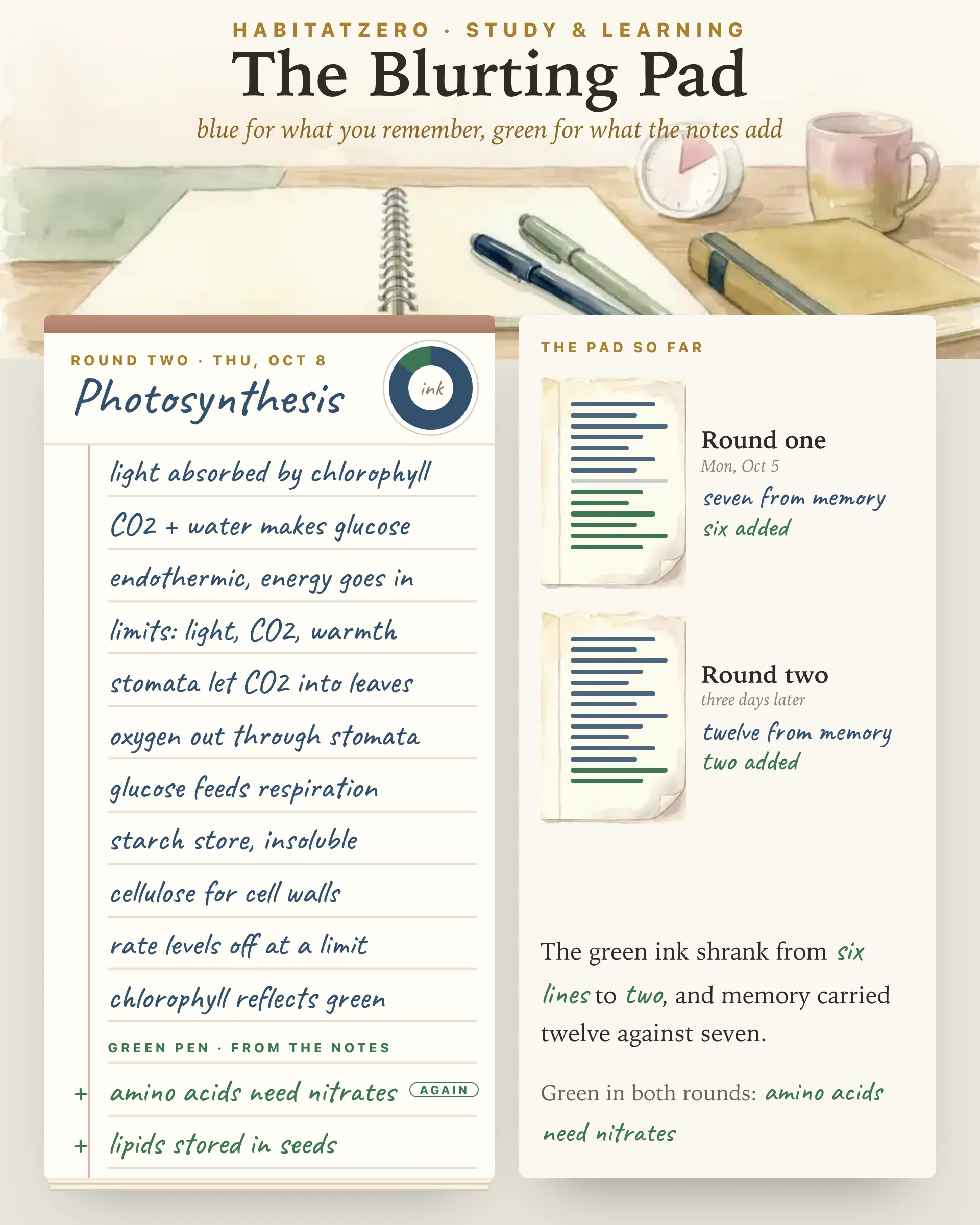
Blurting is the student name for an exercise that memory researchers call free recall and some teachers call a brain dump. You put your notes away and get down everything you remember about one topic, as fast as it comes. Then you open the notes, fix what was wrong, and add what you missed in a second color. The finished page is a map of your memory: one ink for what was already there, another for what was not.
Pick a topic that fits on a page. "Biology" is too big and "stomata" is too small; one lesson or one section of a chapter is about right.
Hide everything and start the dial. Five minutes suits a short topic or a phone keyboard, ten is the usual choice, and fifteen suits a long section. Write one idea per line in blue: a fact, a date, a step in a process, a name you only half remember. The dial is silent; when it empties, the blue pen is capped and the line you were typing is kept.
Check it in green. Open your notes, tap any blue line they show to be wrong so it is struck through, and add each point you left out as a green line. A vague line that only half matches the notes is a gap in disguise.
Study the green, then come back. The green lines are what to study that day. Two or three days later, blurt the same topic on a fresh page before you look at anything.
After pens down, the dial becomes an ink ring, blue for memory and green for the notes. Filed rounds line up as torn-off pages, and from the second round on, the pad says in plain words how far the green shrank and how many days sat between rounds. While you check a later round, last round's green lines come back as buttons, so a gap missed twice takes one tap and is tagged again.
A blurt asks for recall with no cues at all. A meta-analysis of the testing effect found that practice tests which made people recall answers gave larger benefits than recognition tests, where the answer only has to be picked out.
The closest experiment to a blurting round comes from Karpicke and Blunt. College students read a science text. One group then recalled as much as they could with nothing to prompt them, reread the text, and recalled it again; another spent the same time building a concept map with the text open. A week later the recall group answered about two thirds of a short-answer test correctly, against under half for the mappers, including questions that asked for inferences. Beforehand, the students had ranked recall as the least useful method. Concept-mapping researchers disputed the comparison in a published comment, so read it as one strong result, not the final word.
The green pen has support too. In experiments by Kornell, Hays and Bjork, trying a question and failing, then seeing the answer, led to better learning than reading question and answer together. There the answer came straight after the attempt; here it arrives a few minutes later, when the notes open.
Spacing matters as well. In a study that taught facts to more than thirteen hundred people, the best gap between a first session and a review grew with the wait until the final test. For a test a week after the review, the best gap was roughly a day and a half to three days. The pad's two-or-three-day nudge borrows that figure, and tests further off did better with longer gaps.
Nobody has tested blurting under that name, with a timer and two colors, as a package. The studies above used prose, word pairs and trivia, mostly with college students, and measured recall days later rather than exam grades. The timer length is a convention, and typing instead of handwriting is untested here. A line count is a rough gauge, since one line can hold a whole mechanism or a single term, so read the ring and the strip as a trend, not a score. And the check is only as good as your notes.
Blurting fits topics that hang together as a web of facts and explanations: a biological process, a period of history, the argument of a text. For math or physics, blurt the method and the formulas, then work a few problems, because writing about a skill is not practicing it.
Run the first round the day after you meet the material, once some forgetting has set in, the second two or three days later, and a third in the week of the test. Book those days in the Revision Timetable Builder so the second round happens. When a line keeps coming back green, turn it into a question card in The Active Recall Deck, which suits single facts better than a blank page does. If blurting feels wrong for the material in front of you, The Study Techniques Cabinet suggests what fits instead.
A blank page is uncomfortable because it shows you exactly where the gaps are. That discomfort is the useful part.
Blurting is a study technique in which you write down everything you can remember about one topic on a blank page, with your notes shut, then check the page against the notes and add what you missed in a second color. Some teachers call the same exercise a brain dump, and memory researchers call it free recall.
Pick a topic small enough for one page and hide your notes. Set a timer for five to fifteen minutes and get down every idea you can, one per line. When time is up, open the notes, strike out anything wrong and add the gaps in a different color. Study those additions, then repeat the blurt on the same topic a few days later.
Nobody has tested it under that name, but it is a form of free recall, one of the most studied kinds of retrieval practice. In one well-known experiment, students who read a science text and then recalled it with nothing to prompt them did better on a test a week later than students who built concept maps from the same text. The checking step matters as well, since a blurt that is never checked can leave a wrong idea in place.
Active recall is the broad idea of pulling information out of memory instead of reading it again. Blurting is one version of it: a whole topic at once on a blank page, with no questions to steer you. Flashcards are another version, one question at a time. A blurt shows how much of a topic hangs together in your head, while cards are better for drilling single facts.
You can look over the empty pad and a filled-in example on this page without signing up. Running the dial, keeping your blue and green lines, and laying one round beside the next across several days all happen inside HabitatZero, which costs nothing to join.
By the team behind Fabulous, the science-based self-care app used by over 30 million people.