
The Overwhelm Recovery ProtocolWellness & Routines · ~5 min
About this template · Updated September 2026
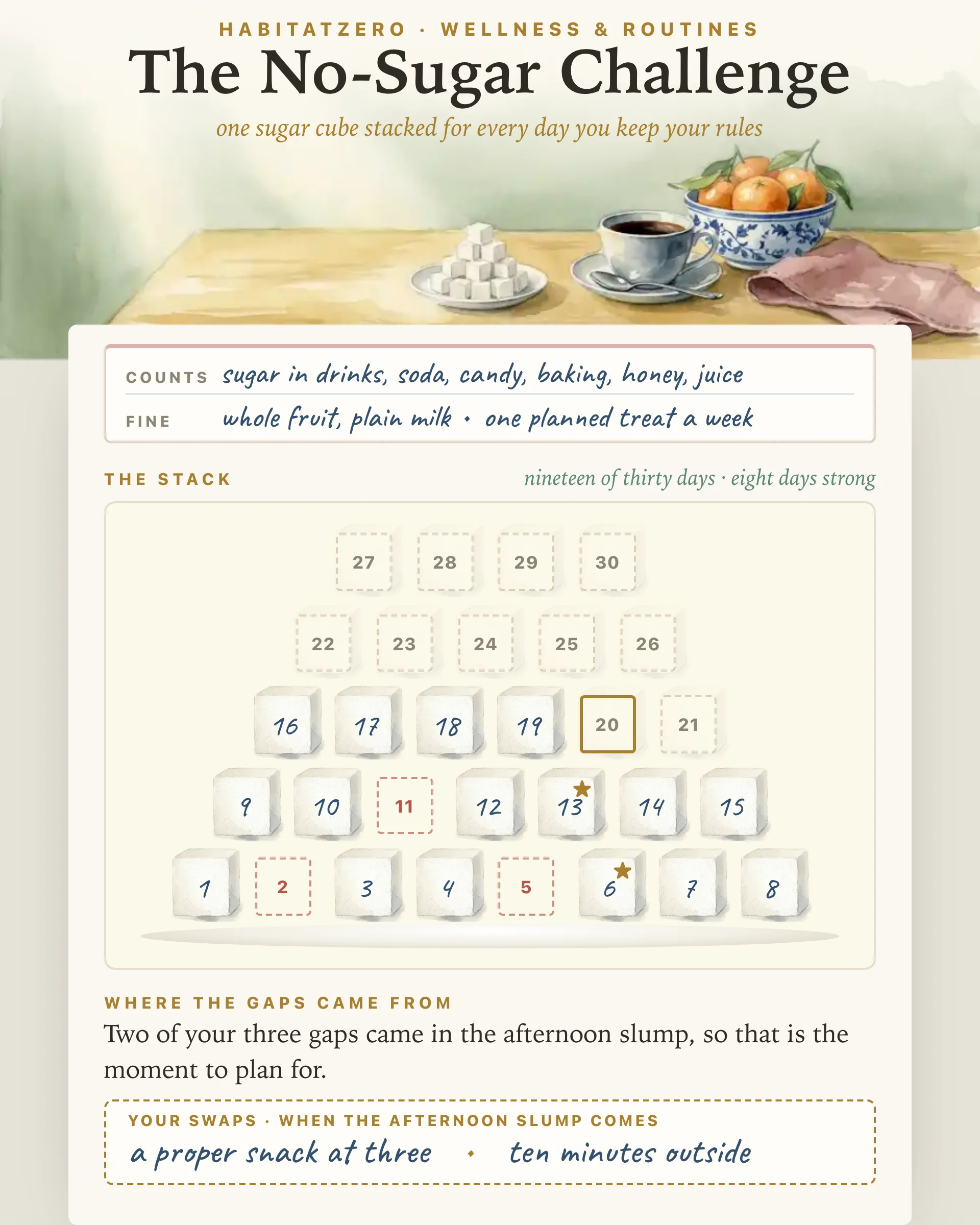
A no-sugar challenge is a set run of days, often thirty, in which you leave out added sugar by rules you choose before you begin. It is popular in January and before Lent, and it works best as what it is: a habit experiment. This page makes no promise about your weight or any health marker, it is neither a diet nor a detox, and it is not medical advice. If you live with diabetes or have a history of an eating disorder, talk with your clinician before you change how you eat.
Most challenges wobble on definitions rather than willpower. On day four someone hands you a slice of birthday cake, and you discover you never decided whether the honey in your tea counted. So the page opens with a rules card. Each line gets a circle, counts or fine, and you can add up to three lines of your own, such as the candy bowl at work.
Two public-health sources offer a sensible starting point. The World Health Organization's guideline on sugars defines free sugars as sugars added by a manufacturer, cook or consumer, plus the sugar naturally present in honey, syrups and fruit juices. It recommends keeping them under ten percent of daily energy and suggests going below five percent, roughly six teaspoons a day, while leaving the sugar in fresh fruit, vegetables and milk out of it. The Dietary Guidelines for Americans, 2025–2030 are blunter: no amount of added sugar is recommended, and one meal should hold no more than ten grams. They also state that the sugars in fruit and plain milk are not added sugars, and they advise limiting low-calorie sweeteners, which is worth knowing before you circle fine on that line.
A few gray lines remain, and they are yours: juice and smoothies, diet drinks, the sugar in bread and savory sauces. The last line asks whether one planned treat a week is allowed. There is no correct answer, only an honest one settled in advance, which is what separates a planned treat from a slip.
Choose a week, two weeks, three weeks or thirty days, and the stack takes that shape: a pyramid with day one at the bottom left and the last day on the top row. Each evening, tap that day's cube. If you kept your rules, stack it. If you had your planned treat, the cube still goes on, marked with a small gold star, and the card allows one star per challenge week: days one to seven, eight to fourteen, and so on. If you slipped, say what was going on: the afternoon slump, treats at work, the evening, a night out, stress, boredom, tiredness or hunger.
A slip leaves a gap in the pyramid. Nothing topples and nothing resets. The status line at the top counts days logged, cubes stacked and your current run.
Once a few gaps are in, the card below the stack does the thing a printed calendar cannot. It reads them back to you, in a sentence like two of your three gaps came in the afternoon slump, and a week-by-week line shows whether they are thinning out. Then it offers swaps for that moment, like a proper snack at three or ten minutes outside, and files the ones you pick under a heading such as when the afternoon slump comes.
That when-then shape is deliberate. Researchers call it an implementation intention, and a meta-analysis of twenty-three eating studies found these plans helped people add a healthy food more than they helped people cut out an unhealthy one, though the authors warn that weak comparison groups may have inflated some of the effects. A swap gives the plan something to do rather than only something to avoid. If a craving arrives anyway and you would rather sit with it than feed it, Urge Surfing is a fifteen-minute practice built for that moment.
You will read that sugar cravings disappear after a few weeks. The evidence is thinner than the promise. In a small trial, adults who cut back on simple sugars for three months rated sweet puddings as more intense, about forty percent sweeter by the third month, yet liked them no less, and no difference showed up during the first diet month. A thirty-day run may change your routines well before it changes your palate, if it changes your palate at all.
What a challenge can show you is your own pattern: which moments pull hardest, which swaps hold up, and which rules were stricter than you could live with. That is worth knowing whether or not you keep every rule afterwards.
Start in the last days of December, at the turn of any month, or in the week after a holiday when sweet things have piled up. Circle the rules the evening before day one and keep the page where you will see it at night. If a walk becomes one of your swaps, the Walking Challenge turns each day's steps into a route across a painted map, and if you would rather fill the same month with small, varied tasks, The 30-Day Challenge deals out one for every day.
Most challenges target added sugar: what gets stirred into coffee or baked into cookies, plus honey, syrups and fruit juice, which the WHO also treats as free sugars. The sugar inside whole fruit, vegetables and plain milk is usually left alone. On this page you circle each line yourself before day one.
Thirty days is the classic run, and fourteen or twenty-one days are popular shorter versions. Pick a length you can finish, because two finished weeks tell you more about your habits than a month abandoned in week two. The stack reshapes itself for a week, two weeks, three weeks or thirty days.
Usually, yes. The WHO guideline on free sugars and the US Dietary Guidelines both leave out the sugar that comes naturally in whole fruit and plain milk. Juice and smoothies sit on a different line, since the WHO counts their sugar as free sugar, so settle that one before you start.
You log it and carry on. A slip leaves a gap in the stack rather than knocking it down, and the gaps turn out to be the useful part: after a few, the page shows which moment keeps catching you, whether that is the afternoon slump, cake at work or the evening couch.
No download is needed to look around, since this page shows a stack from a challenge already under way. To circle your own rules and keep your cubes and swaps from one evening to the next, personalize it in HabitatZero, which is free.
By the team behind Fabulous, the science-based self-care app used by over 30 million people.


