
The Overwhelm Recovery ProtocolWellness & Routines · ~5 min
About this template · Updated November 2026
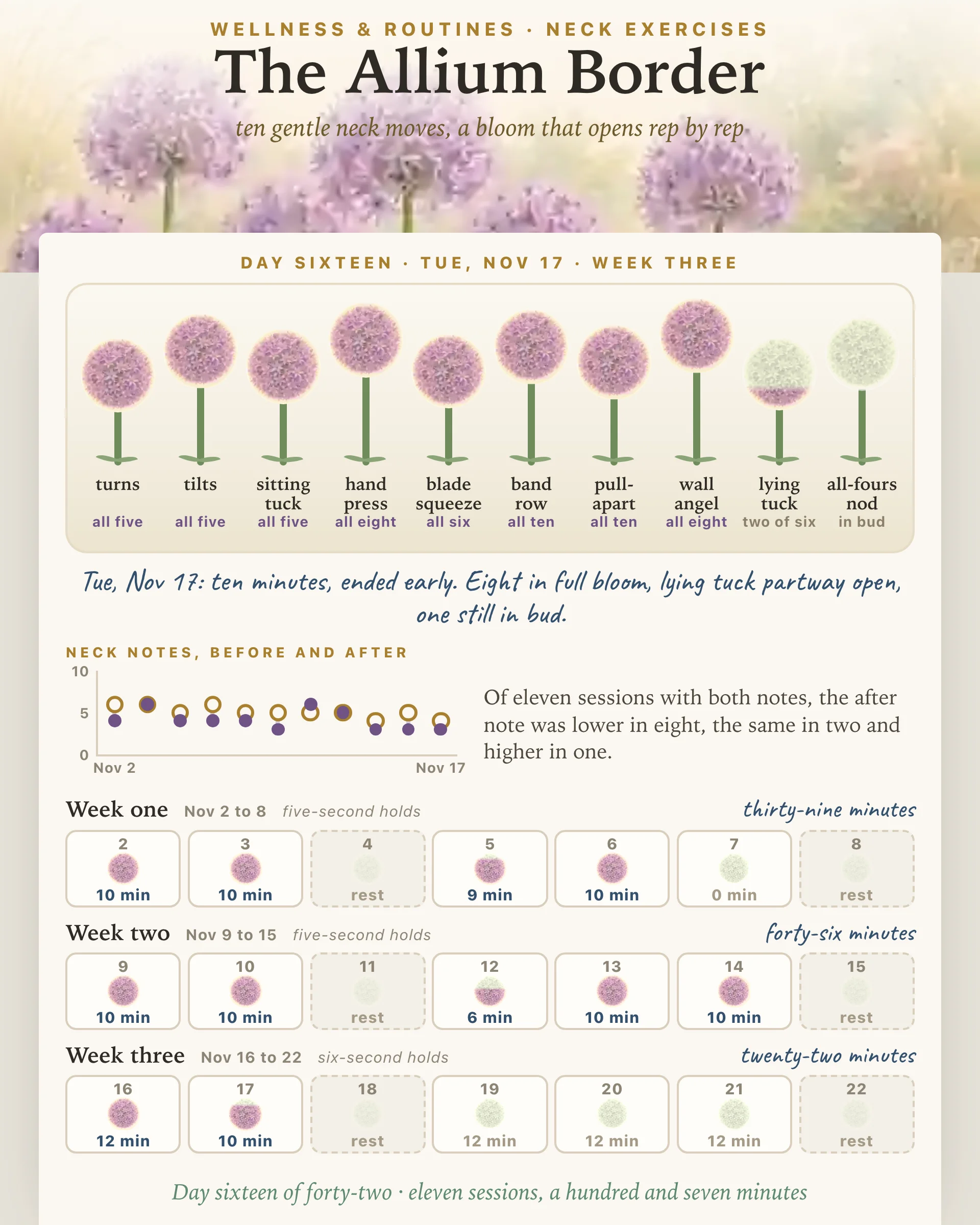
These neck exercises are for a neck that feels stiff or sore, as a support to the care of your doctor or physical therapist and never in place of it. The page holds ten gentle moves, each with an easier version, and a timer that paces every rep and hold and keeps only the ones you finish. Under it sits a six-week plan of short sessions, five days a week, with a 0 to 10 note on how your neck feels before and after each one.
Some neck pain is a reason to get help rather than to exercise. Call 911 or go to an emergency room for neck pain after a fall, a car crash or a blow to the head, a sudden and severe headache, fever with a stiff neck, or dizziness that comes with double vision, slurred speech or trouble walking. See a doctor before starting if you have numbness, tingling or weakness in an arm or hand, pain that wakes you at night, or pain that keeps getting worse.
You begin in a chair with easy head turns and side tilts, a seated chin tuck, and hand-press holds against your forehead, the back of your head and each side, your hand meeting the push so your head stays still. Then you stand for a shoulder blade squeeze, a band row, a band pull-apart and wall angels in a small range, and you finish lying down for a chin tuck and on hands and knees for a small nod with the chin drawn in. The easier versions keep the same rhythm with less asked of you: a smaller turn, a lighter press, empty hands in place of a band, or the kitchen counter instead of kneeling.
There are no head circles or forced rolls. The turns and tilts move one direction at a time and stay in the easy middle of your range.
The clock counts each part of each rep in real time, even while your phone is locked. A rep counts once its last part has run. If a move hurts or tingles, skip it: its unfinished reps never count, and its seconds come off the session. End early and you keep only the whole minutes and whole reps you did.
Each move is an allium, the round purple flower on a tall stem, and its bloom opens from the bottom up as its reps are done. A skipped move stays in bud. Below the border, six weeks of small alliums show each day's best session. Weeks one and two hold each press, tuck and squeeze for five seconds, weeks three and four for six, and weeks five and six for eight, so a session grows from ten minutes to fourteen. The third and seventh day of every week are for rest.
Your before and after notes land on a chart beside only your own earlier notes, with no score or label. If two sessions in a row end with a higher note than they began, the page suggests going back to the easier versions and telling your physical therapist.
A Cochrane review of exercise for neck pain, led by rehabilitation researchers in Canada, gathered twenty-seven trials with about three thousand adults, a little over a hundred per trial. For neck pain lasting months, it found moderate-quality evidence that strengthening the neck, the muscles around the shoulder blades and the upper arms eased pain, and low-quality evidence that stretching on its own may change little. It found no trials to judge for neck pain that had just begun, rated none of its evidence as high quality, and called for research on how much exercise is enough.
A trial in Finland followed 180 women office workers aged 25 to 53 with long-standing neck pain for a year. A strength group and a lighter endurance group both ended with less pain and disability than a group advised only to stretch and do aerobic exercise. No men took part, and no one over 53.
A Danish trial by occupational health researchers enrolled 198 working adults with frequent neck and shoulder pain. It compared two or twelve minutes a day of resistance training with elastic tubing, five days a week, with weekly health information, and after ten weeks both training groups reported less pain. The volunteers were generally healthy and mostly women, and ten weeks says nothing about longer spans or about pain that runs into an arm.
None of them tested this exact routine or promises a pain-free neck.
The Neck and Shoulder Yoke is a stretching routine for tight muscles after desk days. The Plumb Line Posture Plan works on how you stand and sit, and The Paper Clip Chain spreads two-minute breaks across a working day. This page is the strengthening work the review points to, paced rep by rep.
Ask your doctor or physical therapist before week one if you have had a fall or dizzy spells, a neck injury or neck surgery, a joint replacement, a heart or blood pressure condition, or pain that is new or spreading. Stop any move that hurts, breathe out on every press, and keep a sturdy chair or counter within reach whenever you stand.
For neck pain that has lasted months, the strongest evidence is for strengthening the muscles of the neck, the shoulder blades and the upper arms. A review of twenty-seven trials rated that evidence as moderate, while stretching on its own showed little effect. Your doctor or physical therapist can tell you which moves suit your own neck.
This plan uses five short sessions a week for six weeks, ten minutes at first and fourteen by the end, with a rest day after the second and the fifth session. In one trial, office workers with frequent neck and shoulder pain trained with elastic tubing five days a week, and even two minutes a day lowered pain compared with a group given only health information.
No. A press or a squeeze should feel like steady work and a turn or tilt like a mild stretch. Stop any move that brings sharp pain, a pinch, or tingling or numbness in an arm, go back to the easier version next time, and tell your physical therapist.
Call 911 for neck pain after a fall, a crash or a blow to the head, a sudden severe headache, fever with a stiff neck, or dizziness with double vision, slurred speech or trouble walking. See a doctor first for numbness, tingling or weakness in an arm or hand, pain that wakes you at night, or pain that keeps getting worse.
This page leaves them out. A circle or a roll sweeps the neck toward the end of its range one way after another, so the turns and tilts here go slowly, one direction at a time, and stop short of any pinch.
By the team behind Fabulous, the science-based self-care app used by over 30 million people.


