Leaves on a StreamEmotional Fitness · ~3 min
About this template · Updated September 2026
Howard Gardner, a psychologist at the Harvard Graduate School of Education, set out the theory of multiple intelligences in his 1983 book Frames of Mind, and his official site for the theory explains it in his own words. He began with seven intelligences and later added an eighth, the naturalist. The House of Eight Rooms is an independent quiz built on his framework, with no affiliation to Gardner or to Harvard and no endorsement from either.
Online versions of a multiple intelligences test often score each intelligence like a separate IQ. That is exactly the move Gardner warns against. On his site, the belief that researchers should now build tests to measure the intelligences is listed among the myths about the theory, and so is the belief that an intelligence is the same thing as a learning style. Asked about games meant to reveal a child's intelligences, he made a related point: a game may show what a child likes, which is not necessarily where that child performs well.
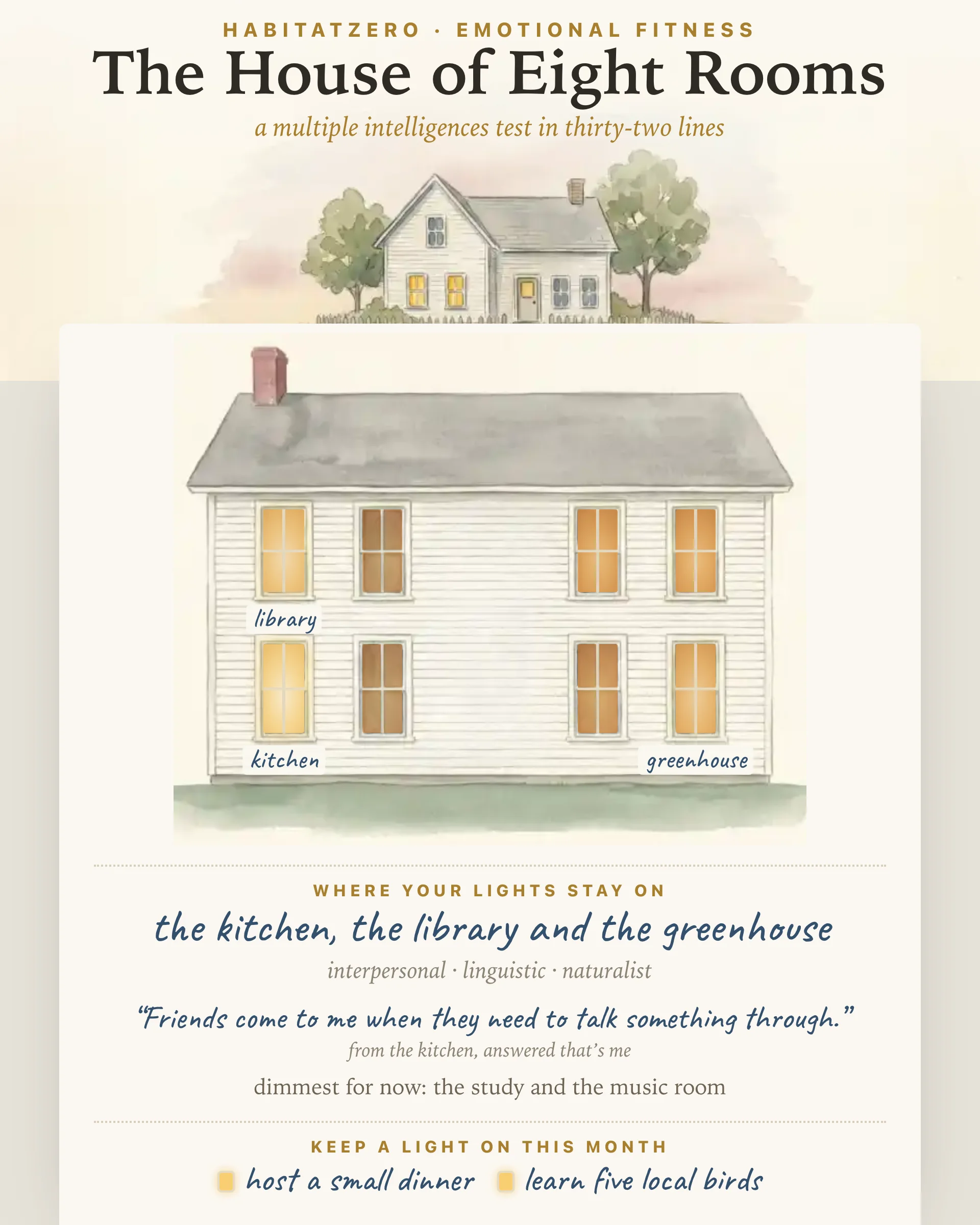
So this quiz asks a narrower and more honest question: where do you like to spend your time? Every line describes something people enjoy, notice or reach for without being told to. Your answers light the rooms of a house, and the house shows your leanings today, not your limits.
Each of Gardner's intelligences gets a room, placed where it might live in an ordinary farmhouse:
Thirty-two short lines arrive one at a time, four for each room, dealt so the same room never comes up twice in a row. Tap not me, sometimes or that's me. A "that's me" gives its room two points of light and a "sometimes" gives one, so each window runs from dark to full across its four lines.
When all thirty-two are in, the reading names the rooms where your lights stay on longest, gives Gardner's name for each, and quotes one line you chose so you can see where the reading came from. If a fourth room ties with the third, it says so rather than quietly choosing. It also names your dimmest rooms, since a room you seldom visit is worth knowing about too.
Tap any room in the key under the house to see its four lines and change an answer. Then choose up to three small things to do more of this month, from a bright room or a dim one you would like to visit; the list stops at three so it stays doable.
Gardner's central claim is that people have several relatively separate intellectual capacities rather than one general intelligence, and that each person carries an individual profile across them. Many researchers dispute whether these are separate intelligences at all. In a critical review in Educational Psychologist, Lynn Waterhouse argued that the theory lacks adequate empirical support and should not be the basis for classroom practice. Gardner replies that the theory rests on a synthesis of evidence from psychology, brain science and anthropology, and that it can be revised as new findings arrive. Read the eight rooms as a handy vocabulary for different kinds of interest, not as a settled fact about your brain.
The theory is also mixed up, constantly, with learning styles: the idea that each student learns best when taught in a preferred mode, a visual learner through pictures and a musical one through song. A review of the learning-styles research by Harold Pashler and three colleagues found virtually no evidence that matching teaching to a preferred style improves learning, and several of the soundly designed studies produced results that flatly contradict the idea. People really do have preferences about how they take things in. The evidence simply says those preferences should not decide how you study.
Take it when you want words for what you enjoy: before choosing a class or a hobby, ahead of a talk with a counselor, or when a crowded season has pushed out the things that used to light you up. Come back in a few months, since rooms brighten and dim as a life changes. Gardner also cautions that knowing your intelligences should not be used to predict a career, so treat the house as one clue among several.
If the question underneath is really how to study better, the Study Style Quiz looks at habits such as spacing and self-testing rather than styles. For teenagers weighing what comes after school, The Signpost turns quick would-you-rather choices into careers and subjects to explore. And if your brightest rooms hint at something worth building a life around, The Ikigai Circles help you test where what you love meets what you are good at.
A self-report quiz like this one measures what you say you enjoy, notice and reach for, not how capable you are. Gardner himself has said there is no test of the intelligences that he endorses, so treat any result as a map of your leanings rather than a set of scores.
Linguistic, logical-mathematical, spatial, bodily-kinesthetic, musical, interpersonal, intrapersonal and naturalist. Gardner described seven of them in his 1983 book Frames of Mind and added the naturalist years later. On this page each one is a room of a house, from the library to the greenhouse.
It is contested. Researchers still argue over whether the eight are separate intelligences at all, and Lynn Waterhouse concluded in a 2006 review that the theory lacks the empirical support to guide teaching. Gardner answers that it rests on evidence from psychology, brain science and anthropology and can be revised as findings come in.
The evidence says no. A major review of learning-styles research found almost no support for matching teaching to a preferred style, and Gardner has said plainly that an intelligence is not a learning style. Use your brightest rooms to choose what to explore, not to rule out ways of learning.
You can look over the lit example house above without signing up. Answering the thirty-two lines yourself, keeping your reading and coming back to change a room later all happen in HabitatZero, free of charge.
By the team behind Fabulous, the science-based self-care app used by over 30 million people.