
The Overwhelm Recovery ProtocolWellness & Routines · ~5 min
About this template · Updated September 2026
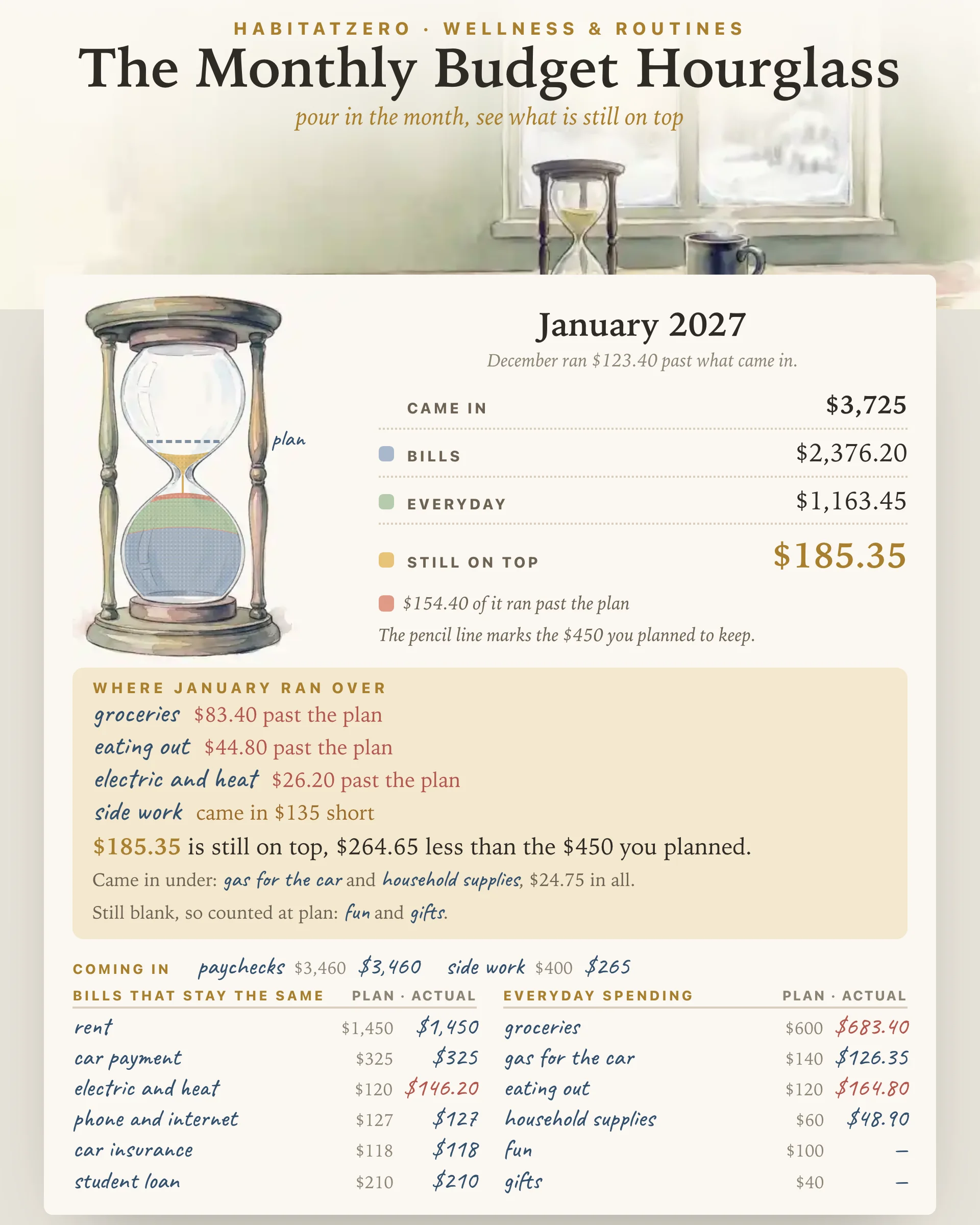
A monthly budget worksheet asks four plain questions. What comes in this month? Which bills cost about the same every time? What does everyday life spend? And what is left once all of that is counted? The Federal Trade Commission's consumer site describes a budget as a plan you write down to decide how you'll spend your money each month, and it recommends the rhythm this page is built around: plan at the start of the month, compare at the end, and let what you learn shape the next plan.
This worksheet draws that plan as an hourglass, because a month of money behaves like one. It all starts on top. Bills and spending fall through as the weeks pass. Whatever is still on top when the month closes is what you kept.
Tap a paycheck or name your own source, and give it the amount you expect. The top bulb fills with gold sand. Add the bills that stay the same, then your everyday spending, each with a plan, and sand drops into the bottom bulb: blue-gray for bills, sage for everyday lines. A dashed pencil line marks what the plan says you will keep.
As the month settles, write each line's actual beside its plan. A bill paid at its usual amount takes one tap. Any line that costs more than its plan drops the difference as rose sand, so you can see which layer ran long at a glance. If spending passes what came in, the top empties and the extra spills beside the glass.
A blank actual counts at its plan. That keeps a half-finished month honest: groceries you haven't finished buying still take their full share.
Under the glass, a short reading does the sums. It names every line that ran past its plan and by how much, any income that came in short, the lines that came in under, and the ones still blank. Then it sets what is still on top against what you planned to keep, so the gap between the two never has to be guessed at.
In the sample month, groceries, eating out and the electric bill ran $154.40 over between them, side work came in $135 short, two lines came in $24.75 under, and $185.35 is still on top of a planned $450.
Most people already budget in their heads. Across three studies, Chip Heath and Jack Soll found that consumers set budgets for categories of spending and track purchases against them, and that because no budget can foresee every opportunity, people earmark too much for some categories and too little for others. A head is a poor ledger, though. Seeing the plan and the actual side by side is what shows you which category you keep underfunding.
Checking in also seems to help on its own. A meta-analysis of 138 experiments led by Benjamin Harkin found that interventions which raised how often people monitored their progress also improved how often they reached their goals, with larger effects when progress was physically recorded. That research spans many kinds of goals, not money alone, so read it as support for the habit of writing your figures down rather than a promise about savings.
The ready lines lean toward household costs: rent or mortgage, electric and heat, water and trash, phone, internet, insurance, groceries and household supplies. Name your own for anything else. Each list holds ten lines on purpose, because a budget with thirty categories rarely survives its second month; when a list fills, fold two small costs into one line.
Costs that don't arrive every month, like a car registration or a yearly premium, sit better on The Sinking Funds Shelf. To see where the everyday lines really go, log each purchase in The Receipt File and carry its totals here when the month ends. To keep due dates straight across the year, use The Bill Ledger.
When the month is done, turn the glass. Your plans carry over, every actual clears, and last month's real figure stays beside each line in small type. Until the new actuals come in, the reading shows where last month would have run past this plan, the moment to raise a line you keep underfunding. A January plan set beside December's figures tends to show what gifts and eating out really cost.
It is a worksheet, not financial advice, and it never connects to a bank or a card. Every number is one you typed, and it stays on your own sheet. The research above supports planning by category and checking the plan against what happened; it does not say that any particular split of your pay is the right one.
Set up the glass in the first days of a month, ideally with last month's statements beside you. Write actuals as each line settles, or all at once on the last weekend of the month, then turn the glass and begin again. After a few months, the small figures beside each line become a record of what your household really costs.
Four things: the money that comes in, the bills that cost about the same every month, the everyday spending that moves, and whatever is left once those are counted. A plan column beside an actual column shows the month you meant next to the month you had.
Yes. Exploring the filled January sample here costs nothing, and so does personalizing your own copy in HabitatZero. The sheet adds every column itself, so there are no spreadsheet formulas to build or repair.
It was built around household costs. Rent or mortgage, electric and heat, water and trash, insurance, groceries and household supplies each have a ready line, every list holds ten, and when one fills up you fold two small costs into a single line.
Yes. Printing drops the buttons and keeps the hourglass, each line with its plan and actual, and the reading underneath, which makes a tidy page for the fridge door or the folder where your bills live.
No. You type every figure yourself and it stays on your own sheet, never reaching a bank, a card company or anyone else. The glass does arithmetic and nothing more, so treat it as a mirror for your month rather than financial advice.
By the team behind Fabulous, the science-based self-care app used by over 30 million people.


