
The Overwhelm Recovery ProtocolWellness & Routines · ~5 min
About this template · Updated September 2026
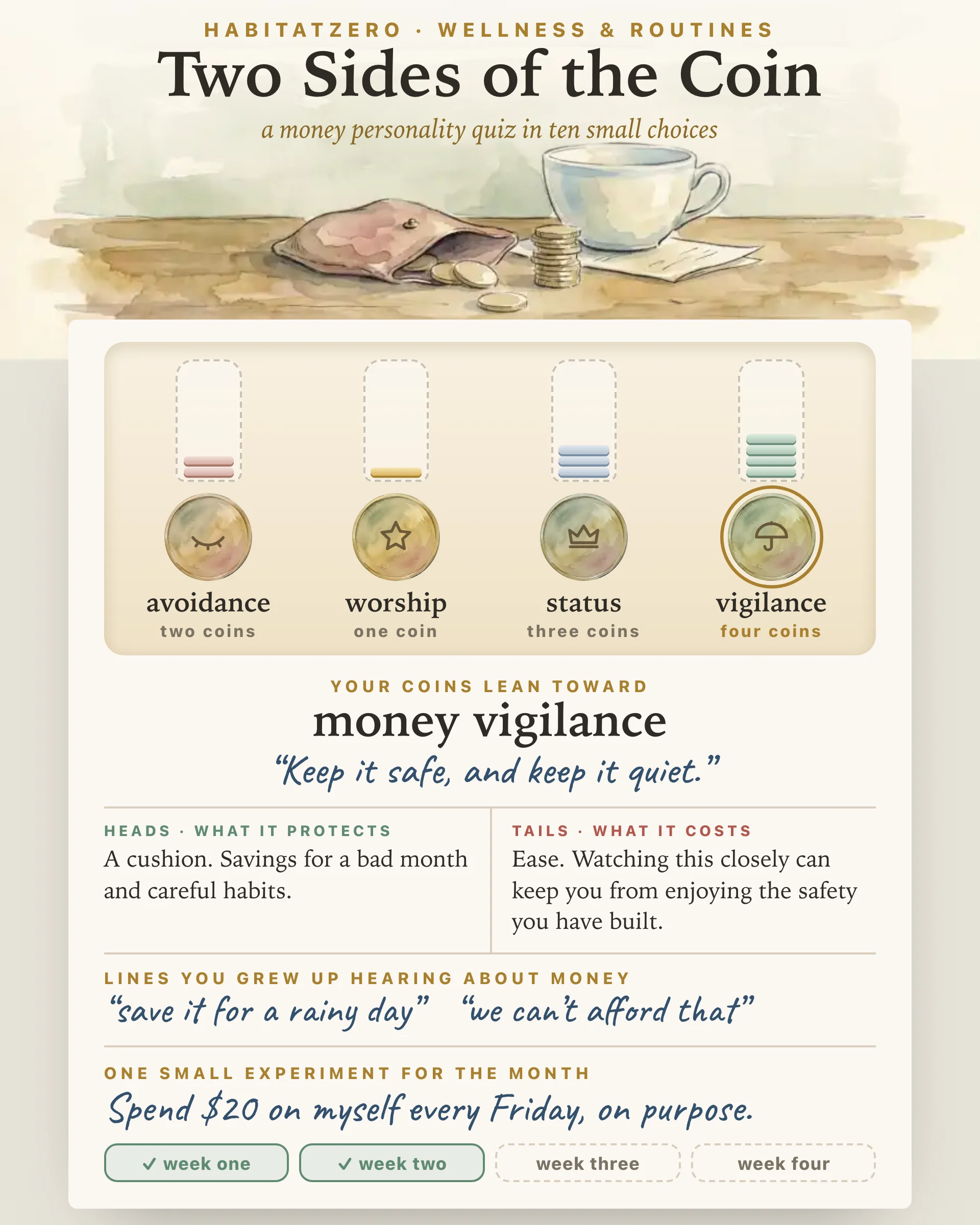
The four beliefs behind this quiz were named by psychologist Brad Klontz and three colleagues in a 2011 paper in the Journal of Financial Therapy: money avoidance, money worship, money status and money vigilance. They call these beliefs money scripts. This page is an independent reflection that borrows those four names and nothing else. It is not the Klontz Money Script Inventory, its authors have not reviewed or endorsed it, and its ten scenes have never been validated.
Ask people whether they are savers or spenders and most pick the flattering answer. Ask what they did the last time a refund landed, or when a friend chose the expensive restaurant, and the answer gets more honest. So each card here is a small scene: a windfall, a dinner bill split evenly, an electric bill that runs over. You pick the reply closest to what you would really do, and a coin drops into one of four tubes.
Klontz's team gathered 72 money beliefs they had heard from financial therapy clients, then asked 422 adults how strongly they agreed with each one. Four clusters held together.
All four scales correlated with each other, so most people carry more than one, and the tray keeps every tube in view.
Ten choices put ten coins in the tray. If a finger slips, take back the last coin and its scene opens again. When the tenth coin lands, the fullest tube becomes the reading: heads shows what the belief protects, tails shows what it costs, because a script that has lasted this long is usually doing some job for you. Beneath that, the page quotes the answers that pointed there, so you argue with evidence rather than a verdict. Ties are named as ties, and any coin in the tray can be opened.
You can also keep up to three money lines you grew up hearing, choose one small experiment for the month, and mark each week you tried it.
The 2011 sample came from an open web survey that skewed highly educated and 82 percent white, and the authors say plainly that their findings may not generalize. The links they found are modest correlations. People who leaned toward avoidance, worship or status tended to report lower incomes. Those who leaned toward worship were more likely to carry a credit card balance from month to month, and those who leaned toward vigilance were less likely to. Nothing in the data shows which came first, the belief or the bank balance.
The inventory has since been shortened into the Klontz Money Script Inventory-Revised, which showed high reliability in a sample of 326 college students. If you want a measured score, that instrument is the right tool. This quiz is closer to a mirror you hold up for five minutes.
Klontz and Klontz proposed that money scripts are learned in childhood, handed down through families, and sometimes set by an emotionally charged moment they called a financial flashpoint. That remains a hypothesis rather than a finding, but it fits the socialization research. In a study of 2,098 first-year college students, the part parents played in shaping young adults' money learning, attitudes and behavior outweighed work experience and high school financial education combined. So each reading pairs the belief with a likely origin and asks for the lines you heard at home.
Understanding a belief rarely loosens it. Acting against it in a small way, and noticing that nothing terrible follows, often does. Each reading offers three experiments sized for a month, such as opening every bill the day it arrives or spending a set amount on yourself each week. Pick one, mark the weeks, and take the quiz again when the month is out.
Take it on an ordinary week, not the afternoon a bill lands, and answer for what you usually do. It also makes a good warm-up before a money talk with a partner, since the study's authors suggest that naming two different scripts can help a couple untangle an old argument. If a bill set this off, The Bill Ledger lays the whole year of them out on one page. If December is the pressure point, The Christmas Budget sets a ceiling before the spending starts. If the belief underneath is about your worth rather than your wallet, try The Core Belief Trellis.
None of this is financial advice. Nothing on the page connects to a bank, and your answers stay on your own sheet.
Money avoidance, money worship, money status and money vigilance. Brad Klontz and colleagues named them in 2011 after asking 422 adults how strongly they agreed with 72 common money beliefs. Avoidance treats money as bad or undeserved, worship expects more of it to fix things, status ties it to self-worth, and vigilance keeps it saved, watched and private.
Many popular lists of money personalities come from books and coaching programs rather than data. The four used here are the patterns that held together when researchers analyzed agreement with dozens of money beliefs, which makes them a sturdier starting point, though still not a diagnosis.
No. The inventory is a set of agreement statements that researchers built and tested, and a shorter revised version has been checked for reliability with college students. This page borrows only the four names. Its ten scenes were written for reflection and have never been validated, so treat the reading as a prompt rather than a measurement.
Money scripts are learned, often at home, so they can be noticed and loosened. In the 2011 study, avoidance and worship scores ran lower in older age groups. Insight alone rarely shifts a belief, which is why the reading ends with one small experiment to try for a month.
Yes. The page shows a finished example you can read through. To drop your own coins, keep your lines and mark your weeks, personalize it in HabitatZero at no cost. Nothing on it links to a bank account, and none of it is financial advice.
By the team behind Fabulous, the science-based self-care app used by over 30 million people.


