Leaves on a StreamEmotional Fitness · ~3 min
About this template · Updated September 2026
The miracle question belongs to solution-focused brief therapy, the approach Steve de Shazer, Insoo Kim Berg and their colleagues built at the Brief Family Therapy Center in Milwaukee. Their 1986 paper, Brief Therapy: Focused Solution Development, set out the model. This worksheet is an independent practice page: it has no tie to the center, to the founders or to the Solution Focused Brief Therapy Association, and none of them has reviewed or endorsed it.
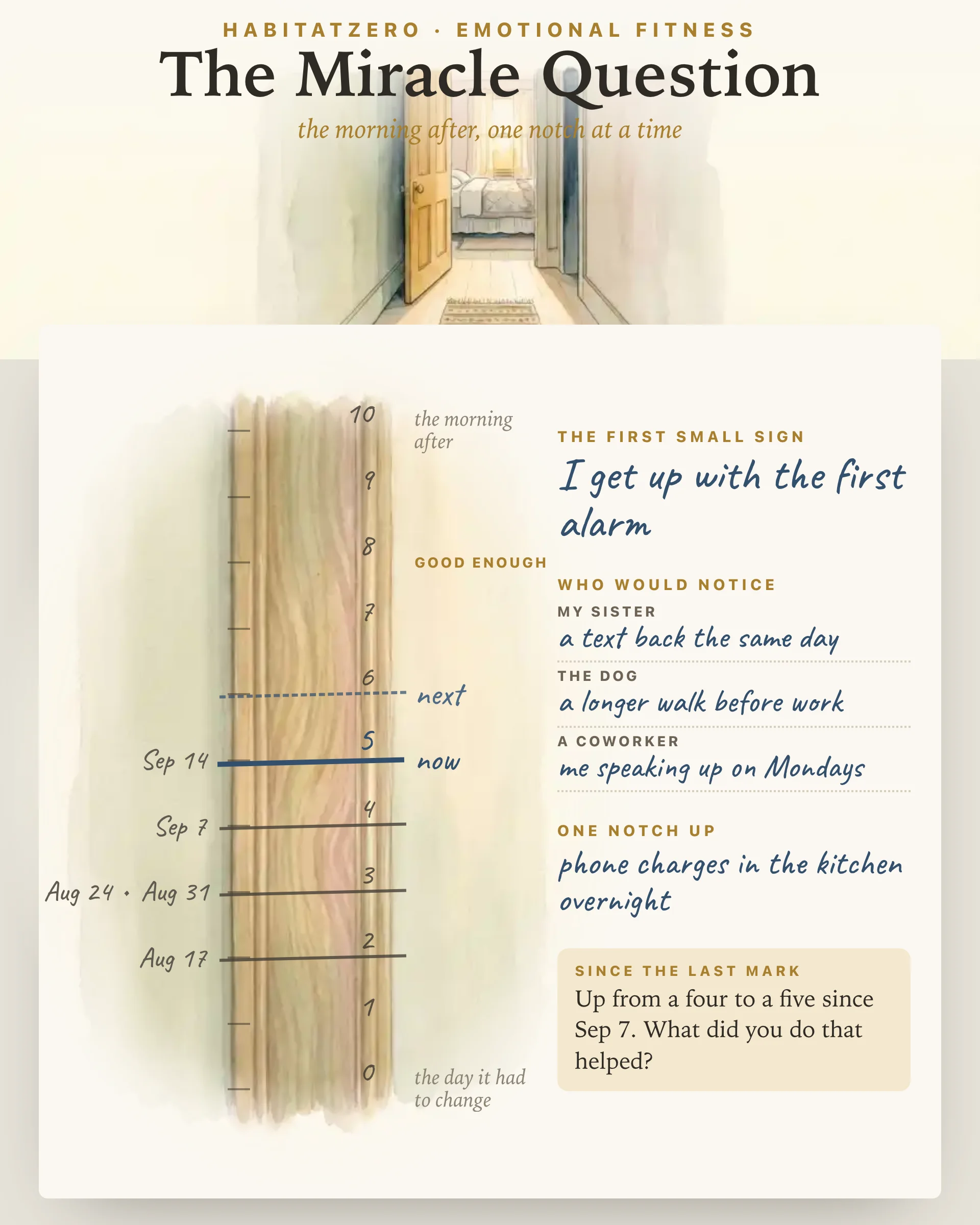
The association's treatment manual gives the standard wording, credited to Berg and Yvonne Dolan. You go to bed tonight. While you sleep, a miracle happens and the problem that brought you in is solved. Because you were asleep, you have no idea it happened. So when you wake up tomorrow, what is the first small change that tells you something is different?
The miracle is a device, not a promise. It lets you skip the part you are stuck on, which is how, and go straight to what you want, in enough detail to picture it. The manual describes it as a way to respect how big a problem feels while drawing out smaller, workable pieces of the goal.
Two habits make your answers useful. Describe what would be there, not what would be gone: "I wouldn't feel so anxious" names an absence, while "I'd eat breakfast at the table" is something you could spot on an ordinary Tuesday and do again. And keep it small and in your own hands. The manual counts both among the marks of a useful goal: stated as what you will be doing rather than what you won't, in terms of behavior, as a first small step, and within your control.
After the first sign, a therapist usually asks who would notice and what they would see. Your partner can't read your mood at seven in the morning, but they would hear you humming while the coffee brews. Answering from someone else's point of view turns a private feeling into something you can watch for.
Then comes a number. In the manual's version, ten is the day after the miracle, zero is the moment you set up the first appointment, and you say where things are now. On this page, zero is the day you knew something had to change, since you may be doing this on your own.
The follow-ups matter more than the number. What has you at a four and not at zero? That finds what is already working. What would one notch up look like? That shrinks the next move to something you could try this week. It also helps to decide what would be good enough. In a couples example in the manual, both partners agreed an eight would mean it had worked, and one of them called a ten unrealistic.
Tap a suggestion under the question or write your own first sign, then add up to four more. Name up to four people, or the dog, and what each would see. On the painted door frame, tap the notch where you stand this week. The step you write appears one notch above you, and good enough is labeled wherever you set it.
Pencil in the week and a dated mark stays on the frame, the way families mark a child's height on a doorway. One mark per week; the frame holds twelve, about one season. Each new mark is compared with the last, and the page asks the question the manual pairs with that direction: if you moved up, what did you do that helped; if you held steady, how did you keep it from slipping; if you slid down, what kept it from going lower.
A review of 43 controlled studies of solution-focused therapy found that 32 reported significant benefit, with the strongest evidence in adult depression, where the approach held up against well-established treatments. A meta-analysis by Johnny Kim was more cautious: the effects were positive but small, and reliably so only for internalizing problems, the kind turned inward, such as depression and anxiety.
Both looked at therapy with a trained clinician, not a worksheet used alone. Treat this page as a structured way to think about change, not as treatment.
Reach for it when you can list every problem but can't picture better, when your goals keep starting with stop or less, or when you want a weekly check that notices small movement. If you aren't sure what matters enough to aim for, the ACT Values Worksheet helps you find a direction first. The Future Self Journal is a daily cousin: one small act as the person on the other side of the change. And when your miracle points at a concrete goal, the Goal Planning Worksheet turns it into a plan.
This is practice, not therapy. If you keep landing on a zero or a one, or the weeks feel stuck or heavy, bring the page to a therapist; solution-focused clinicians ask these same questions and can take them much further. If the heaviness includes thoughts of hurting yourself or ending your life, set the worksheet aside and call or text 988 in the US, or your local emergency number, right away.
It is a question from solution-focused brief therapy that asks you to imagine your problem solved overnight while you slept, so you wake up without knowing why things are different. Your answer sketches the life you want in small, visible details instead of circling what is wrong.
It grew out of the Brief Family Therapy Center in Milwaukee, where Steve de Shazer, Insoo Kim Berg and their colleagues developed solution-focused brief therapy. This worksheet is an independent way to practice their question, with no affiliation to them, the center or any therapy association.
Scaling questions ask you to rate where things stand from zero to ten, with ten as the day after the miracle. The follow-ups do the real work: what already has you at your number rather than lower, what one point higher would look like, and what number would be good enough.
Strong answers are small and easy to spot: getting up with the first alarm, eating breakfast at the table, calling a friend back the same day. An answer like feeling less anxious names what would be gone, so the natural next question is what you would be doing in its place.
Yes, as practice, and many people use it alone to work out what better would even look like. If the same low number keeps returning week after week, or the days feel heavy, a therapist trained in solution-focused work can take these questions much further than a page can.
By the team behind Fabulous, the science-based self-care app used by over 30 million people.