Leaves on a StreamEmotional Fitness · ~3 min
About this template · Updated July 2026
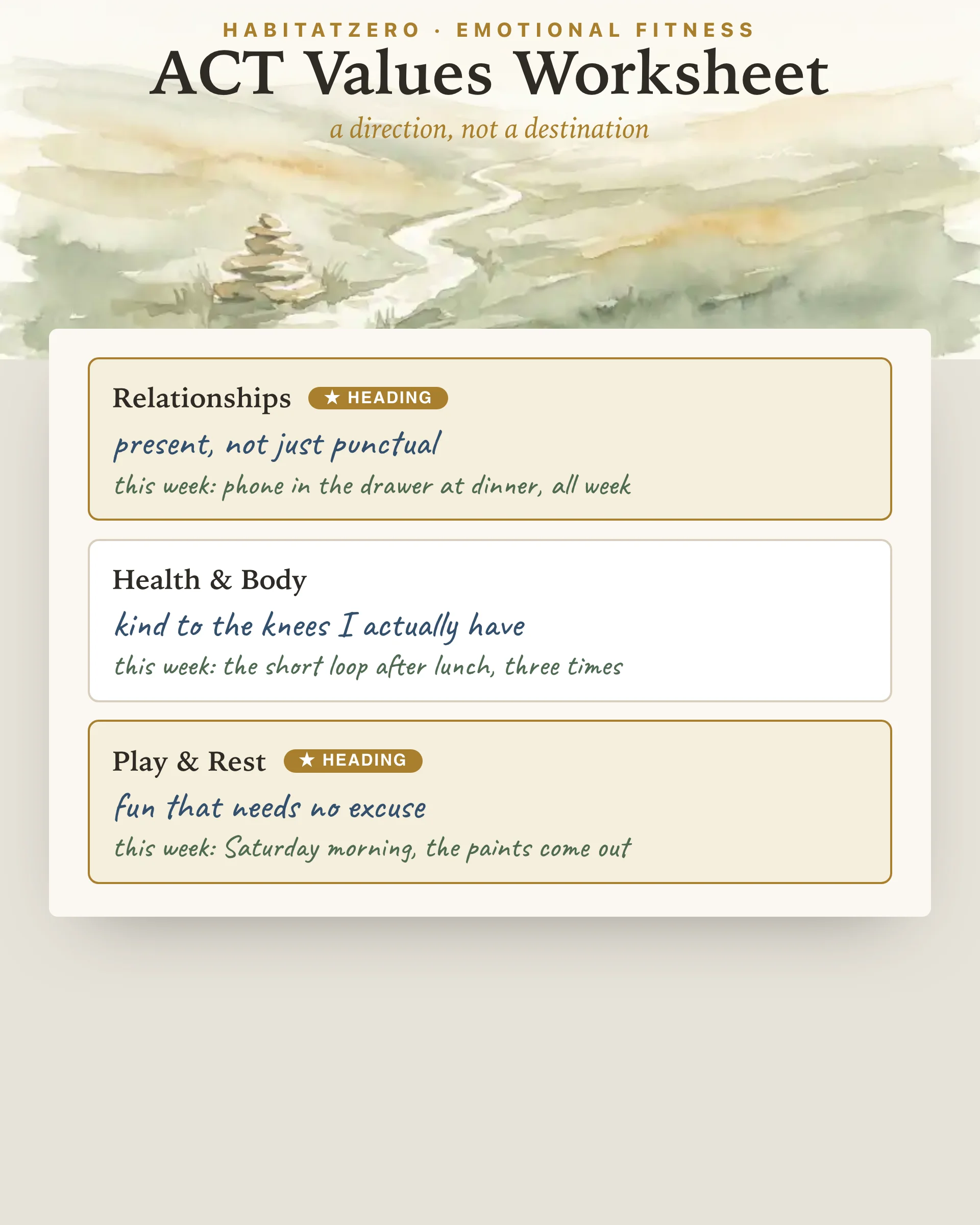
There is a particular kind of tired that comes from a full calendar and an empty compass — weeks that were busy the whole way through and somehow still felt beside the point. Acceptance and Commitment Therapy has a blunt diagnosis for that feeling: activity has come loose from values. This worksheet is the ACT tradition's classic repair, rebuilt as an interactive compass. Six life domains, the quality you want to move toward in each — written in your own words — one committed action per value, and a star on the one or two domains that get the needle this season.
The single most useful idea in ACT's values work is grammatical: values are verbs of direction, not nouns of arrival. You can finish a goal; you cannot finish a value. "Run the marathon" ends on a Sunday in October. "Treat this body kindly" offers you a fresh step every day for the rest of your life — and never once tells you that you have arrived and may stop. That is not a bug. A direction you can never complete is also a direction you can never permanently fail: however far off course the last month went, the heading is still exactly where you left it.
ACT is not a folk practice borrowing a scientific costume — it is a well-studied therapeutic model with decades of process and outcome research behind it, developed by Steven Hayes and colleagues. And its values work has a measurement tradition of its own: the Valued Living Questionnaire asks people to look at life domain by domain, which is exactly the structure this worksheet keeps.
The worksheet lays out six domains: relationships, work and craft, health and body, learning and growth, play and rest, and community beyond yourself. At each point you write the value in your own words — not because lists are bad, but because a borrowed word carries no instructions. "Integrity" from a picklist means whatever the list meant. "Present, not just punctual," in your handwriting, tells you exactly what to do at dinner tonight.
If you enjoy the pick-and-rank approach — a long menu of value words cut down to a top five — the core values worksheet does precisely that, and the two exercises complement each other well. This one starts from your life; that one starts from the words.
Under each value sits the second half of the exercise: one committed action for this week. ACT is insistent on this pairing — values without action decay into decoration, and the worksheet would rather have "the short loop after lunch, three times" actually walked than a beautiful paragraph about vitality admired from the couch. Small is the discipline. A committed action you can finish inside an ordinary week is a vote your values can actually cast.
The worksheet lets you star at most two domains as this season's heading, and it will gently refuse a third. The cap is the exercise. Every domain matters, which is precisely why "all of them, equally, now" is not a strategy — a compass needle pointing everywhere points nowhere. Starring relationships and play this season does not demote your work or your health; it names where the deliberate effort goes, and the stars are yours to move when the season turns.
One more thing, in ACT's own spirit: somewhere along the way your mind will probably announce that you are failing your values. That announcement is a thought, not a verdict. Notice it, let it pass like weather, and take the small step anyway — if that skill appeals to you, leaves on a stream is the classic ACT exercise for practicing it.
Honest labels: ACT is a full therapy, practiced with a trained professional, and it covers far more than values — acceptance, defusion, mindful attention, self-as-context. This worksheet borrows the values-and-committed-action corner of that tradition as a self-help exercise, with attribution and without pretending to be the rest. If you are seeing a therapist, bring your compass along; it makes good session material. And if the reason the weeks feel beside the point is heavier than a misaligned calendar — a low that will not lift, anxiety that runs the day — a mental-health professional is the right next step, and no worksheet is.
A values-clarification exercise from the Acceptance and Commitment Therapy tradition. This one is a compass: six life domains, the quality you want to move toward in each — written in your own words — and one committed action per value, small enough to happen this week. You can also star the one or two domains that get your deliberate effort this season.
A goal can be finished; a value cannot. Run the marathon is a goal — one day it is done. Take care of the body I actually have is a value — a direction you can keep walking for the rest of your life, and every day offers another step in it or away from it. ACT treats values as chosen directions, which is why this worksheet asks for a heading rather than a finish line.
Because a borrowed word carries no instructions. Integrity from a list means whatever the list meant; present, not just punctual — in your handwriting — tells you exactly what to do at dinner tonight. The phrasing is the point: when a value sounds like you, you can hear it over the noise of a busy week.
No, and it does not claim to be. ACT — Acceptance and Commitment Therapy, developed by Steven Hayes and colleagues — is a full therapy practiced with a trained professional, covering much more than values work. This page borrows one exercise from that tradition as self-help: a compass, not a course of treatment. If you are working with a therapist, it makes a fine companion; it is not a substitute.
Yes — free, interactive, in your browser, no signup. If you want a paper or PDF copy, print the page: the sheet is print-styled, and your browser can save the print output as a PDF. Inside Fabulous your compass also saves to your account, so next season you can reread the old heading before you set the new one.
By the team behind Fabulous, the science-based self-care app used by over 30 million people.