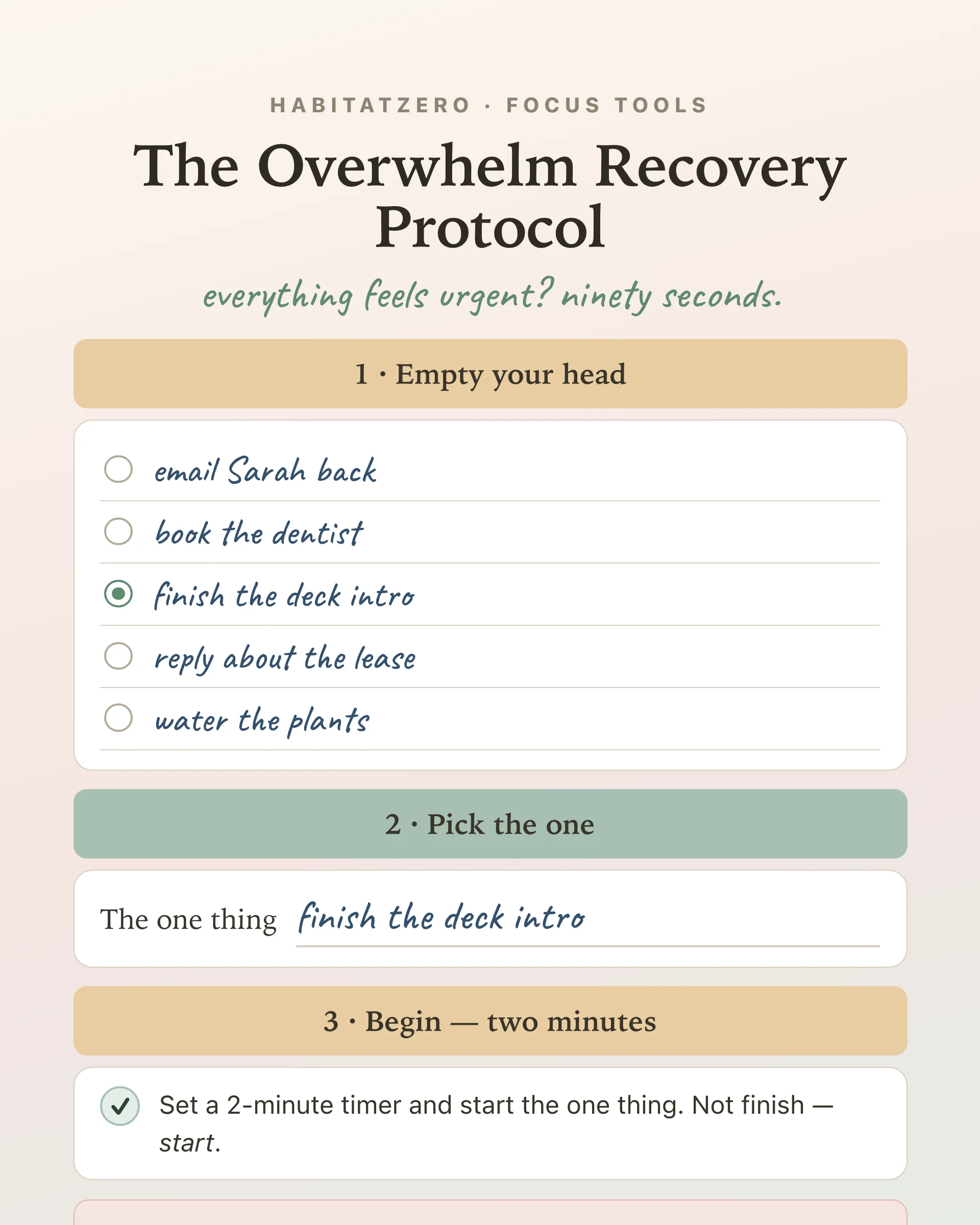
The Overwhelm Recovery ProtocolWellness & Routines · ~5 min
About this template · Updated September 2026
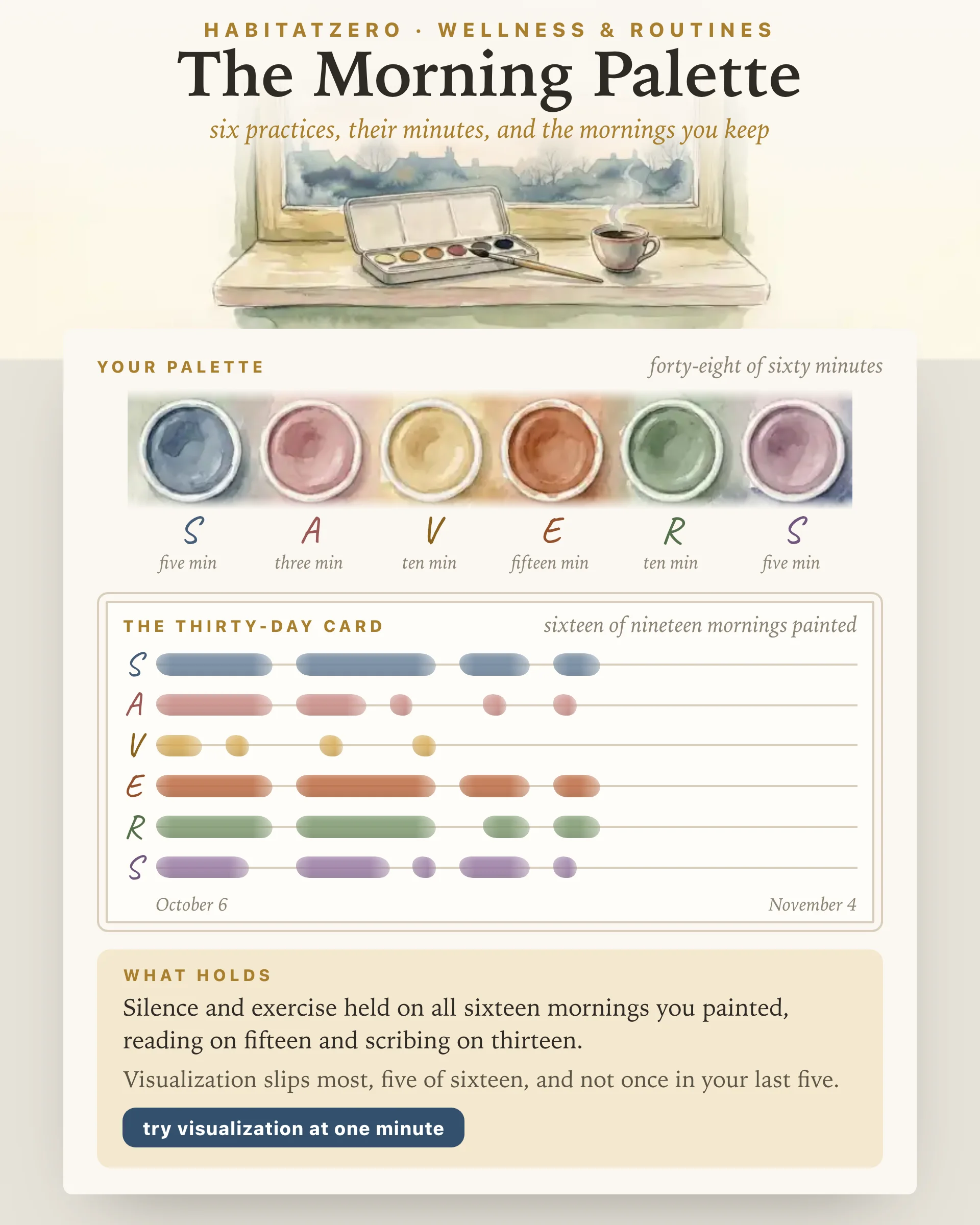
The Miracle Morning belongs to Hal Elrod. He laid it out in his book of the same name, first published in 2012, and still teaches it through his official Miracle Morning site. At its center are six practices whose initials spell SAVERS: silence, affirmations, visualization, exercise, reading and scribing. Every one of those names, and the idea of doing all six before the day begins, is his. The palette on this page is ours: an independent practice sheet that Elrod, his company and his publishers had no hand in making and have not reviewed or endorsed.
Elrod has written that his own session usually lasts about sixty minutes, that on rushed days he gives each practice a single minute, and that the six can come in any order.
Each practice is a pan of paint. Tap a pan to plan it: set its minutes with the plus and minus buttons, then write one short line about what you will actually do, or tap a suggestion. You can also start from six minutes, half an hour or the full hour, split evenly, and adjust from there. The palette stops at sixty minutes in all and tells you when a change would pass that, since an hour is the length Elrod describes for his own mornings.
Then comes the part a printout cannot do. After your practices, tap each one you kept, and that morning is painted onto a thirty-day card, one column per day. A practice you keep morning after morning turns into a long unbroken stroke; one that comes and goes leaves scattered dabs. Forgot to paint yesterday? Step back as far as a week and paint it there. A second tap takes a practice off again.
Once three mornings are on the card, the page reads it for you. It names the practices that held on at least four mornings in five, and the one that slips most. When that slipping practice is also one of the longer ones in your plan, it says so and offers to cut it to a single minute, a smaller way back in that borrows the logic of Elrod's six-minute version. When the thirty days run out, start a fresh card; your plan stays exactly as you left it.
We found no controlled trial of the Miracle Morning as a whole, so nothing here promises what the full routine will do for you. Several of its parts have been studied on their own, and the findings change how you might fill the palette.
Exercise has some of the strongest evidence behind it. An umbrella review of 97 meta-analyses, together covering more than a thousand trials, found that physical activity had medium-sized effects on symptoms of depression, anxiety and distress compared with usual care (Singh and colleagues, 2023), although the authors rated most of the reviews they drew on as critically low in quality.
Visualization seems to pay off when it rehearses steps rather than the prize. In a study of first-year college students, some spent the days before a midterm picturing how they would study and others pictured getting a good grade; it was the rehearsal of the steps that improved both studying and grades (Pham and Taylor, 1999). That is why the suggestions here walk through the hardest hour of your day instead of admiring the finish line.
Affirmations need more care than their reputation suggests. People with low self-esteem who repeated a sweeping line, "I'm a lovable person," ended up feeling worse than people who did not repeat it (Wood, Perunovic and Lee, 2009). Lines you can honestly believe, about what you will do today and why, are the safer kind, and the Affirmation Journal is a good place to draft them.
The routine asks you to get up before the day starts making demands, and the real price of an early alarm is sleep. The CDC advises that adults up to age 60 need seven or more hours a night, so an earlier morning has to be paid for with an earlier bedtime. The Wind-Down Routine Builder looks after that end of the day.
Mix the palette the evening before your first early start, when there is time to think in minutes. Paint each morning straight after your practices. Read the card at the end of every week, and when one practice keeps slipping, shrink it before you give up on it. If scribing turns into the part you look forward to, the Morning Journal gives it more room than a single line.
It is Hal Elrod's plan for opening the day with six short personal practices before email, errands or news can claim your attention. His book on it first came out in 2012, and he has written that his own sessions usually run about an hour.
Silence, affirmations, visualization, exercise, reading and scribing, which is Elrod's word for journaling. He says the six can be done in any order, so the order on this page simply follows the letters.
As long as your morning allows. Elrod describes a usual session of sixty minutes and a pared-down version for rushed days with one minute per practice, six in all. This palette holds up to an hour and lets each practice run anywhere from one minute to thirty.
No. Elrod's company offers its own app with a SAVERS tracker. The Morning Palette is an independent sheet for practicing the same six ideas, and neither Elrod nor his team built it, checked it or vouches for it.
Yes. The card covers thirty days counted from the first morning you paint, which matches the length of the thirty-day challenge Elrod runs. To keep your card from one morning to the next, personalize the template in HabitatZero, which is free.
By the team behind Fabulous, the science-based self-care app used by over 30 million people.