The Overwhelm Recovery ProtocolWellness & Routines · ~5 min
About this template · Updated July 2026
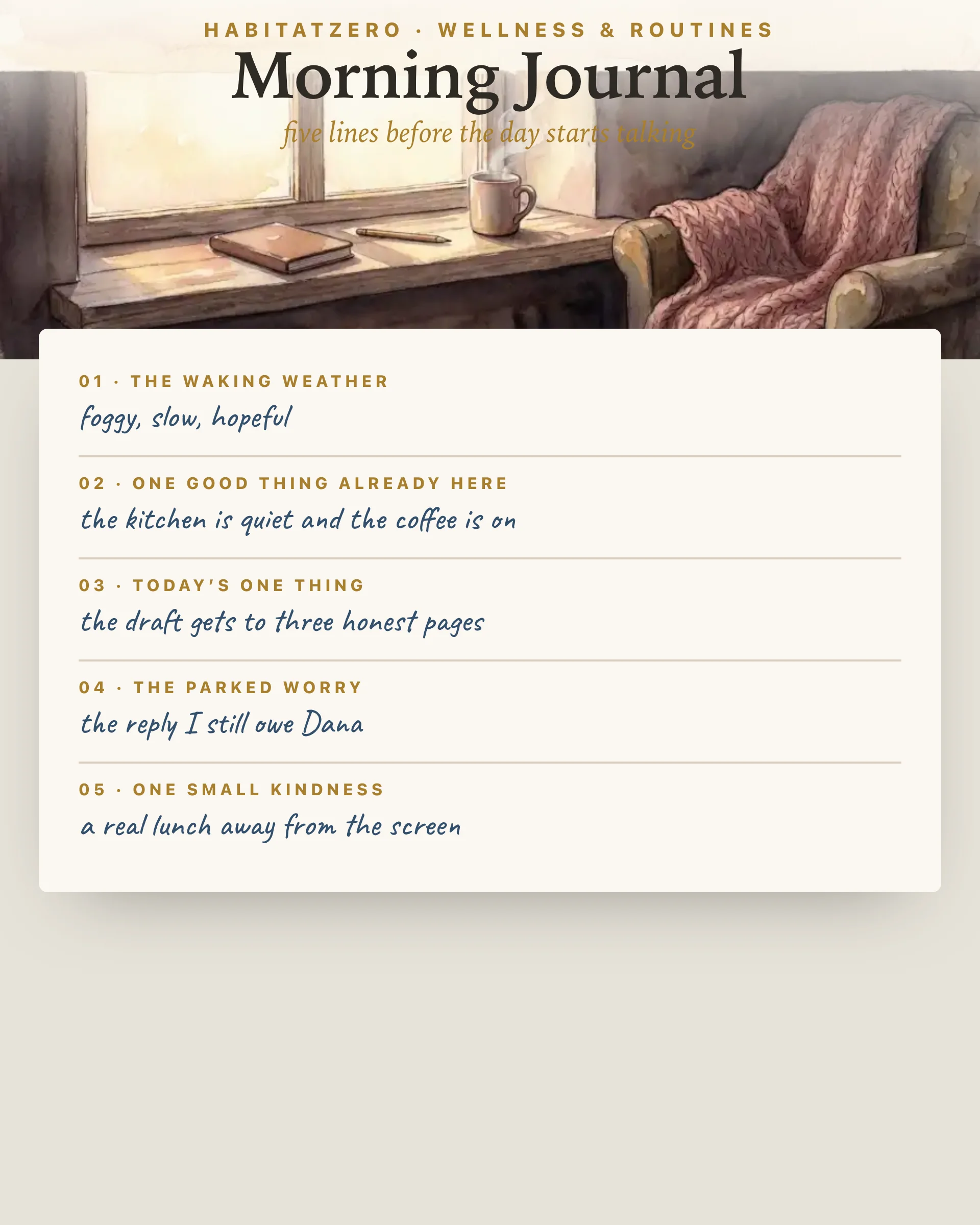
Search this question and you'll find lists of two hundred prompts, which is exactly the problem. At 7 a.m. nobody wants a menu; they want an order. So here is the direct answer, the one this journal is built around: write five short lines, the same five every morning, and close the page. The repetition isn't a limitation — it's the feature that keeps a morning practice alive past Thursday.
01 — The waking weather. Three words for how you woke: foggy, slow, hopeful. No fixing, no analysis — a report. This line exists because the hardest sentence of any journal is the first one, and a weather report has no bar to clear. It also becomes the most interesting line in retrospect: two weeks of waking weather is a record no memory keeps.
02 — One good thing already here. Not gratitude homework — just one true thing that predates the day's efforts. The kitchen is quiet. The coffee is on. Starting the ledger with something already in the plus column changes the tone of everything written after it.
03 — Today's one thing. Finish the sentence: today went well if… This is the only required line on the sheet, and it's one sentence on purpose. The research on implementation intentions — simple written plans of the when-then shape — found that committing a plan to words dramatically raises the odds of doing the thing compared with merely intending it. A morning journal is the cheapest place that effect is available. One finish line, not a to-do list: lists describe a day, a finish line aims one.
04 — The parked worry. Name the loudest one in a phrase: the reply I still owe Dana. Written down, a worry gets a parking spot and a pickup time; unwritten, it circles the block all morning honking. You're not solving it at 7 a.m. — you're telling it where to wait.
05 — One small kindness. A promise to yourself sized to survive contact with the day: a real lunch away from the screen. Grand self-care intentions die by noon; a small named one mostly doesn't.
Then — and this matters — close the page. The button is the ritual: the morning gets sealed, the entry joins a two-week shelf of your last fourteen mornings, and the day is allowed to begin. A journal you never close is just a tab you feel guilty about.
Deciding what to write is the expensive part of journaling, and morning is when decisions cost the most. A fixed sequence spends that budget once, at setup, instead of every day. It also compounds: because the lines repeat, the shelf reads like a chart — wakings that trend foggy, finish lines that keep involving the same project, worries that park themselves twice a week. Variety is for afternoons.
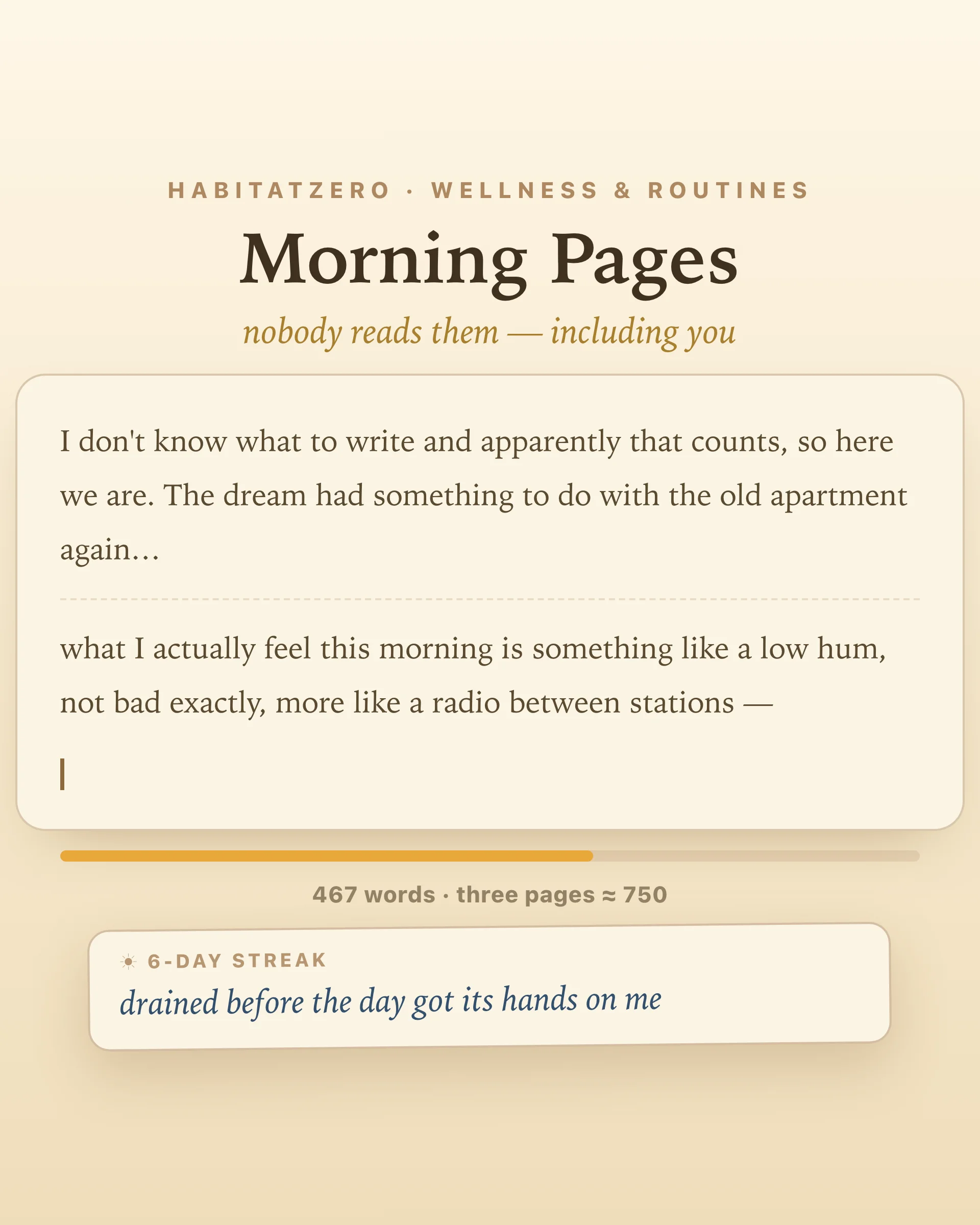
That said, this journal is the narrow tool in a family. When the head is too loud for five tidy lines, morning pages is the fire hose — three unstructured pages that keep nothing at all, by design. And when what you want is range rather than ritual, the journal prompts deck deals a different question every sitting. Ritual, fire hose, deck: mornings, in that order of urgency.
Five lines. Four minutes. Close the page, and let the day start talking only after you've said your piece.
Five short lines cover the whole job: three words for how you woke, one good thing that is already here, a finish line for the day (today went well if…), the loudest worry named so it can wait, and one small kindness you promise yourself. That is the entire sequence this journal asks for — most mornings it takes four minutes, and only the finish line is required.
Because the fixed shape is what makes it survivable at 7 a.m. Deciding what to write is the expensive part of journaling, and mornings are when deciding is most expensive. A repeated sequence removes the decision, and repetition is what turns the five lines into a reading: after two weeks, the shelf of closed mornings shows you how your waking weather actually runs.
The evidence on simple written plans is unusually strong: research on implementation intentions found that committing a specific plan to words markedly raises follow-through compared with holding the same intention in your head. The sheet borrows that mechanism at day-scale — one sentence, one finish line, written where you will see it settled — rather than asking for a to-do list.
They solve different mornings. Morning pages is the long unstructured version: three full pages of freewriting that deliberately keep nothing, built for draining a crowded head. This journal is the short structured version: five fixed lines in four minutes that close with a plan. Plenty of people alternate — pages on the days the head is loud, the five lines on days that just need aiming.
In the first quiet minutes after waking, ideally before your phone gets a vote — the sheet works best while the day is still yours to describe rather than react to. Pair it with something that already happens, like the first coffee. If mornings genuinely never have four minutes, the five lines work at the desk before the first meeting too; the ritual matters more than the clock.
By the team behind Fabulous, the science-based self-care app used by over 30 million people.