The Overwhelm Recovery ProtocolWellness & Routines · ~5 min
About this template · Updated July 2026
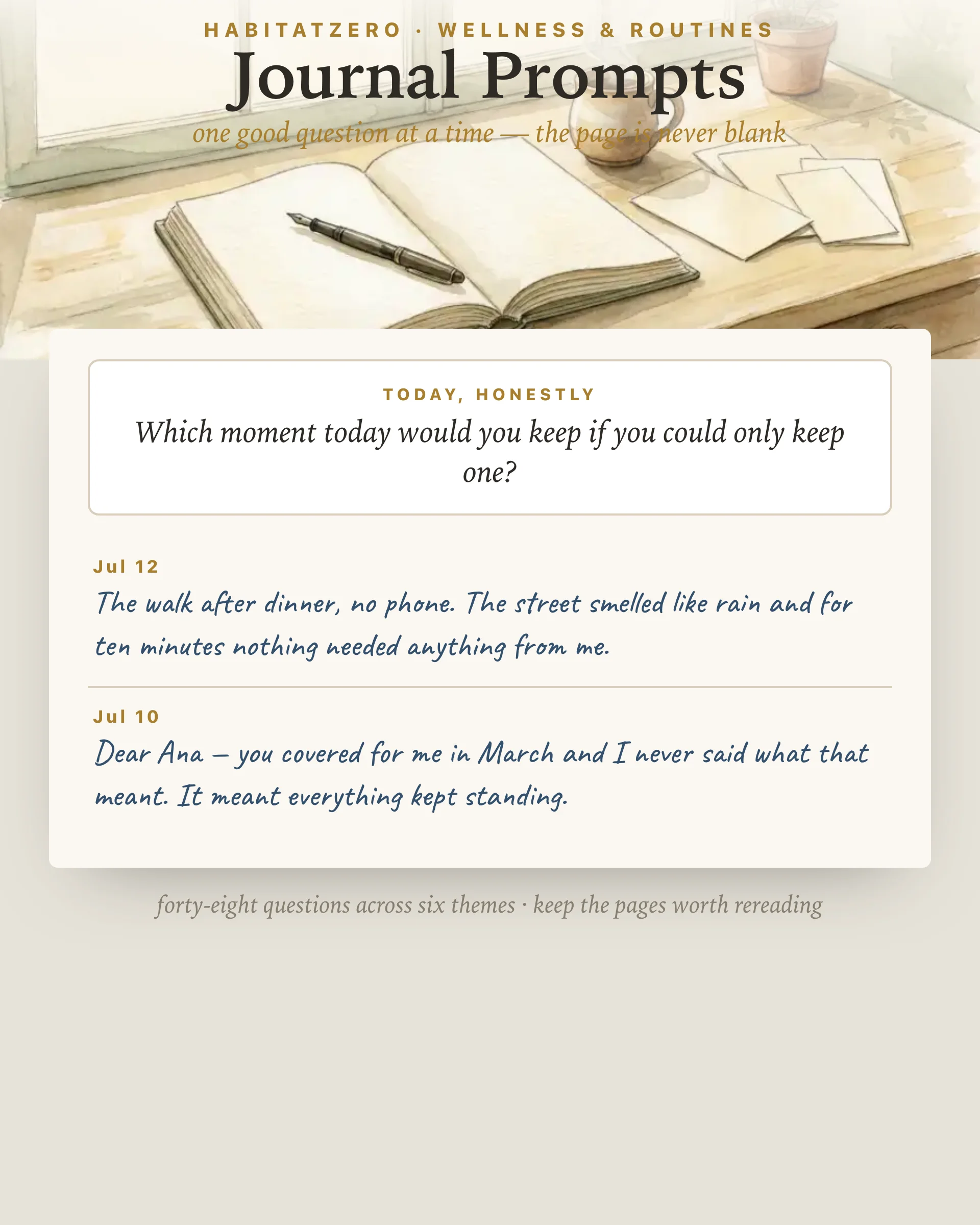
Ask anyone who quit journaling why they stopped, and the answer is rarely "I ran out of feelings." It's the blank page. Write about your day is a terrible assignment — too big to start, too vague to finish. Journaling with prompts flips the assignment: instead of you interrogating the page, the page asks you one question specific enough to answer. This deck holds forty-eight of them, sorted into six themes, dealt one at a time.
The research tradition behind therapeutic writing never used blank pages. When James Pennebaker ran the first expressive-writing experiments, participants got explicit instructions about what to write toward — and the health effects that made the paradigm famous followed from those directed sessions. A later meta-analysis across dozens of studies found the benefits held across formats, but the sessions were always structured: a direction, a duration, a done. Clinical summaries of the field, like Baikie and Wilhelm's review, describe the same shape — writing works when it has somewhere to go.
A good prompt is that somewhere. Which compliment do you never quite believe? can be answered by anyone, tonight, in four sentences — and the fourth sentence is usually where the interesting part starts.
People open a journal for different reasons on different nights, so the deck is split by urge rather than by topic:
Pick a theme when you know what kind of night it is. Leave the whole deck in play when you don't — it remembers what it dealt you recently, so the same question won't come knocking twice in a week.
The sitting is deliberately small. The deck deals a single prompt — never a listicle of thirty — and below it there's one page, written in your own hand. If the question doesn't bite, deal another; no guilt attaches. When you finish, you make the one decision most journals never ask for: keep it or let it go. Kept pages land on the shelf with their date and the question that started them, up to forty. Everything else was for the writing, which was the point.
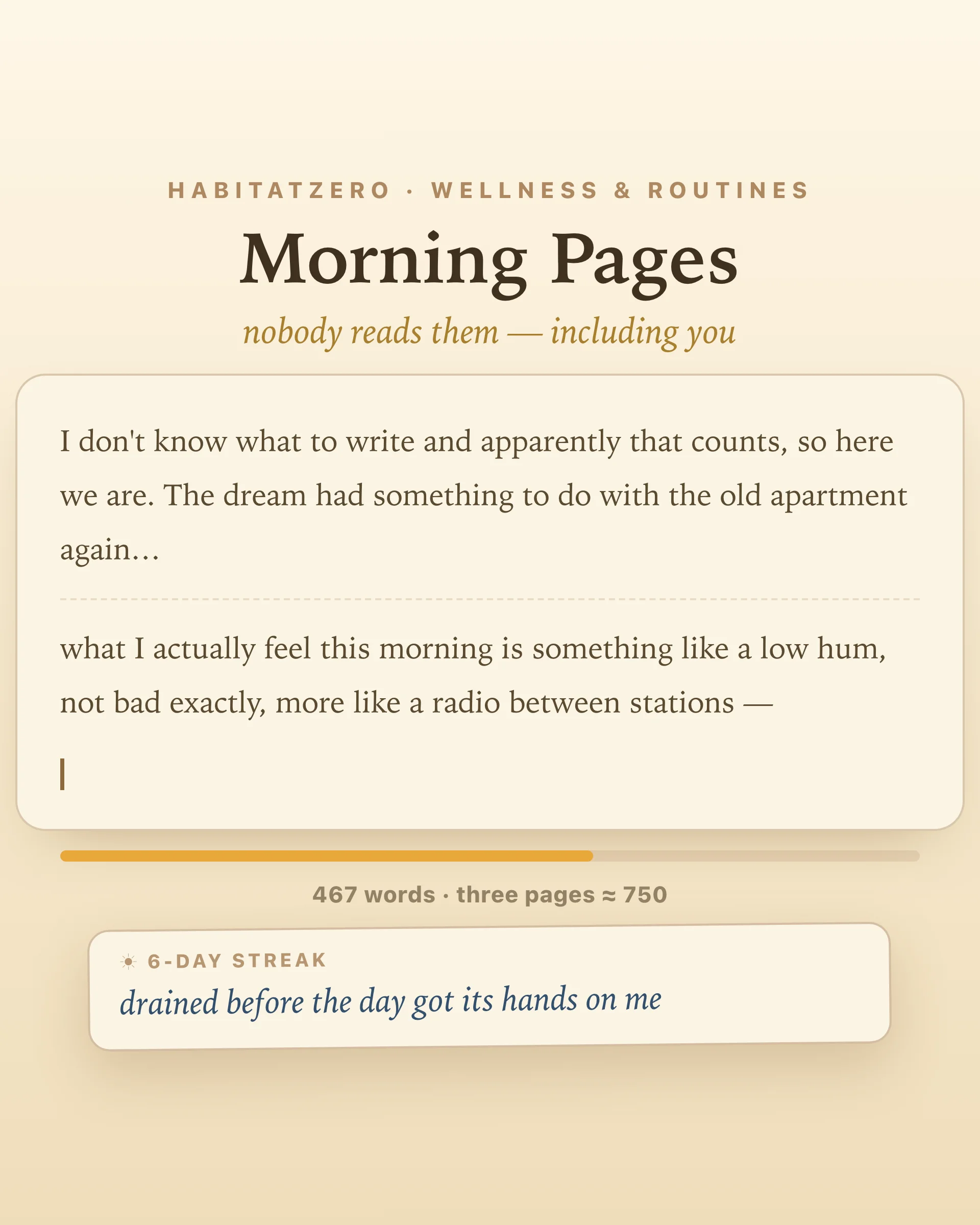
If the deck warms you up and you want distance-running instead, morning pages is the long-form version — three unfiltered pages that keep nothing at all. And if the urge is specifically thankfulness, the gratitude prompts deck asks better questions about a good day than a general deck ever will.
Forty-eight questions. One at a time. The page is never blank again.
It is journaling where a specific question starts each entry instead of a blank page. Rather than asking yourself what to write about, you answer something concrete — which moment of today would you keep, what rule do you follow that you never agreed to — and the entry unspools from there. The question does the starting so your attention can do the noticing.
They solve different problems. Free writing shines once you are already moving; prompts solve the cold start. The research on expressive writing used directed instructions rather than open pages, and most abandoned journals die at the blank page, not mid-sentence. If starting is your bottleneck, a dealt question removes it — and nothing stops you from wandering off the prompt once the pen warms up.
A few honest sessions a week beat a daily obligation that curdles into guilt. The classic expressive-writing protocols asked for three or four sessions of about fifteen minutes, and the benefit tracked with engagement, not frequency. This deck deals one question per sitting on purpose: one real answer is a complete session.
Concrete ones with a small doorway: trace one hour of today you cannot account for, describe an ordinary Sunday from when you were ten, write the thank-you you never sent. Vague prompts like describe your feelings stall beginners because they ask for a summary. Good questions ask for a scene, a person, or a specific moment — the feelings arrive on their own.
Keep the ones you would want to reread and let the rest go. This journal treats keeping as a choice, not a default: every entry can be written for the writing alone, and only the pages you deliberately keep collect on the shelf, each with its date and the question that started it. A shelf of forty chosen pages says more than a thousand automatic ones.
By the team behind Fabulous, the science-based self-care app used by over 30 million people.