Leaves on a StreamEmotional Fitness · ~3 min
About this template · Updated September 2026
Overthinking rarely feels like thinking. It feels like a song stuck on repeat: the conversation you replay on the drive home, the plan you rebuild for the fourth time, the what-if that starts over the moment it ends. Arguing with the song doesn't stop it. Mindfulness takes another route. It trains you to notice that the record is skipping, to say plainly what is playing, and to rest your attention on something real for a few breaths.
This page turns that practice into an object: every loop you catch is drawn onto a painted record, so within a week or two you can see what your overthinking is made of and whether you are catching it sooner.
Notice. The skill is the moment you realize you have been circling. You will usually notice late; noticing late still counts, and it is the part that speeds up with practice.
Name. Give the loop one plain word. Planning is rebuilding tomorrow in your head. Replaying is rerunning something that already happened. What-if is the future going wrong in several versions. Judging is the running commentary on how you did. Rehearsing is scripting a conversation that hasn't happened yet. When nothing fits, just thinking will do. The name is not a verdict; it lets you see the loop as a loop instead of as the whole world.
Come back. Choose one thing you can sense right now: three sounds, the floor under your feet, one long breath out, five things in view, whatever your hands are touching. Stay with it for a few breaths. You are not trying to empty your mind, only giving your attention a place to land.
In a 2012 brain-imaging study at Emory University, fourteen meditation practitioners pressed a button each time they realized their mind had wandered from the breath, then returned to it, and the team modeled the practice as a repeating cycle of wandering, becoming aware, shifting attention and staying. The button on this page asks for that same moment of awareness in ordinary life, where most overthinking happens.
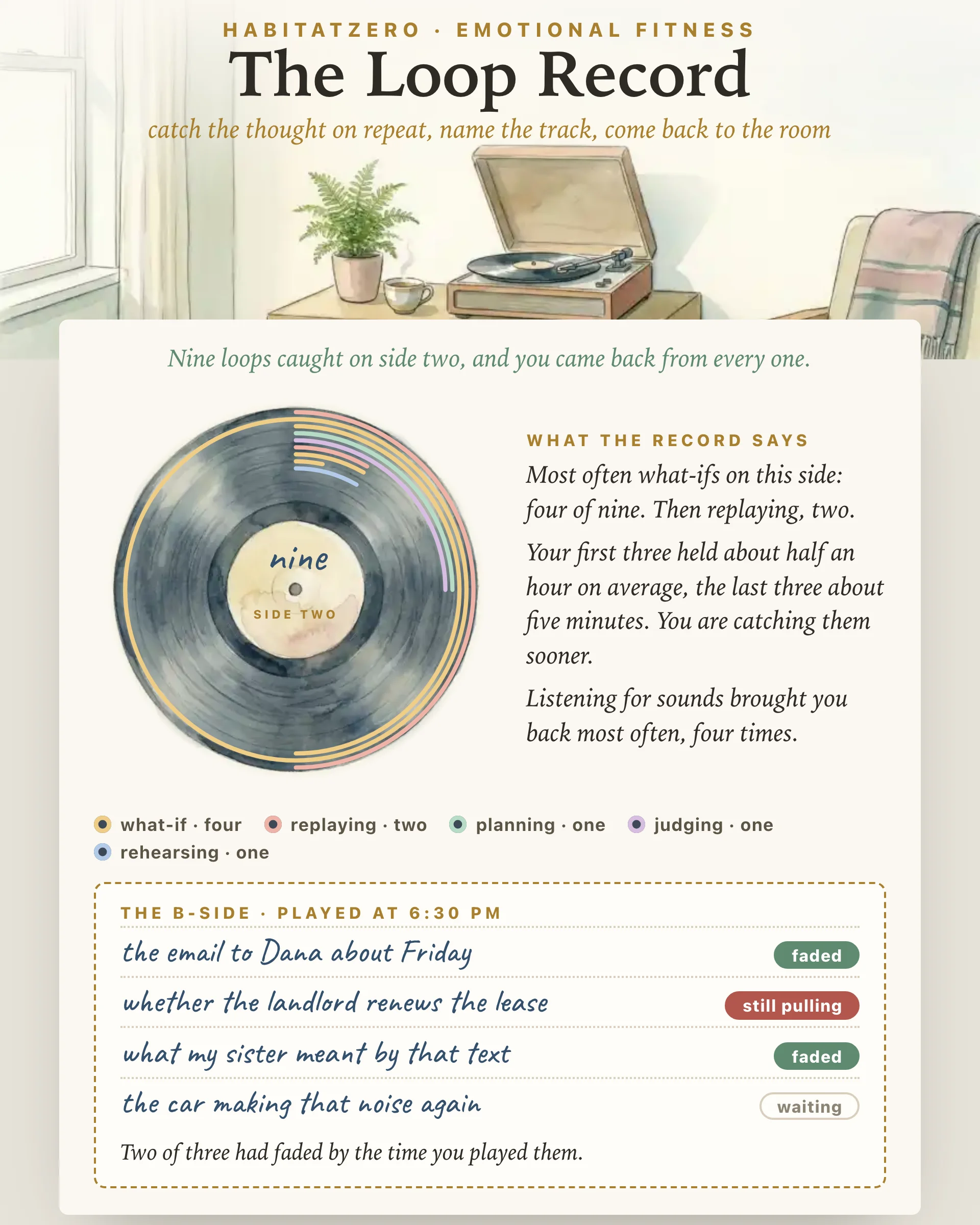
Tap the kind of loop, pick roughly how long it had been playing, and choose a sense to come back through. When you press back in the room, a groove appears. Its color is the kind of loop. Its length is how long the loop held before you caught it: a quarter turn for fifteen minutes, a full turn for an hour or more. Your first catch is the outer groove, since records play from the edge inward, and a side holds twelve before you flip it; the count carries over.
Beside the record, the page reads the side back to you in plain sentences: which kind of loop turns up most, whether your last three held shorter than your first three, and which sense most often brings you back. The aim is not a blank record. The aim is shorter grooves.
Some loops are not noise: the bill is real, and the email does need writing. Mindfulness doesn't ask you to ignore those. Worry postponement gives them an appointment: pick a set time, and when a worry arrives early, write a few words and go back to what you were doing. At the set time, give each one real thought, then mark whether it still pulls or has faded.
The evidence here is mixed, and worth knowing. In a small 2013 trial with people who worry a lot, two weeks of a daily thirty-minute worry period, held at the same time and place, reduced worry, anxiety and insomnia more than a comparison condition did. But a larger online trial found that telling people to postpone worked no better than having them simply record their worries, and its participants reported that postponing was hard. So treat the B-side as an experiment and let your own faded count decide. If worry needs a daily appointment of its own, the Worry Journal is built around one.
The firmest support for mindfulness against rumination comes from structured programs. A 2017 meta-analysis of eleven studies in people with depression found that mindfulness-based interventions moderately reduced rumination compared with usual care, with no clear difference from other active treatments in the three studies that compared them. Most of those studies tested mindfulness-based cognitive therapy, typically eight weekly sessions. That is a course, not a worksheet. A page like this helps you practice the move on your own; it does not replace care.
Use it the moment you notice you have been going round, on the couch late at night or halfway through a meeting. If one sense isn't enough to bring you back, 5-4-3-2-1 Grounding walks through all five. If you want to rehearse the catch in a formal sitting, The Fold-Out Script guides one from start to close.
If the loops fill most of your day, cost you weeks of sleep, or arrive with a low mood that won't ease, talk with a doctor or a therapist. And if a loop ever circles toward hurting yourself or ending your life, don't hold it for any set time: call or text 988 in the US, or your local emergency number, right now.
Three small moves carry most of the weight. Notice that your mind has been circling, give the loop a one-word name such as planning, replaying or what-if, then rest your attention on something you can sense right now, like three sounds or the floor under your feet. For worries that need real thinking, add a set time later in the day and do that thinking then.
It trains you to spot a loop while it is still running rather than an hour later, and to step out of it without arguing with it. A 2017 meta-analysis of eleven studies in people with depression found mindfulness-based programs moderately reduced rumination compared with usual care. Most of those programs were eight weekly sessions of mindfulness-based cognitive therapy, so a worksheet is practice for the skill, not a substitute for that kind of course.
A short daily sit rehearses the exact move you need in the middle of a busy afternoon: the mind wanders, you notice, you come back to the breath. A 2012 brain-imaging study of meditators modeled breath-focused meditation as exactly that cycle of wandering, noticing, shifting and staying. This page gives the same catch a home outside the cushion, in the minutes when you actually overthink.
You choose a set time each day for worrying on purpose, and when a worry turns up early you jot a few words and bring your attention back to the present. In a small 2013 trial with people who worry a lot, two weeks of a daily worry period eased worry, anxiety and sleep trouble more than a comparison condition. A larger online trial found it did no better than simply logging worries, and its participants found postponing hard, so run it as an experiment and watch your own faded count.
Yes, with the same moves done faster. Racing thoughts are a loop at speed, so name the speed rather than each thought (just “racing”), give one sense a few seconds, such as the weight of your feet or the farthest sound in the room, and come back each time the mind takes off again. At night, a few words on paper give the thoughts somewhere to wait until morning. If racing thoughts arrive with several nights of little sleep and unusual energy, tell a doctor; that pattern is worth checking, not just sitting with.
The public page shows a record someone has half filled, so you can see how the grooves and readings look. To catch your own loops, keep your count across sides and play your own B-side, open it in HabitatZero, where it costs nothing.
By the team behind Fabulous, the science-based self-care app used by over 30 million people.