
Leaves on a StreamEmotional Fitness · ~3 min
About this template · Updated September 2026
Telling a teenager to calm down rarely helps, and telling them to meditate tends to land worse. What has a better chance is smaller and more specific: one short practice for the exact spot where the day goes sideways. The minute before a chemistry test, the hallway after an argument, the ceiling at one in the morning.
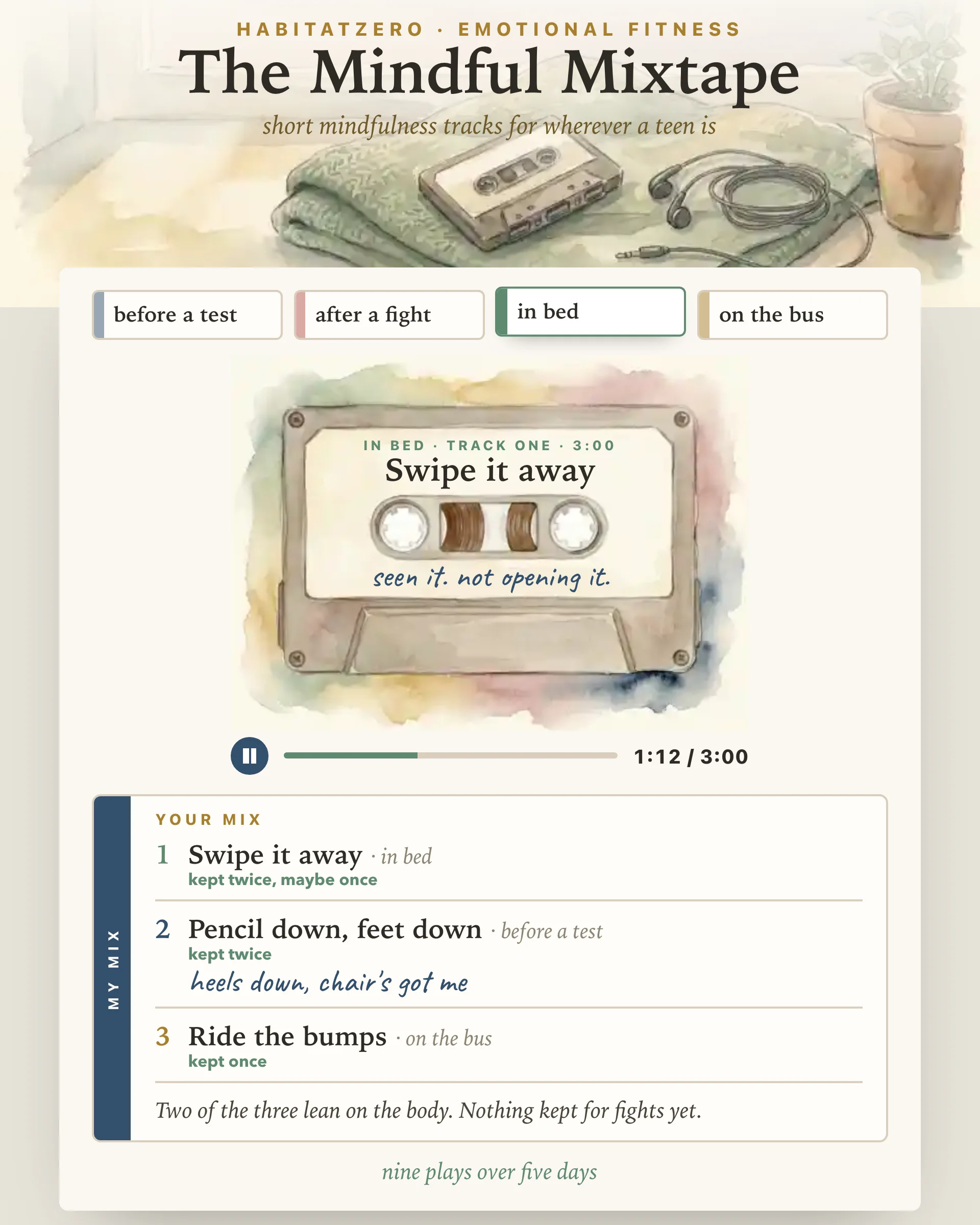
This page sorts twelve mindfulness exercises for teens by place rather than by technique, gives each one a silent timer, and lets your teen decide which ones are worth keeping. You set it up; they own it.
Each place is a cassette with three short tracks.
Every track carries two or three plain steps and a line in a teen's voice: "Seen it. Not opening it. Back to breathing." Your teen can rewrite it in their own words, which then appear on the tape label in handwriting.
Pick the tape for where you are, press play, and a counter runs. There is no audio and no narrator, only the liner notes and the time. When the track ends, or your teen stops it after fifteen seconds or more, the page asks one question: would you play this one again? Yes, maybe or no.
Each answer lands in a dated log. Tracks kept more often than skipped rise onto the mix, which holds three, and a short reading underneath says what the keepers have in common ("Two of the three lean on the body"), which places still have no keeper, and which tracks have been skipped without ever being kept.
Mindfulness for adolescents has been tested in dozens of controlled trials, with results more modest than school hallway posters suggest.
The MYRIAD trial followed 8,376 students aged 11 to 14 in 84 schools across the UK. Ten mindfulness lessons taught to whole classes did no better than ordinary social-emotional lessons on depression risk, emotional and behavioral functioning, or well-being a year later (Kuyken et al., 2022). A follow-up analysis found that students already at risk scored slightly worse after the lessons, though the gap was too small to matter clinically, and that the classes mostly failed to build the skills they aimed at. Students whose skills did grow tended to fare better. The authors advised against running the course as a class for everyone and cautioned that it may not suit students who already have symptoms (Montero-Marin et al., 2022).
A review of 66 randomized trials with more than 20,000 young people found small improvements in stress, anxiety, attention and behavior compared with no program, smaller gains in stress and anxiety against other activities, and no lasting benefit in the studies that checked back later. Its authors wrote that enthusiasm for these programs has arguably run ahead of the evidence (Dunning et al., 2022).
What holds up is modest: in trials, mindfulness practice eases stress and anxiety a little in the short run, and skills a teen actually uses seem to matter more than lessons they sit through. What does not hold up is mindfulness as a cure, as a fix for a whole class, or as a stand-in for care. The mixtape is practice, not treatment, which is why it asks your teen what they would play again instead of telling them what works.
Set it up together once, on a calm evening, and try one track side by side. After that, hand it over and let the places do the reminding. Offer a track in a hard moment instead of ordering one, since "go do your breathing" in the middle of an argument turns a tool into a punishment. Count every skip as information, and let the mix stay theirs even when you would have picked differently.
If worry is the bigger story, Anxiety Worksheets for Teens goes further. If fights are, The Domino Run traces what sets anger off, and for a longer practice at bedtime, The Body Scan Cord moves slowly from head to feet.
If worry, anger or low mood has been getting in the way of school, sleep, eating or friendships for more than a couple of weeks, talk with your teen's doctor or a school counselor; a few tracks can sit alongside that care but should not replace it. If you are a teen reading this and you are thinking about hurting yourself or ending your life, call or text 988 (US) or your local emergency number right now, and tell an adult you trust.
The quick ones that get used are tied to a real moment: pressing both heels into the floor before a test, unclenching the jaw and hands after an argument, counting belly breaths to ten in bed, or following one thing out the bus window until it disappears. Each takes between thirty seconds and five minutes.
Offer it rather than assign it. Try one track together on a calm evening, let your teen choose which tape to start with, and treat a skipped track as useful information instead of a failure. A practice they picked for themselves stands a better chance on a hard day than one handed over like homework.
Modestly, and not for everyone. In the large MYRIAD trial, ten mindfulness lessons taught to whole classes did no better than usual social and emotional teaching a year later, and a review of 66 trials found small effects on stress and anxiety that did not last. Short practices a teen chooses and repeats are worth trying as practice, not as treatment.
If worry, anger or low mood has been getting in the way of school, sleep, eating or friendships for more than a couple of weeks, talk with your teen's doctor or a school counselor. If your teen talks about hurting themselves or ending their life, act the same day: call or text 988 in the US, or your local emergency number.
All twelve tracks and their steps can be read on this page at no cost. Running the silent timer, logging answers and watching a mix take shape happens when you open the mixtape in HabitatZero, which is free.
By the team behind Fabulous, the science-based self-care app used by over 30 million people.


