Leaves on a StreamEmotional Fitness · ~3 min
About this template · Updated September 2026
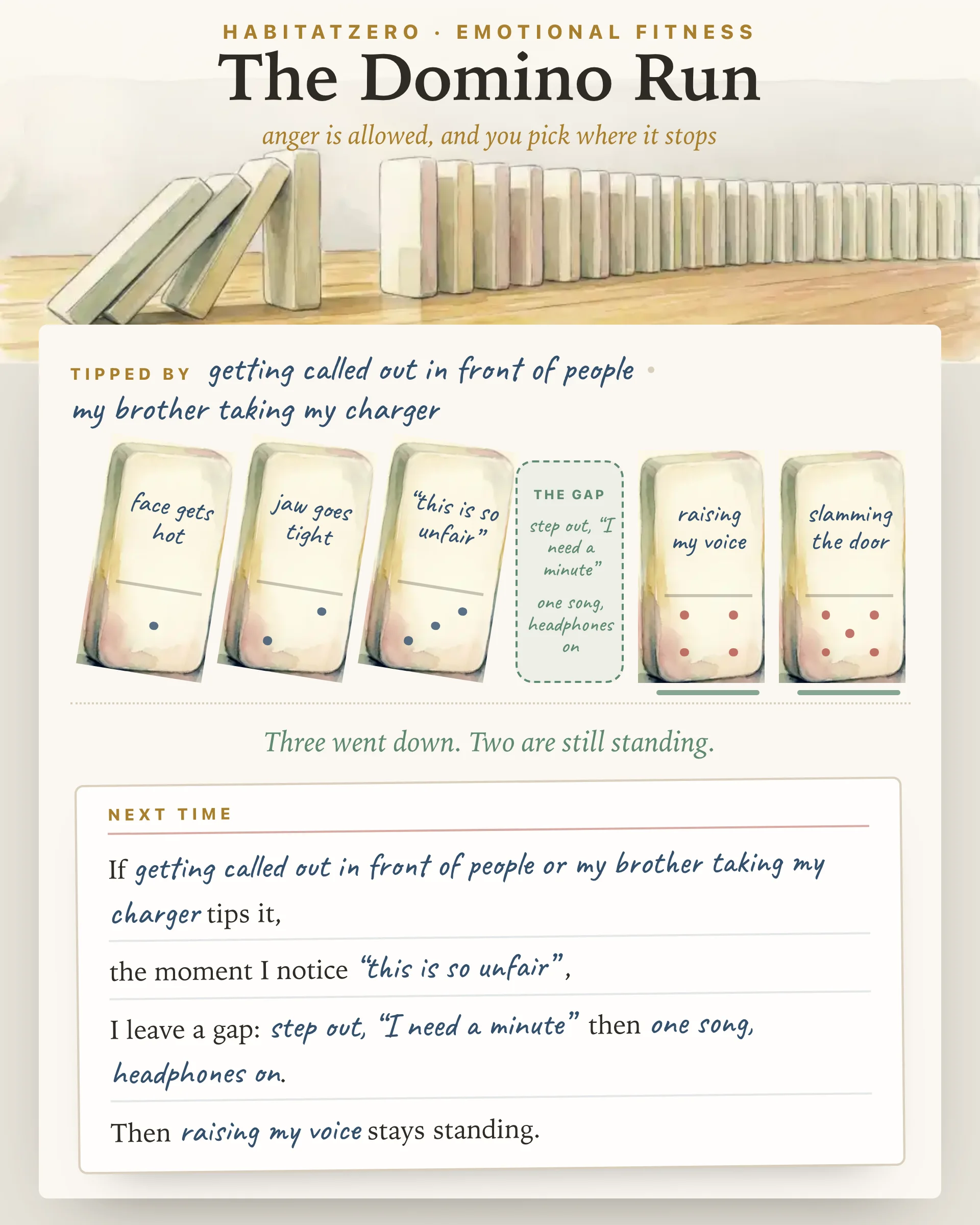
A teenager's blowup almost never comes out of nowhere. Something tips the first tile: a comment in front of friends, a sibling in their room, one more "calm down." Then the body goes, then a thought like they did it on purpose, then the raised voice and the slammed door, fast enough to feel like one event.
This page turns anger management worksheets for teens into one object your teen can set up alone: a domino run. They build the chain as it really goes for them, choose a spot to leave a gap, then tip it and watch where it stops. It is a coping practice, not a treatment, and it never asks anyone to stop feeling angry. The feeling is allowed. What it knocks over is the part worth practicing.
There are four short steps, and nearly all of them are taps.
The push. Your teen picks up to three things that tend to start the run, such as getting called out in front of people or running on no sleep, or writes their own.
The tiles. They stand up what falls next, in order: first the signs they notice, like a hot face or replaying what someone said, then what they do once it takes over, like raising their voice. Six tiles fit, each numbered in pips.
The gap. They choose the last tile they can let fall and what fills the space after it, such as stepping out with a quick "I need a minute" or cold water on the face. The tiles before the gap still fall. That is the anger, and it gets to happen.
Then they tip the run, and the page does what paper cannot. The tiles fall one by one and stop at the gap, and the sheet reads the run back: how many warnings come before your teen does anything, what stayed standing, and whether the gap sits between feeling and doing or one tile too late. It also writes a next-time card in their own words.
After a blowup. The last step asks which part was theirs to own and drafts a short repair script from their answers.
Printing an empty page gives a one-page paper version with blank tiles and lines to write on; a filled page prints the run, the card and the script.
Cognitive-behavioral anger programs for young people have a decent record. A meta-analysis of forty studies, with participants averaging twelve and a half years old, found medium-sized improvements in anger and aggression. Programs that practiced skills did better than ones that only taught about feelings, and practice between sessions went with better results.
What goes in the gap matters too. A 2024 review of 154 studies found that calming activities such as slow breathing and meditation reduced anger and aggression, while activities that rev the body up, like hitting a bag or going for a run, did not help overall. That is why every suggestion in the gap slows things down, and why you will not find "punch a pillow" among them.
The next-time card is written as an if-then plan on purpose. Across 94 tests, plans that name the situation and the response in advance had a medium-to-large effect on people reaching their goals.
The repair script follows apology research from Ohio State, where people rated six parts of an apology and owning responsibility counted most, with an offer to fix things second. So the script opens with "I'm sorry for" and leaves out the "but."
None of these studies tested this page. They looked at programs run by trained adults and at how people judge apologies, and a worksheet cannot replace that kind of support.
Offer it on a quiet evening, not in the middle of an argument, and not as a consequence. Let them fill it in on their own. Building a run about your own temper first makes it feel less like an assignment.
Your real part comes afterward. If the next-time card says your teen will step out and ask for a minute, agree now that walking away to cool off is allowed and is not disrespect. The conversation can pick up later, once both of you are calmer. A gap only works if the people around it let it happen.
Big anger is a normal part of being a teenager. If the anger leads to someone getting hurt, to your teen hurting themselves, or seems out of their control, talk to a school counselor, a doctor or a therapist. If you are in crisis or thinking about hurting yourself, call or text 988 (US) right now, or reach your local emergency number.
The best time is a few hours after a blowup, or the next day, when the run can be looked at instead of lived. Come back when the next-time card stops matching what actually happens.
If your teen struggles to name the first tiles, The Emotions Body Map helps them find where anger shows up in the body. To practice the slow breathing that fills a gap, try Steady the Flame. Once things are calm, The Anger Iceberg looks at what sat under the anger.
The ones worth using cover four things: what sets the anger off, the body signals that show up first, something to do in the pause before acting, and a way to make things right afterward. This page puts all four on a single domino run, so a teen can see how each one leads to the next.
Yes. Print the page from your browser or save it as a PDF. An empty page comes out as a one-page paper version with blank tiles and blank lines to write on, and a filled one prints the run, the next-time card and the repair script.
Offer it on a calm evening, never in the middle of a fight, and let them fill it in alone. Ask to see the next-time card only if they want to show you, and agree ahead of time that stepping out to cool off is allowed and the conversation picks up again later.
Anger on its own is a normal feeling, including big anger. Talk to a school counselor, a doctor or a therapist when it leads to someone getting hurt, when your teen hurts themselves, or when it seems out of their control most days.
You can look at a filled-in run on this page without signing up. Setting up a run of your own, tipping it and keeping the next-time card happen in HabitatZero, at no cost.
By the team behind Fabulous, the science-based self-care app used by over 30 million people.