
Leaves on a StreamEmotional Fitness · ~3 min
About this template · Updated September 2026
Credit first. The raisin exercise comes from Mindfulness-Based Stress Reduction, the eight-week program Jon Kabat-Zinn developed in 1979 at UMass Memorial Medical Center, where the UMass Memorial Health Center for Mindfulness still teaches it. In the standard curriculum it belongs to the very first week, alongside the body scan. This page is an independent worksheet built around that practice. It has no tie to Kabat-Zinn, UMass or the MBSR program, and none of them has reviewed or endorsed it.
Most bites go down while you read, scroll or plan the afternoon, and you notice the food only once it is gone. This exercise reverses that for one small bite, met one sense at a time as if you had never seen one before.
Choose something small you can hold. A raisin is the classic, but a grape, an almond or a square of chocolate works as well. Then go slowly, in this order:
Swallow when you are ready and notice what stays: an aftertaste, a pull toward another, a memory, or nothing much. Your attention will wander, to a to-do list or an opinion about raisins, and catching that and coming back is the practice itself.
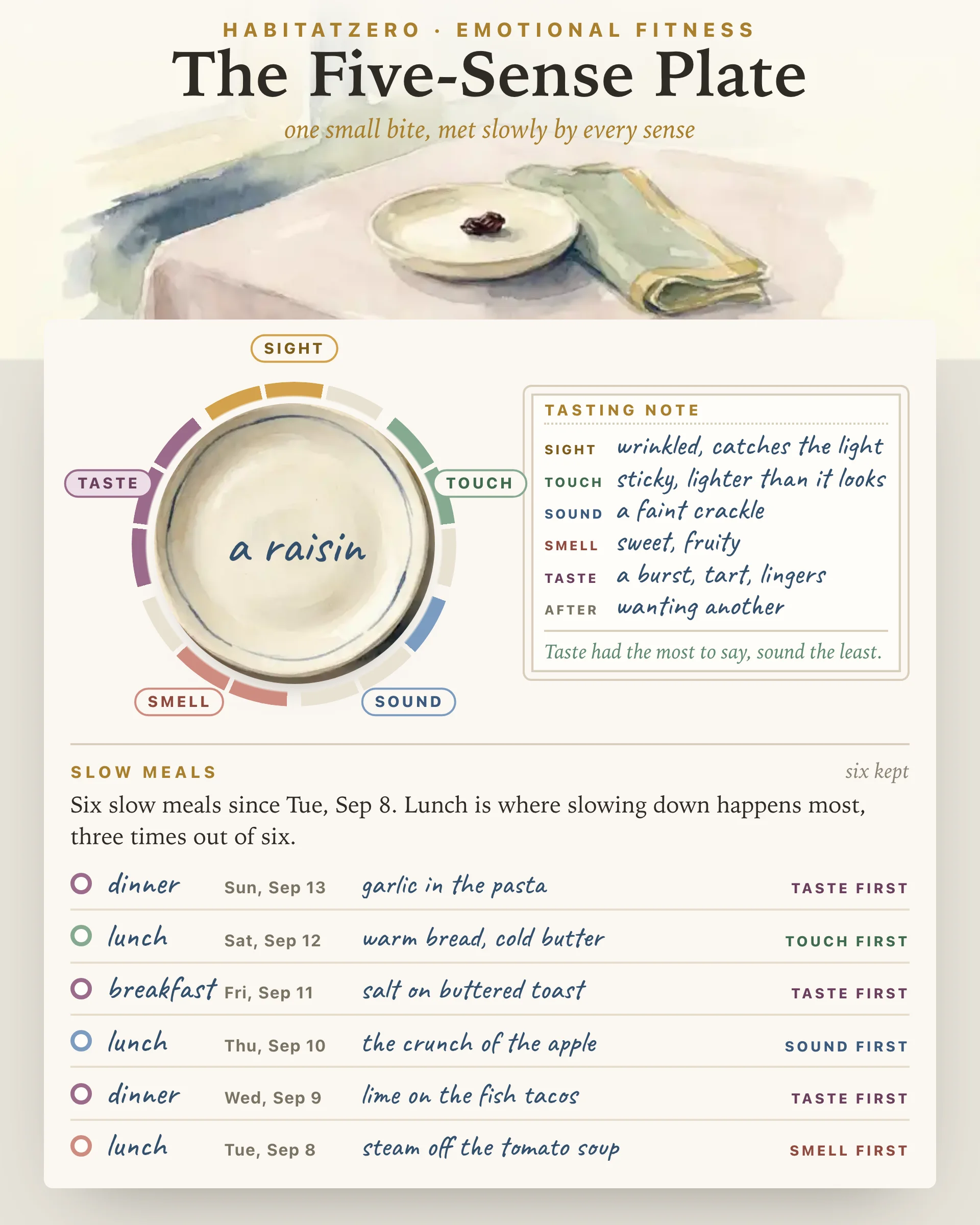
The painted plate holds the bite you choose, and its rim is split into five arcs, one per sense, running clockwise from sight at the top. Each arc has three beads. Tap a word that fits what you noticed, or write your own, and a bead fills with that sense's color, so by the end the rim shows where your attention found the most. Three words per sense is the limit, so each line stays short.
Your words gather into a tasting note in handwriting, and the note reads the rim back to you: which sense had the most to say and which stayed quiet. If sound found nothing at all, the note says so plainly instead of treating silence as a gap.
Below the plate is the part you will use most afterward: a record of slow meals. After a meal you began slowly, tap which meal it was, which sense reached you first and how long the slowness lasted. The record holds fourteen meals and reads them back: when in your day you slow down, which sense tends to arrive first, and how far into a meal your attention stays.
The raisin itself has mostly been studied as a quick lab task. In one experiment with 411 people, those who first ate a raisin mindfully enjoyed the foods they then sampled, anchovies, wasabi peas and prunes, picked because people often dislike them, more than people who ate a raisin the ordinary way or did no task. It did not make people any more willing to try those foods. One study and one sitting make a hint that attention can deepen enjoyment, nothing larger.
Longer programs have more research behind them, much of it on binge eating. A 2025 review of fifty-four studies of mindfulness-based programs, a family that runs from mindful eating courses to dialectical behavior therapy, found medium to large drops in binge eating compared with no psychological treatment. Against other psychological therapies, the difference was close to zero. Mindfulness, in other words, did about as well as other therapies, not better, and one bite on a screen is not therapy at all.
This page makes no promise about weight and treats no food as good or bad. It is practice in paying attention, and all it keeps is what you noticed.
Food-focused exercises do not suit everyone at every stage. If you are in treatment for an eating disorder, ask your care team whether this one fits right now. If eating feels out of control, or thoughts about food and your body start crowding out the rest of your day, talk with a doctor or an eating disorder specialist, or a registered dietitian who works with eating disorders. In the US, the National Alliance for Eating Disorders runs a free helpline at 866-662-1235, staffed on weekdays from 9 a.m. to 7 p.m. Eastern by licensed therapists who specialize in eating disorders. If things ever feel like a crisis, or you find yourself thinking about hurting yourself or ending your life, call or text 988 in the US at any hour, or your local emergency number.
Try the one-bite practice once on an unhurried afternoon. After that it lives in ordinary meals: slow down for the first few bites of one meal a day and note it on the plate. For short practices suited to other moments, open The Mindfulness Tea Chest. If hunger and fullness are what you want to notice, The Hunger and Fullness Scale is built for it, and The Food Journal keeps a fuller record of when, where and how you eat.
It is a short practice of eating with your full attention, usually one small bite taken slowly while you notice how it looks, feels, sounds, smells and tastes. The best known version is the raisin exercise from Mindfulness-Based Stress Reduction, the program Jon Kabat-Zinn developed in 1979.
Hold one raisin as if you had never seen one. Study it, roll it between your fingers, listen to it by your ear, smell it, then rest it on your tongue before one slow bite, and follow the taste until you swallow. When your mind drifts, notice where it went and return to the raisin.
Use any small food you can hold. A grape, an almond, a blueberry, a square of chocolate or an orange segment all work, because the practice is about the quality of your attention rather than the food. The plate also lets you write in a bite of your own.
No. It is a practice in attention: it never counts, limits or labels food, and this page makes no promise about weight. If eating feels out of control, or thoughts about food and your body take over, talk with a doctor or an eating disorder specialist.
The whole practice is written out on this page, and any snack in your kitchen will do for a first try. Filling the plate, keeping your tasting note and logging slow meals start once you personalize it in HabitatZero, at no cost.
By the team behind Fabulous, the science-based self-care app used by over 30 million people.


