The Overwhelm Recovery ProtocolWellness & Routines · ~5 min
About this template · Updated September 2026
The ideas behind this page come from Intuitive Eating, the approach created by dietitians Evelyn Tribole and Elyse Resch. Two of its ten principles are honoring your hunger and feeling your fullness, and a hunger scale is one of the plainest ways to practice both. This worksheet is an independent project: Tribole, Resch and their organization did not make it, review it or endorse it.
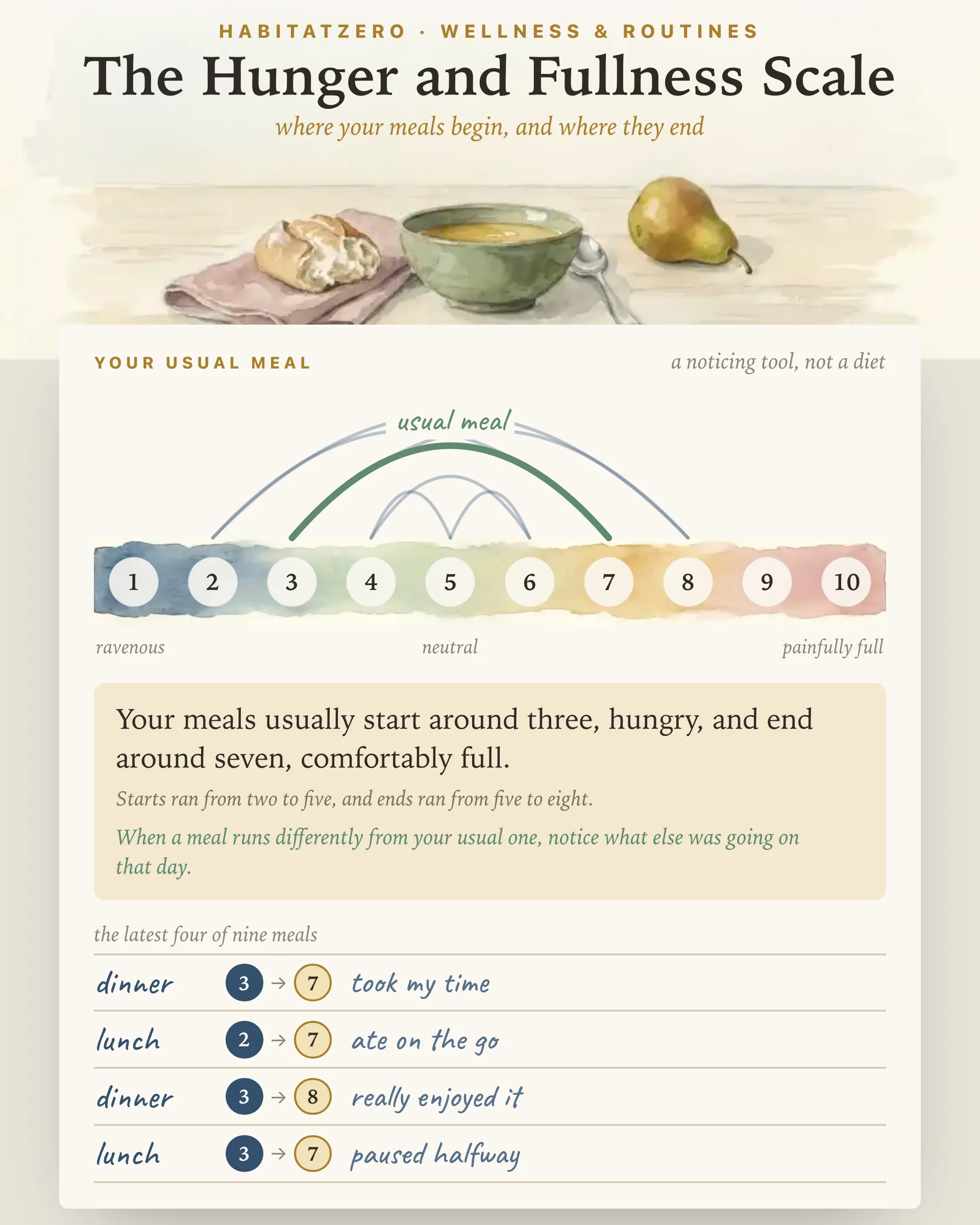
A hunger scale puts a number on something your body reports all day long. On this one, one is ravenous and ten is painfully full, with neutral at five. You check in as you sit down to eat and again when you finish, and after a week or two you can see the shape of your own eating: where your meals usually begin, and where they usually end.
Many hunger scale handouts set target zones, such as begin at three or four and stop by six or seven. This page leaves those out on purpose. There is no correct number here, and nothing on the page tells you when to put the fork down. The job is to notice, and to get curious about the meals that run differently. The one exception is hunger that lingers after a meal, which is a signal worth answering, and the reading points it out when your meals keep ending there.
Treat these words as a starting point. Your three may feel like someone else's four, and that is fine, because the only comparison this page makes is you against you.
Before you eat, tap the stop that matches how you feel. The page holds that mark while you eat. Afterward, tap where you landed, choose breakfast, lunch, dinner or snack if you like, add a few words (took my time, ate on the go), and put it on the scale. Each meal becomes an arc from its before to its after: a meal that started very hungry and ended stuffed draws a tall arc across most of the scale, and a small snack makes a little hop.
Once three meals are on the scale, a green arc marks your usual meal, joining the middle of your starting points to the middle of your ending points, and a sentence spells it out with a note on what to notice next. The card holds fourteen meals, roughly five days of three a day. When it is full, remove one or clear the card and begin again.
Appetite researchers routinely rate hunger and fullness by marking a point on a line. A review of those line scales found that they are consistent within the same person, that they predict when people start eating, and that they work best for comparing someone's ratings with their own under different conditions. The same review found they track with how much people eat but cannot stand in for it, which is one more reason not to turn any number into a portion rule.
A meta-analysis of ninety-seven studies found that people who score higher on intuitive eating report fewer disordered eating symptoms, a kinder body image and more well-being. Nearly nine in ten of those studies measured people at a single point in time, so they show a link rather than cause and effect, and none tested a hunger scale on its own.
Try it for a week or two when meals have started to feel rushed, skipped or automatic, or after a long stretch of eating by someone else's rules. If your meals keep starting at the very hungry end because the day gets away from you, planning the week's dinners in the Meal Planner can put the next meal in place before hunger gets loud. If a pull toward food feels more like a feeling than an empty stomach, The Emotions Body Map is a gentle place to find where that feeling sits.
If you are being treated for an eating disorder, ask your care team whether a scale like this fits the stage you are in; some teams start with a set meal plan and bring hunger cues back later. In the US, the National Alliance for Eating Disorders helpline (866-662-1235) is answered by licensed therapists on weekdays from 9 a.m. to 7 p.m. Eastern, and ANAD's helpline (888-375-7767) is open weekdays from 9 a.m. to 9 p.m. Central. And if a hard day ever turns into thoughts of hurting yourself, 988 takes calls and texts in the US around the clock; anywhere else, use your local emergency number.
It is a simple rating, usually from one to ten, of how physically hungry or full you feel, running from ravenous at one through neutral at five to painfully full at ten. You may also see it called a hunger-fullness or hunger satiety scale, and it is a common way to practice intuitive eating, the approach developed by dietitians Evelyn Tribole and Elyse Resch.
Pause before a meal and pick the number that fits, then do the same once you finish. Over a week or two the pairs show where your meals tend to begin and end, and which situations, such as working through lunch or eating on the go, move those numbers.
Many handouts name a target, such as starting at three or four. This page deliberately leaves targets out, because the same number can feel different from one person to the next and from one day to the next. Read the scale as information about you rather than a rule, and if hunger is still there after a meal, treat it as a signal worth answering.
Both versions are in use. The Veterans Affairs nutrition handout runs from zero, painfully hungry, to ten, painfully full, while one-to-ten versions such as this one begin at ravenous. Neutral sits at five in both, and the practice is the same either way.
It can be, but it is not the right tool for everyone at every stage. After long stretches of restriction, hunger and fullness cues can be hard to read, so many care teams start with a regular meal plan instead. Ask your own clinician first. In the US, the National Alliance for Eating Disorders (866-662-1235) and ANAD (888-375-7767) run free weekday helplines.
By the team behind Fabulous, the science-based self-care app used by over 30 million people.