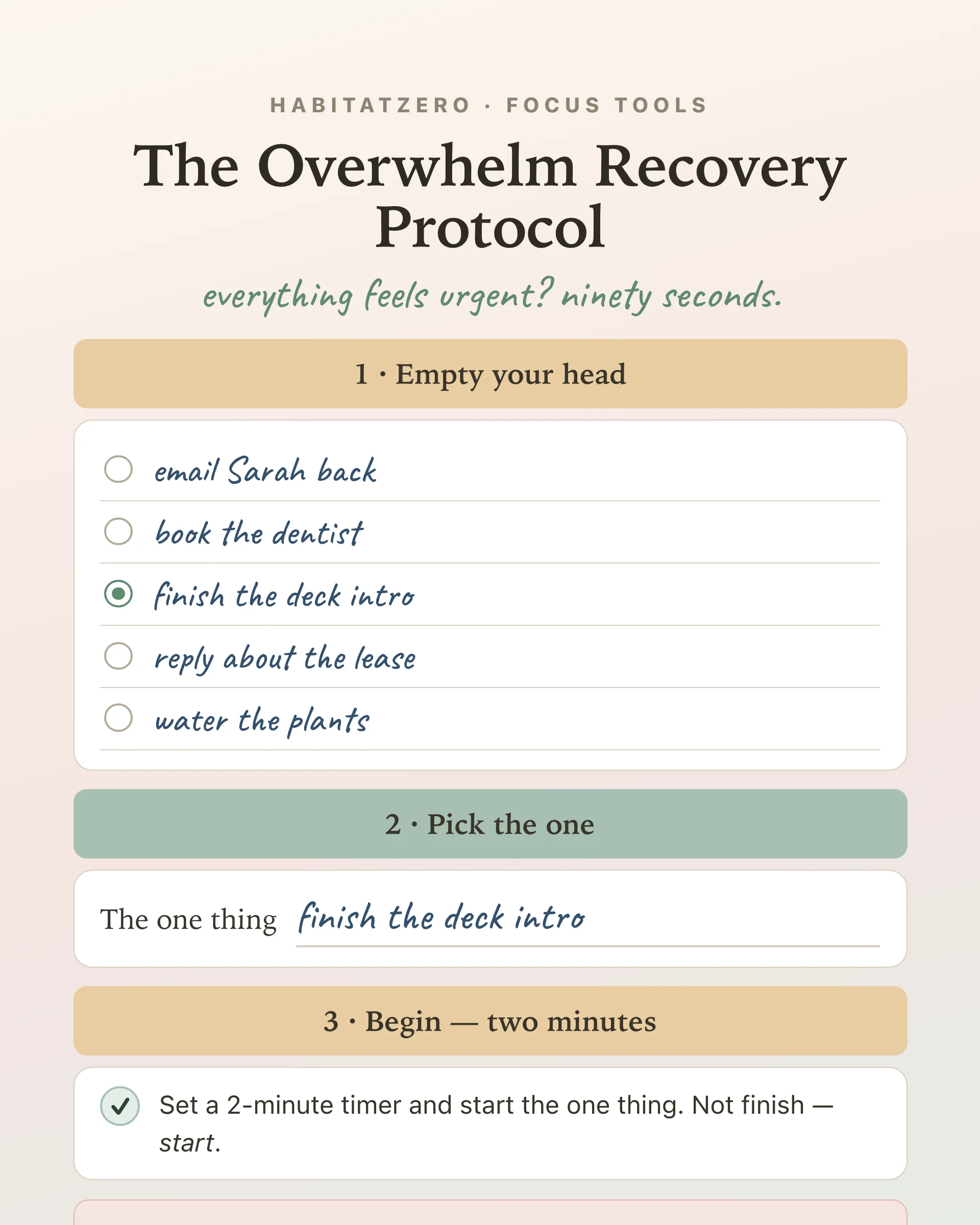
The Overwhelm Recovery ProtocolWellness & Routines · ~5 min
About this template · Updated September 2026
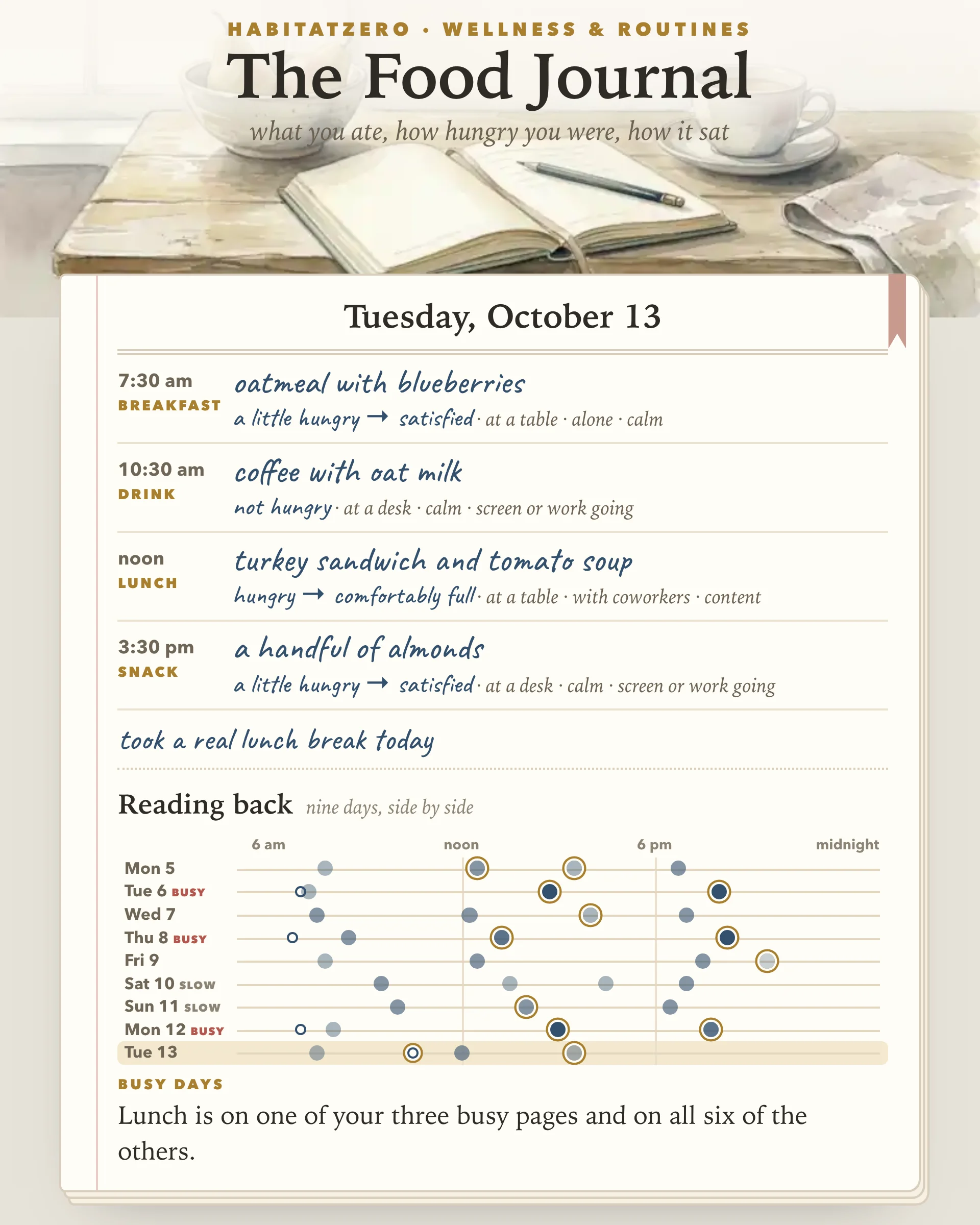
A food journal is a record of what you ate and when. Kept for a week or two, it can also show you things no single meal will: the lunch that vanishes whenever the day fills up, the evenings you reach dinner ravenous, the snacks that happen at the desk while an inbox scrolls past. This page is built for that kind of noticing. It asks about hunger, fullness, setting and mood, and it leaves out calories, portions and any verdict about food.
Each entry starts with a tap on breakfast, lunch, dinner, snack or drink. A slider sets the time, and a short line in your own words says what it was. Then come the details that explain a meal instead of just listing it:
Only the food itself is required; a time and three words still count, and the rest can wait. At the foot of each page you can call the day ordinary, busy, slow or away, and add one line of context, like a late meeting or a long drive.
A page holds eight entries, and the journal holds fourteen pages, which is two weeks of days. When it is full, it asks you to tear out the oldest page first instead of quietly dropping your writing.
Each page sums itself up underneath: how many entries, the span from first to last, and the longest gap between meals and snacks. From the third day with entries, a chart lines up your pages from early morning to midnight, with deeper dots for the meals you started hungrier.
Below the chart the journal writes a few plain observations, always as counts from your own pages. It might note that four of your six very hungry starts came after five hours or more without a meal or snack, or that lunch appears on one of your three busy pages and on every other page. It never tells you what a pattern says about you, and it never calls a meal good or bad.
Any page prints as a daily sheet: your entries in place, ruled lines for the rest of the day, and a key to the hunger and fullness words, so it works just as well with a pen. Save as PDF in the print dialog keeps a copy as a file.
The case for noticing is stronger than the case for counting. A meta-analysis of twenty-four experiments found that people who ate while distracted ate somewhat more at that meal and more again at the next, while sharpening the memory of a meal worked the other way. Those were short lab studies that say little about any one person's week, but they are why this journal asks about screens and work.
Eating in response to hunger and fullness cues has its own research under the name intuitive eating. A meta-analysis of ninety-seven studies found that it went along with fewer signs of disordered eating and with better body image, self-esteem and wellbeing. Most of those studies took a single snapshot in time, so they cannot say which came first.
Counting calories is a different matter. In a survey of nearly five hundred college students, those who used calorie trackers reported more eating concern and dietary restraint, and the authors suggested the tools may do more harm than good for some people. That finding is correlational, but it is enough to keep number fields off this page entirely.
Two weeks of pages is a small sample, so treat a pattern as a question, not a conclusion. The journal cannot tell you what to eat or whether something is wrong; a doctor or a registered dietitian can, and your pages give them something concrete to look at.
A food journal is there to answer a question you have, not to become one more thing to get right. If food, eating or weight feels hard to think about, or keeping this journal starts to feel like pressure, stop and talk with a doctor or a registered dietitian. In the US, the National Alliance for Eating Disorders runs a free helpline staffed by licensed therapists at 866-662-1235, which also answers the number NEDA's helpline used before it closed, and ANAD offers another at 888-375-7767. Both answer on weekdays and neither is a crisis line, so if you ever find yourself thinking about harming yourself, call or text 988 at any hour, or your local emergency number.
If busy days keep swallowing lunch, it can help to settle meals before the week starts; the Printable Meal Planner puts a week of dinners and the grocery list on one sheet. Drinks can live in this journal, but if water is the real question, the Water Tracker stamps cups against a line you choose, and the Hydration Calculator helps you pick that line.
Start with what you ate and when. Adding how hungry you were going in, how full you felt afterward, where you ate, who was with you and your mood is what turns a list of meals into something you can learn from. Here each of those is a tap, so an entry is mostly taps plus a few words about the food.
Yes. Once you personalize the journal, the print button turns the open day into a daily sheet with your entries in place, blank ruled lines for the rest of the day and the hunger and fullness words as a key along the bottom. If you would rather keep a PDF than a sheet of paper, the print dialog can save one.
Because the aim is to notice timing, hunger and setting, not to score food. Studies of calorie-tracking apps have tied them to more eating concerns in some people, so this page has no number fields and never labels a food good or bad. If a medical condition calls for nutrition targets, set them with a registered dietitian.
Two weeks is plenty for a first look, which is why this journal holds fourteen pages and starts reading them back once three days have entries. Carry on past that only while it keeps telling you something new; the point is noticing, not a flawless record.
This page shows a sample journal filled in over nine days. Personalize it in HabitatZero, at no cost, to get your own pages, which keep your entries, the reading back and the print button between visits.
By the team behind Fabulous, the science-based self-care app used by over 30 million people.