The Overwhelm Recovery ProtocolWellness & Routines · ~5 min
About this template · Updated September 2026
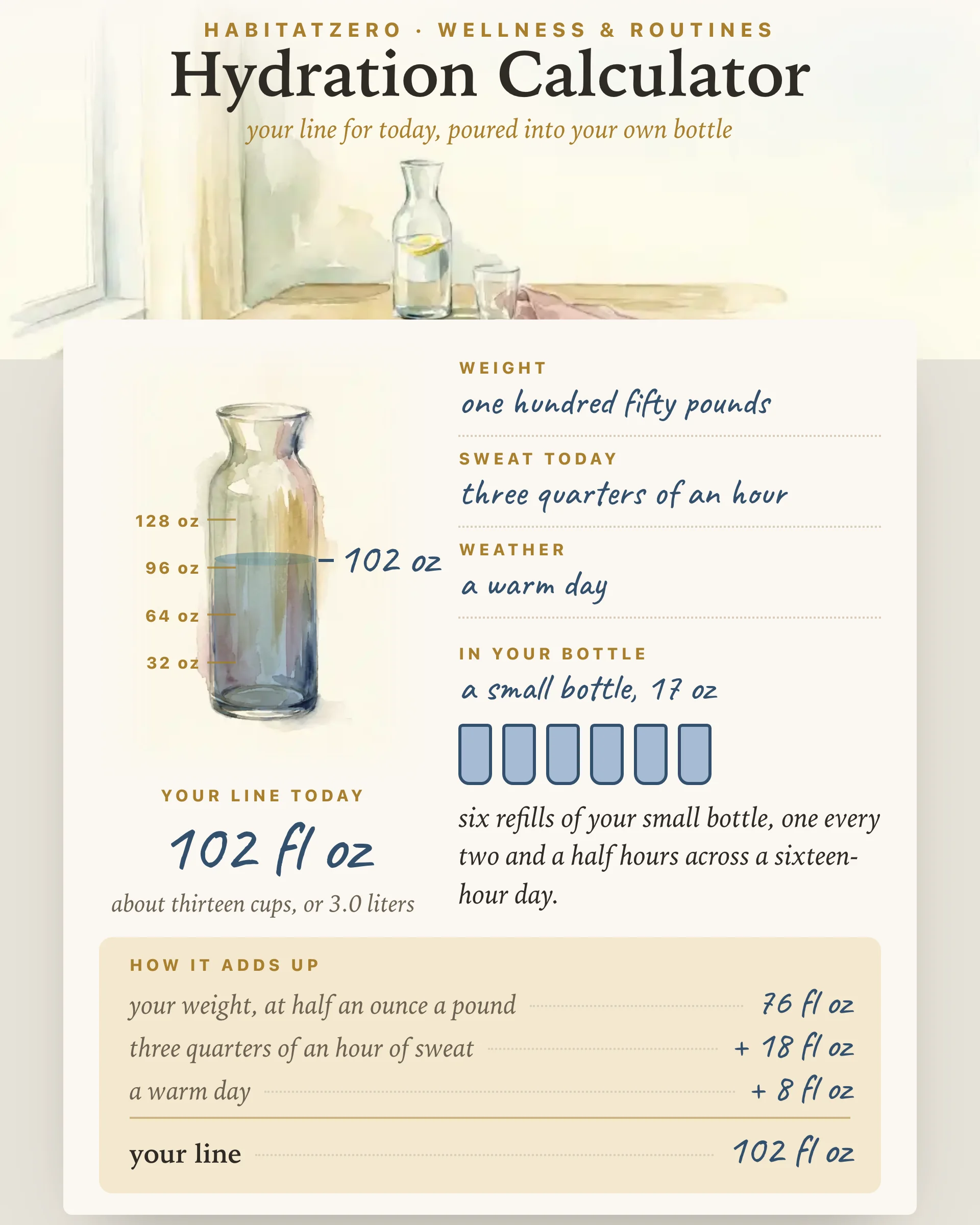
Most hydration calculators ask for your weight, ask whether you exercise, and hand back a number with far more confidence than the evidence behind it deserves. This one does the same sum, but it shows its working, tells you which parts are reference values and which are rules of thumb, and then does the one thing a bare number never does: it pours the result into the bottle you actually carry.
The base is thirty-three milliliters of drink for every kilogram you weigh. That figure was chosen because of where it lands. The European Food Safety Authority's reference values for water put total intake at about two liters a day for women and two and a half for men, with food supplying roughly a fifth of it. The US National Academies set their adequate intakes for water higher, at 2.7 and 3.7 liters. For a seventy-kilogram adult, thirty-three milliliters per kilogram gives 2.3 liters to drink, which sits between the two. If you grew up with the American rule of half your body weight in ounces, that is the same arithmetic in different units.
Sweat is the second line. The page adds twelve milliliters for every minute you move hard enough to sweat, about a small bottle every forty minutes. That is deliberately at the low end: the American College of Sports Medicine's position stand on exercise and fluid replacement reports sweat rates from half a liter to two liters an hour depending on the person, the pace and the heat, and recommends drinking enough to keep body-mass loss under about two percent rather than chasing a fixed volume. A slider cannot know your sweat rate. For long or hot sessions, the honest method is to weigh yourself before and after.
Weather adds a quarter liter for a warm day and half a liter for a hot or humid one. These are round adjustments, not measured ones, and the receipt labels them as such. Pregnancy and breastfeeding add three hundred and seven hundred milliliters, the increments EFSA gives in the same opinion.
The object on the page is a graduated carafe. Slide your weight and it fills to the base line; slide today's sweat and the water climbs; tap the weather and it climbs again. A handwritten label rides the surface, and marks up the side keep the scale honest whether you are reading liters or ounces.
Under the carafe, a receipt lists each addition with its amount and draws a rule under the total. That receipt is the point of the page. A number you can audit is a number you can argue with, and a number you can argue with is one you can adjust when your day does not match the sliders.
Then comes the translation. Choose the vessel you drink from, a glass, a mug or one of three bottle sizes, and the line becomes a row of small glasses: so many full, the last one part-filled, with a pace across a sixteen-hour day. Two and a half liters is abstract. Five refills of the bottle on your desk, one every three hours, is a plan. The status line closes the loop by telling you what to set as today's line on the Water Tracker, which is where the drinking gets counted.
Reference values are not prescriptions. Both the European and American figures describe what healthy people in those populations tend to take in, and both say that for most healthy adults thirst does a reasonable job of steering intake day to day. The eight-glasses rule has no comparable source behind it. So the line here is somewhere to aim on a day when you have been forgetting to drink, not a floor below which harm begins.
Everything you drink counts, coffee and tea included, and food carries about a fifth of the day's water on its own. Meeting the line with plain water is fine; meeting it with soup, fruit and a flat white is also fine.
More is not better. Past about five liters the page says so out loud and stops trusting its own arithmetic, because the ACSM document is clear that drinking far beyond sweat losses during long exercise can dilute blood sodium to dangerous levels. And if a clinician has limited your fluids for a heart, kidney or other condition, their number replaces every number on this page.
Run it once to find your ordinary line, then return on the mornings that differ: a long run, a heatwave, a day of walking a city, the first weeks of breastfeeding. It takes a minute, and the settings keep, so the second visit is two taps. If the trouble is not knowing the number but remembering to drink, pair the line with the Daily Habit Tracker or hang the first glass on something you already do each morning with the Morning Routine Checklist. The calculator sets the line; the habit is what gets you to it.
There is no single figure that fits everyone, which is why this calculator starts from your weight rather than a slogan. European reference values put total water at around two liters a day for women and two and a half for men, with roughly a fifth of that arriving in food; the American reference values run higher, at 2.7 and 3.7 liters. Thirty-three milliliters per kilogram of body weight lands between the two for an average adult, and sweat, heat and pregnancy move it from there.
It is the same arithmetic as thirty-three milliliters per kilogram, so this page quietly uses it too. Its weakness is not the number but the silence about everything else: an hour of sweat can add a fifth of a liter or more, a hot day adds again, and nobody needs that much on a cool desk day when they are not thirsty. Treat it as a starting line rather than a rule.
Yes. The reference values behind this calculator count every drink, caffeinated ones included, and note that food typically supplies about a fifth of a day's water. The line the carafe shows is meant to be met with whatever you actually drink, not with plain water alone.
You can, mostly during long, hot exercise when someone drinks well beyond what they are sweating out; the sports medicine position on fluid replacement warns that this dilutes blood sodium and can be dangerous. That is why the sheet stops trusting its own arithmetic past about five liters and suggests weighing yourself before and after long efforts instead. If a doctor has limited your fluids for a heart or kidney condition, their number replaces this one.
The public page shows a worked example you can read but not change. Sliding your own weight, choosing your bottle and keeping the settings for tomorrow happens in HabitatZero, where the calculator sits next to the water tracker that carries the line. Both are free.
By the team behind Fabulous, the science-based self-care app used by over 30 million people.