
Leaves on a StreamEmotional Fitness · ~3 min
About this template · Updated September 2026
Mindful coloring is coloring with your attention on the coloring itself. You watch the pencil meet the edge of a shape, you feel the breath going in and out, and when your mind wanders off to the email you have not answered, you notice where it went and come back to the next shape. The finished picture is almost beside the point. What you are practicing is a soft, steady kind of attention that is hard to hold with nothing in your hands.
This page is a small coloring book made for that practice. It holds four original line drawings, drawn for this book rather than traced from anywhere: a petal mandala, a star mandala, a fern, and a moonrise over the hills. Color them on screen, or print one blank and use real pencils.
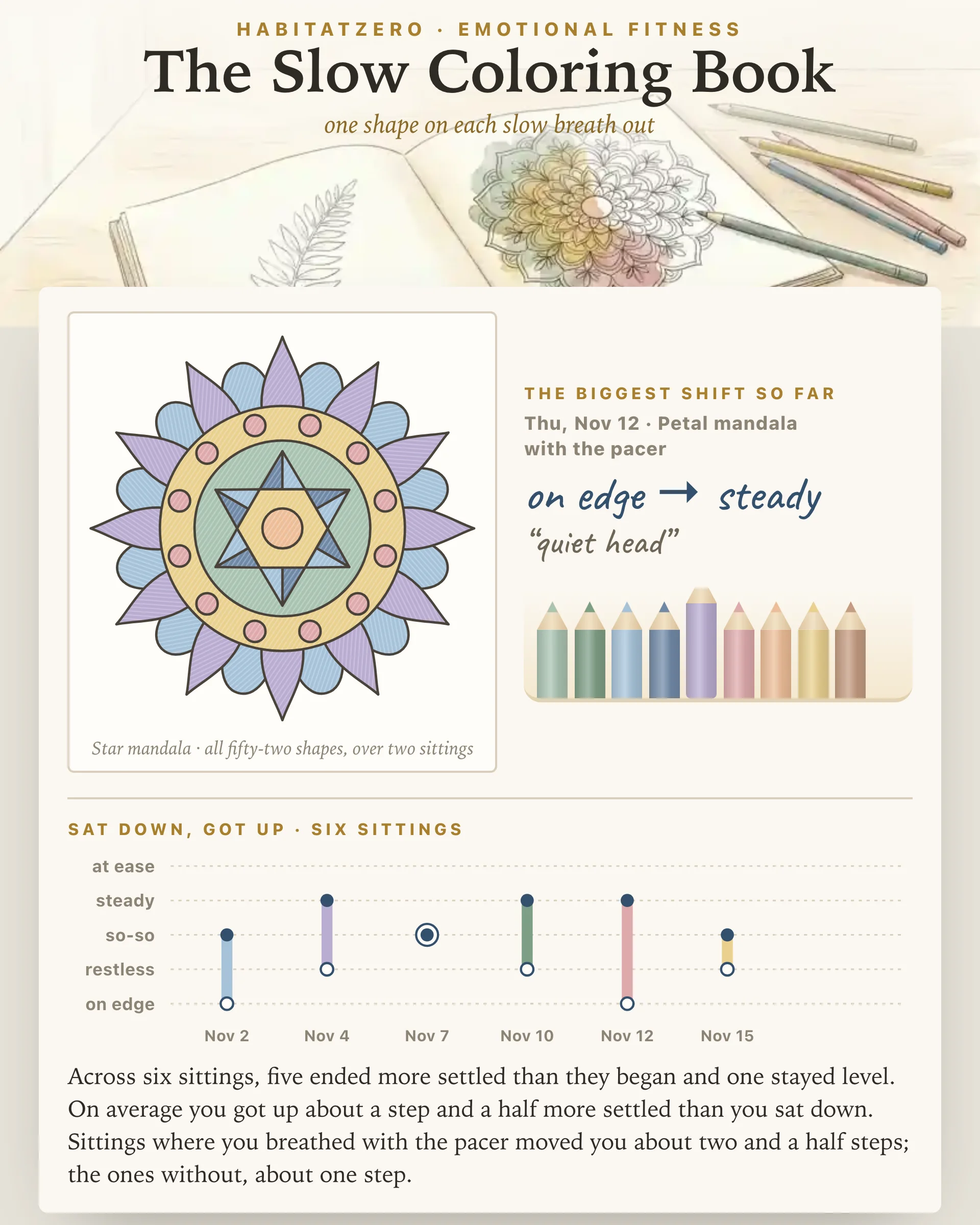
Start at the top of the page by tapping how you feel as you sit down, on a scale that runs from on edge to at ease. Then take one of nine muted pencils from the tray and tap a shape to color it. Tapping a shape with the color it already has changes nothing, and the eraser at the end of the tray turns a shape back to paper. Each page keeps its colors between sittings, so a mandala can take you a week.
The breath is what makes the coloring mindful. Breathe in while you choose the next shape, and breathe out while you color it. If your pace keeps drifting, the pacer will lead five rounds of breathing in for four seconds and out for six, which works out to six breaths a minute.
When you are ready to stop, tap how you feel as you get up, add a few words if something stood out, and close the book. If you pick the pencil up again after marking how you feel, that mark clears, because you have not really gotten up yet.
Each closed sitting becomes a pencil stroke on the strip under the page, drawn in the color you used most. The stroke starts at how you sat down and ends at how you got up, so a stroke that climbs means you left more settled than you came. After a few sittings, the reading beneath the strip tells you how many ended more settled and by how much on average. Once there is enough to compare, it also says whether one of the drawings, or the pacer, tends to move you further.
That record is the point of the page, because the research on coloring describes groups of students, not you. Your own strip is the best evidence you will get about whether coloring helps you, on which pages, and on what kind of day.
The best-known study is small. Curry and Kasser gave 84 undergraduates a brief task meant to make them anxious, then asked them to color a mandala, a plaid form or a blank sheet of paper. Anxiety dropped about as much with the plaid as with the mandala, and both dropped more than with the blank page. The authors suggested that coloring a reasonably complex, orderly pattern may bring on something close to a meditative state.
A replication by van der Vennet and Serice found that the mandala did better than both the plaid and the blank page. And in a week-long trial with 104 female university students, daily coloring lowered anxiety and depressive symptoms, while a week of daily logic puzzles did not.
Not every result points the same way. In the first of two experiments by Mantzios and Giannou, coloring a mandala changed neither anxiety nor mindfulness compared with free drawing. In the second, students whose coloring was led by a guide using instructions borrowed from breathing meditation grew less anxious than students who colored on their own. That finding is why this book pairs every shape with a breath.
Put plainly: coloring a detailed design can calm you down for a while, especially with some guidance, in the kind of young adults these studies recruited. None of this work tested coloring as a treatment for an anxiety disorder, and a mandala is not magic. The shape seems to matter less than the structure and the attention you bring to it.
Open the book when your mind is busy and your hands are free: the evening after a long day, the quarter hour before something you are dreading, or a waiting room with a printed page and a few pencils in your bag. If the tension lives in your body more than in your head, Resonance Breathing works at the same slow pace without the pencils. If you would rather make marks of your own than fill someone else's shapes, try Expressive Art Prompts. For something quicker in the middle of a spike, 5-4-3-2-1 Grounding walks your senses back to the room in about three minutes.
If worry or panic keeps returning, lasts for weeks, or gets in the way of work, sleep or the people close to you, talk with a doctor or a therapist. A coloring book can sit beside that kind of care, but it cannot stand in for it.
They are coloring pages used as a short attention practice. You keep your mind on the pencil, the edge of the shape and your breathing, and each time it drifts off you bring it back to the next shape. The picture matters less than the noticing.
Some small studies, mostly with college students, found that coloring a mandala after a stressful task calmed people more than coloring a blank page. A careful pair of experiments found no change from coloring on its own, and a bigger drop in anxiety once a guide added breath-focused instructions. Treat it as a way to settle for a while, not as a treatment for an anxiety disorder.
Curry and Kasser, who ran the best-known study, suggested that coloring a reasonably complex, orderly pattern can bring on a meditative kind of focus. In their study a plaid pattern calmed people about as well as the mandala, so the structure seems to matter more than the circle.
Yes. Print this page blank gives you the current drawing as clean line art, with the two feeling rows as words you can circle by hand. Print it as colored keeps your colors and adds your strip of sittings on a second sheet.
You can page through the sample coloring book above without an account. To color the four drawings yourself, keep your sittings and grow a strip of your own, personalize it in HabitatZero at no cost.
By the team behind Fabulous, the science-based self-care app used by over 30 million people.


