The Overwhelm Recovery ProtocolWellness & Routines · ~5 min
About this template · Updated September 2026
The first question a medication log answers is a small one: did I take it? It is nine at night, the bottle is on the counter, and you cannot say whether this evening's tablet went down or whether you are remembering yesterday's. Guessing wrong one way means a missed dose; guessing wrong the other way means a second one. A log settles it at a glance.
The second question only shows up once a week of marks sits side by side: which doses slip, and when? Misses are rarely spread evenly. They gather around one hour, one kind of evening, one stretch of the week, and this page makes that visible.
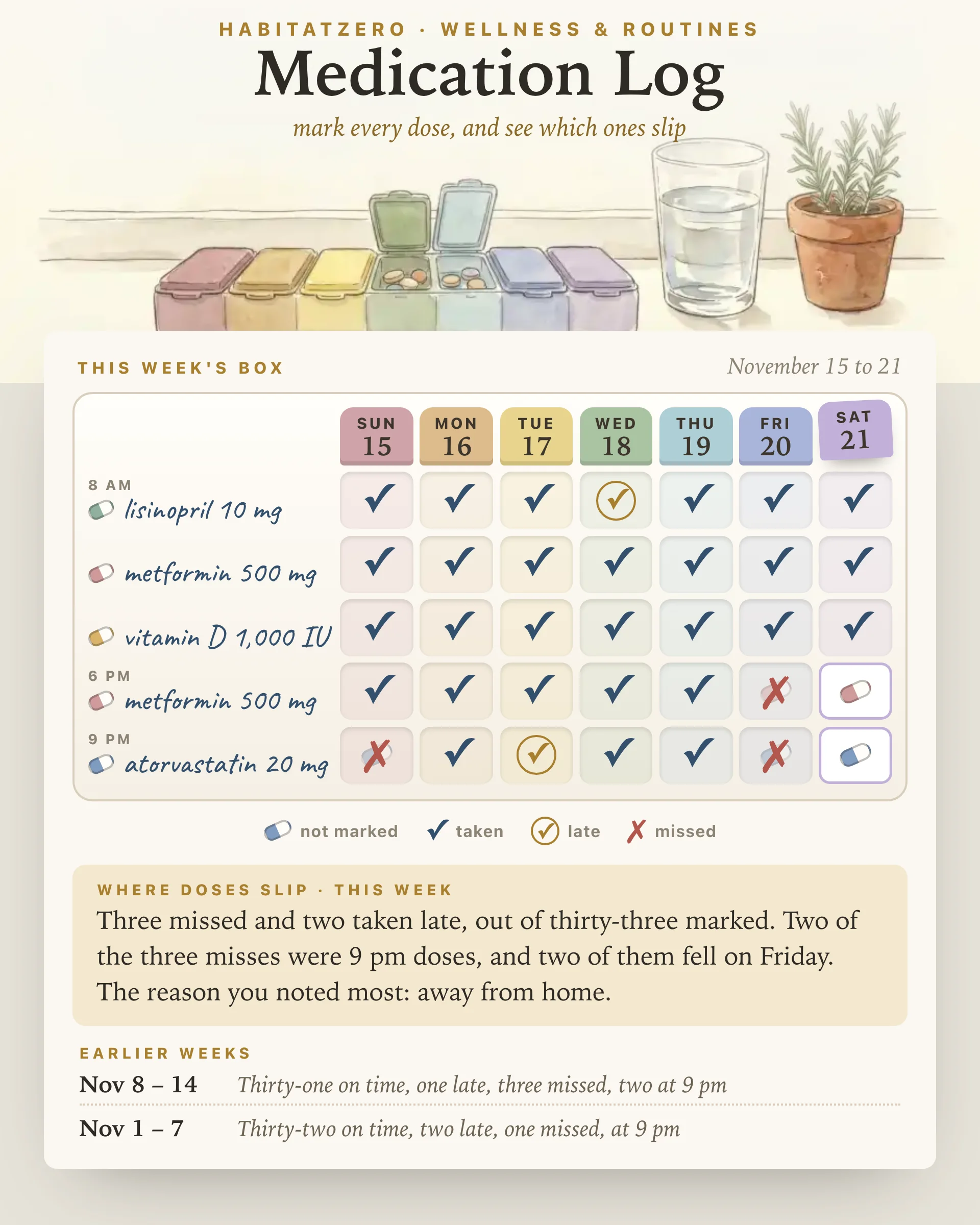
The log is laid out like the weekly pill box it is named after: seven colored lids across the top, Sunday to Saturday, and a row of compartments for every scheduled dose.
Start by putting each medicine in the box: type the name and strength as the label prints them, then tap the times you take it. The box holds eight medicines and twelve doses a day, with four times per medicine at most, and it says so when a new line would not fit.
Today's lid opens by itself, and the open day below the box lists its doses with three buttons each: taken, late, missed. Pills swallowed together at one hour can be marked with a single tap. A late or missed mark offers six optional reasons, from forgot to side effects.
In the compartments, a small capsule waits until the dose is marked. A check replaces it, a gold ring means it came late, and a red cross leaves the capsule where it was, like an untouched pill. The reading below names the hour and the day that hold most of the misses, then lists every late or missed dose so each number can be checked against the grid.
When Saturday is behind you, start a fresh box. The finished week folds into one line under Earlier weeks, which keeps the last eight.
Missed doses are common, and they come in patterns. A study that pooled electronically recorded dosing histories from 4,783 people taking once-a-day blood pressure medicine found that people still on their treatment skipped about one scheduled dose in ten on any given day. Of those gaps, 42 percent were a single day's dose, and 43 percent belonged to a run of three or more days in a row.
The number of doses in a day matters as well. A review of 76 studies that counted doses with electronic monitors found that taking the prescribed number of doses fell as schedules got busier: about 79 percent on once-daily regimens against 51 percent on four-times-daily ones.
Those figures are averages from research with electronic monitors, which log each dose whether or not anyone remembers it. A hand-kept log is only as complete as your marks, and neither study tested a log like this one. What the research does support is the premise here: doses slip in clusters, and a cluster is easier to see on a grid than to remember.
It will not tell you what to do about a missed dose, because the right answer belongs to the medicine. MedlinePlus answers the forgotten-dose question drug by drug, and the instructions differ: the page for the blood thinner warfarin, for instance, asks you to call your doctor about any missed dose and never to take a double dose the next day to catch up, while other medicines come with different rules. Read the information sheet from the pharmacy, or ask your pharmacist or doctor, and never double up on your own. If a dose went in twice, or the wrong medicine did, the same MedlinePlus page lists the poison control helpline, 1-800-222-1222, and 911 for anyone who collapses or cannot breathe.
Among the questions the National Institute on Aging suggests asking your pharmacist before a new medicine starts is this one: if I forget to take my medicine, what should I do?
A week of marks gives your pharmacist or doctor something specific to work with. "The nine o'clock dose slips on nights I am out" is a far better starting point than "I sometimes forget." What the gaps mean, and whether anything about the schedule should change, are their calls, not the log's.
The same NIA guidance notes that some people use meals or bedtime as reminders, and others lean on charts, calendars or weekly pill boxes. If one hour keeps slipping, the Habit Loop Worksheet can help tie that dose to something you already do. If you keep this log for a parent or partner, the Caregiver Burnout Quiz is worth ten minutes of your own. And if your care team also asks for readings, the Blood Sugar Log sits well beside this one.
Start a box when a new medicine begins, when a schedule grows to several doses a day, after a hospital stay changes what you take, or in the weeks before an appointment. Mark each dose as it goes down, not at the end of the day, and bring the week with you when you go.
The name and strength of each medicine, the times it is scheduled, and one mark per dose saying whether it was taken, taken late or missed. A word on why a dose slipped makes the record far more useful to whoever reads it with you.
It depends on the medicine, so read the information sheet that came with it or call your pharmacist or doctor. Never double up on your own to make up for the dose you missed.
No. A list records what you take and why, while a log records whether each scheduled dose actually went down. Many people who juggle several medicines keep both: the list for appointments, the log for ordinary days.
Yes. Printing drops the buttons and keeps the week grid, the reading with its list of late and missed doses, and your earlier weeks, so a caregiver or clinician can follow it on paper.
This page shows a filled-in sample week. To keep your own box from one week to the next, open it in HabitatZero, which costs nothing.
By the team behind Fabulous, the science-based self-care app used by over 30 million people.