The Overwhelm Recovery ProtocolWellness & Routines · ~5 min
About this template · Updated September 2026
This card borrows its structure from two public sources. The Agency for Healthcare Research and Quality's step-by-step guide to building a My Medicines List supplies the three piles and the morning-to-bedtime columns, and the FDA's consumer update on how to create and keep a medication list sets out what each line should hold. The worksheet itself is independent: neither agency made it, reviewed it or vouches for it.
Someone will ask what you take at the pharmacy counter, at every new appointment, and in the ambulance if a day goes badly. Answering from memory, while tired or in pain, is exactly when names and doses slip. A systematic review of 22 studies examined the medication histories taken when people were admitted to hospital and found errors in up to 67 percent of them; between 10 and 61 percent of patients had at least one medicine missing altogether (Tam and colleagues, 2005). The authors named closer teamwork between patients, physicians and pharmacists as one way to bring those numbers down. A card in your wallet is your half of that teamwork.
The FDA adds two practical points. A written list speaks for you when you cannot, which helps paramedics and hospital staff decide what to keep giving you. And it bridges clinics, labs and pharmacies whose record systems do not talk to each other.
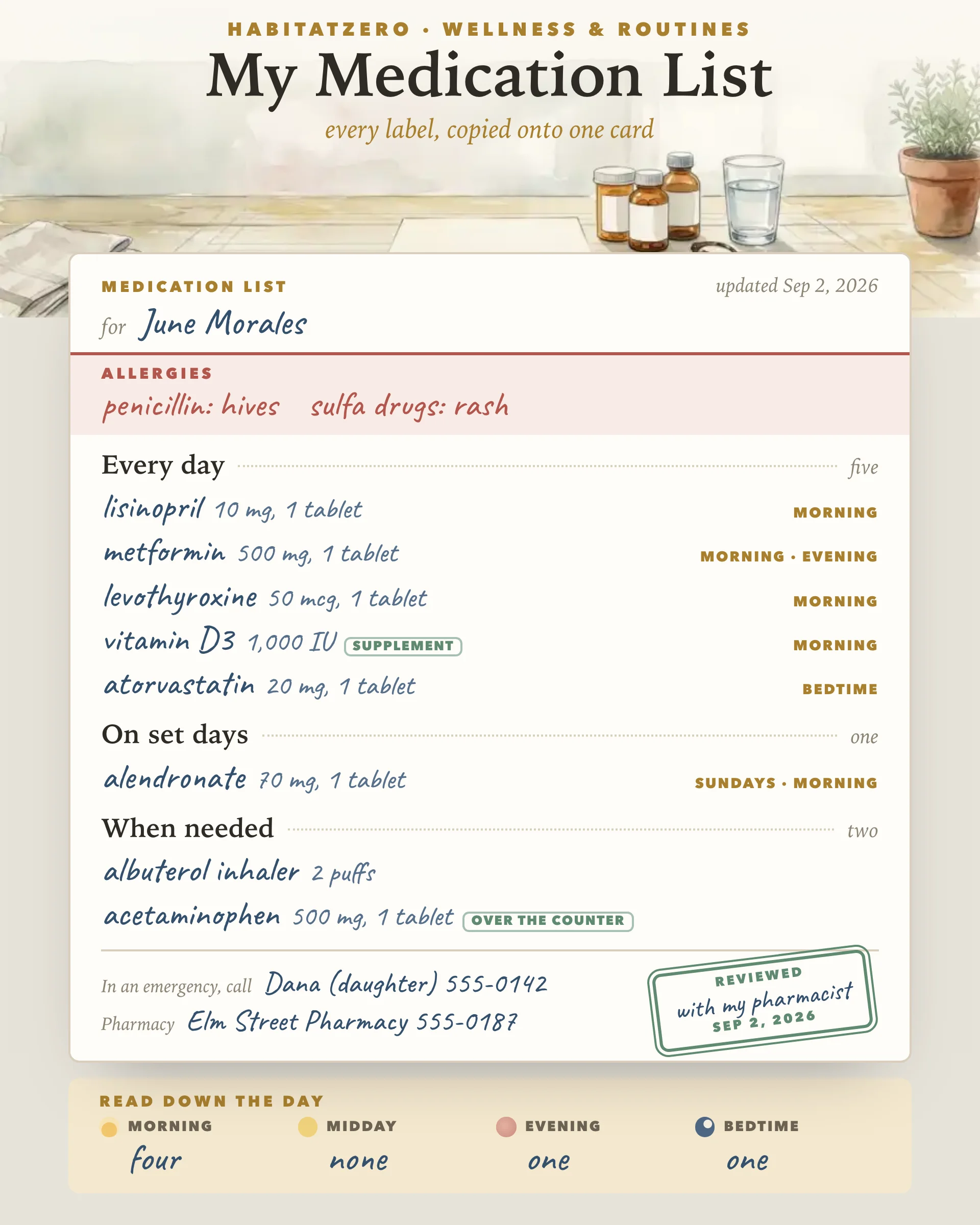
Start at the top with allergies and what happened: penicillin, hives. If you have none, say so with the no known drug allergies line, because a blank band leaves a nurse guessing. Your name, an emergency contact and your pharmacy sit up there too.
Then copy one label at a time:
Over-the-counter medicines, vitamins and supplements belong here as well. The FDA's list of what to include names them alongside prescriptions, and it warns that some combinations with other drugs, foods or supplements can blunt a treatment or make it too strong. Tag each one as over the counter or a supplement so it stands out.
The card opens on the allergy band, with common drug allergies a tap away. Below it, the label slip asks for a name first, then unfolds the rest: how often, the time of day, what it treats, the prescriber and the month you started. Press write it on the card and the line joins its pile in handwriting.
Tap any line to change it. When a doctor ends a medicine, stopped taking it moves the line to a short stopped list with the month, since the next clinician may ask what you came off and when. Removing a line takes two taps, so a stray finger cannot erase one. The card holds sixteen lines, about what fits on one printed chart.
Under the card, read down the day turns your lines into a daily schedule: what you take in the morning, at midday, in the evening and at bedtime, plus the ones that keep their own days or wait until needed. AHRQ builds the same view on paper with columns.
After you go over the card with your pharmacist or doctor, stamp the date in the last box. Change a line later and the stamp fades, with a note to show the new lines at your next visit. Printed, the card becomes a fridge chart with a column for each time of day, plus a wallet-size copy to keep beside your insurance card, where the FDA suggests carrying one.
It will not tell you what dose to take, flag an interaction, or judge whether a combination is safe. It records what your labels and prescribers say, and nothing more. Questions belong with your pharmacist, who can look over the whole card at once. If you think someone took the wrong medicine or too much, call Poison Help at 1-800-222-1222, or 911 if they collapse or cannot breathe.
Fill it in with the bottles in front of you, then bring it to every appointment, pharmacy pickup, hospital stay and trip away from home. Update it the day something starts, stops or changes, print a fresh copy, and throw out the old one. If you look after a parent's medicines, give them a card of their own.
The card pairs well with the logs a doctor reads. If you check your glucose at home, the Blood Sugar Log keeps readings in the columns a clinic expects. If a new prescription seems to be changing your nights, a Sleep Log gives your doctor more than a hunch. And if managing someone else's medicines is wearing you down, the Caregiver Burnout Quiz is a quiet place to take stock.
For each medicine: the name as printed, the strength and amount, when and how often you take it, what it is for, who prescribed it and roughly when you started. At the top go your allergies with the reaction, an emergency contact and the date of the last update.
Yes. The FDA names vitamins and supplements next to prescription and nonprescription medicines in its advice on keeping a list, since some combinations can weaken a treatment or make it too strong. Tag each one as a supplement so a pharmacist spots it quickly.
Whenever a medicine starts, stops or changes dose, rather than on a calendar. This card puts a fresh date on itself whenever a medicine or allergy changes, and its review stamp fades once the lines no longer match what you last went over with a pharmacist or doctor.
Yes. Printing produces a fridge chart with morning, midday, evening and bedtime columns, plus a card-sized copy to cut out and fold. When the wallet copy runs short of room, it says how many more medicines are on the full list.
The page shows a filled-in card to look through. Writing your own and keeping it current between appointments happens in HabitatZero, at no cost.
By the team behind Fabulous, the science-based self-care app used by over 30 million people.