
The Overwhelm Recovery ProtocolWellness & Routines · ~5 min
About this template · Updated November 2026
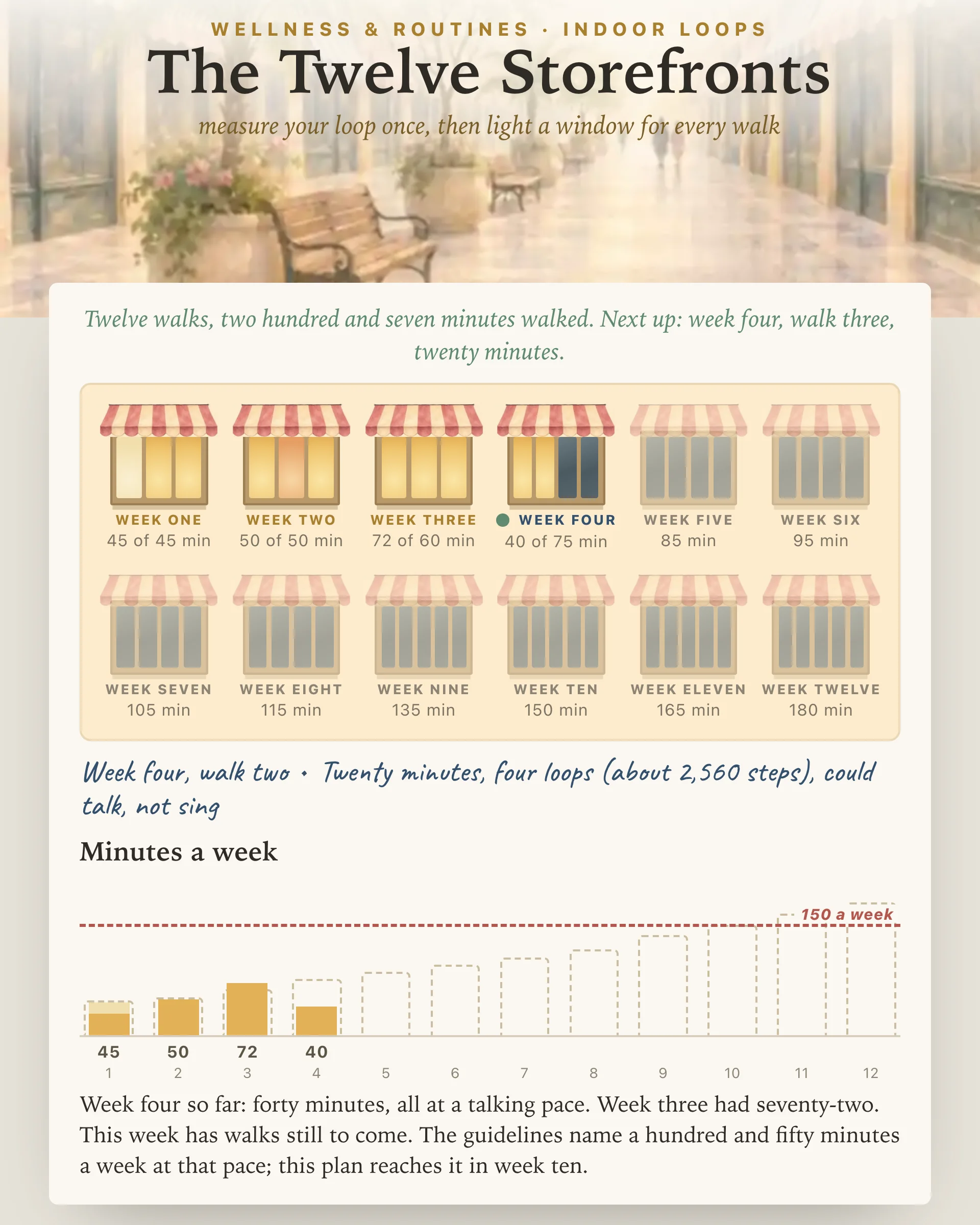
Mall walking is about as plain as exercise gets: loops of a shopping center's hallways, often before the stores open, in a place where the weather never cancels a walk. This page turns those loops into a twelve-week plan drawn as twelve storefronts, one per week, with a window pane for every walk.
Check with a doctor or physical therapist before you begin if you have had a fall, get dizzy, have had a hip or knee replaced, live with a heart or blood pressure condition, or have pain that keeps coming back. Stop at once and sit down for chest pain or pressure, dizziness, or breathlessness that feels out of proportion to your pace, and if it lasts more than a few minutes, call 911 or your local emergency number. The stop-now button on the page says the same.
Researchers at a University of Washington health promotion research center, with colleagues from the US Centers for Disease Control and Prevention and several universities, gathered what had been written about the practice in a scoping review of mall walking programs. Of 254 articles, 32 met their criteria, all of them about programs in the United States. The same draws came up again and again: a steady, climate-controlled temperature, even floors, places to sit, restrooms, good lighting and the company of other regulars. Several programs ran before business hours, some from 7 a.m. The barrier the review singled out was simply getting there.
So the worksheet's notes stay practical. Ask whether your nearest center has walker hours, since hours change from one center to the next and sometimes by season. Wear cushioned sneakers, because polished floors are level but hard. Walk one slow loop first to find the benches and restrooms. And bring someone: a friend, or walkers who already meet there, make an early start easier to keep.
Measure your loop once. Either walk it at your usual pace and count your steps, or use a distance posted for walkers or a route you already know. From then on, each loop you tap on the counter becomes a rough distance.
Each walk runs on a clock that keeps real time even while your phone is locked and counts only minutes on your feet. Tap the bench button whenever you sit down: the clock waits, and the walk notes how many times you stopped and for how long. A walk that runs its full length lights a pane in its week's storefront. A walk you end early keeps its whole minutes in the log, and you walk it again next time, because the next walk opens only once this one runs whole.
The twelve weeks build slowly: three walks of fifteen minutes in week one, a fourth walk in week four, a fifth in week nine, and walks of up to forty minutes by week twelve. Your planned time grows from forty-five minutes a week to a hundred and eighty, reaching a hundred and fifty in week ten.
After each walk you say how talking felt: you could sing, talk but not sing, or manage only a few words at a time. A review by researchers at a Canadian heart institute found the talk test a valid and practical way to judge effort, in healthy adults and in people with heart disease alike, because comfortable speech tends to give out around the point where exercise turns hard. The middle answer is the aim: after a walk you could sing through, the next one suggests a little more pace, and after a few-words walk, a little less.
The Physical Activity Guidelines for Americans ask adults for at least 150 minutes a week of moderate activity, and ask older adults to add balance and muscle-strengthening work as well. The chart sets each week's walked minutes, solid where you could talk but not sing, against that line and your own earlier weeks, never against anyone else.
The scoping review is candid about its limits: of the 32 articles, one was a randomized trial, and only two studies measured physical changes, over eight and twelve weeks. The authors conclude that the impact of these programs is still unknown.
The firmer evidence is about walking together. A meta-analysis of outdoor walking groups by researchers at a UK medical school pooled 42 studies with 1,843 people, most of them women, with an average age of 58. By the end of the programs, blood pressure and resting heart rate were slightly lower and depression scores had improved, and about three in four people kept showing up. Those were outdoor groups measured before and after, not hallway loops tested in a trial, so take them as a reason to bring company, not as a promise about what this plan will do for your body.
For walking at home, The Living Room Mile lays out moves you walk in place around one room. The Picket Fence Walking Plan is an eight-week plan that grows by how each walk felt, and The Daily Steps Ladder builds from the step count your phone already keeps. This page is for a fixed indoor loop, a bench when you want one, and a clock that counts only the walking.
It means walking laps inside a shopping center, often in the early hours before the stores open, when some centers unlock their doors for walkers. The floors are level, the temperature holds steady all year, and benches and restrooms are never far away.
Walked at a pace where talking is easy but singing is not, it counts as moderate activity, the kind US guidelines ask adults to reach 150 minutes of each week. Research on mall walking programs themselves is thin: a 2015 scoping review found mostly weak study designs and called their impact unknown.
Begin with a length you can finish comfortably, often fifteen minutes, and add a few minutes at a time. This plan opens with three fifteen-minute walks and builds over twelve weeks to walks of up to forty minutes, three to five days a week.
Many centers let walkers in an hour or more before the stores open. Hours differ from place to place and can shift with the seasons, so ask at the information desk or a security guard before your first visit.
Anyone who has had a fall, gets dizzy, has had a hip or knee replaced, lives with a heart or blood pressure condition, or has pain that keeps returning. During any walk, stop and sit at once for chest pain, dizziness or unusual breathlessness.
By the team behind Fabulous, the science-based self-care app used by over 30 million people.


