
The Overwhelm Recovery ProtocolWellness & Routines · ~5 min
About this template · Updated November 2026
Lung exercises are short, plain practices for people living with COPD or breathlessness that has lasted for months: breathing out slowly through pursed lips, breathing with the belly, walking in short stretches with rests between, and moving the arms in time with the breath. Treat them as support for the plan your doctor or pulmonary rehabilitation team set, and never as a stand-in for rehab, your medicines or oxygen as prescribed.
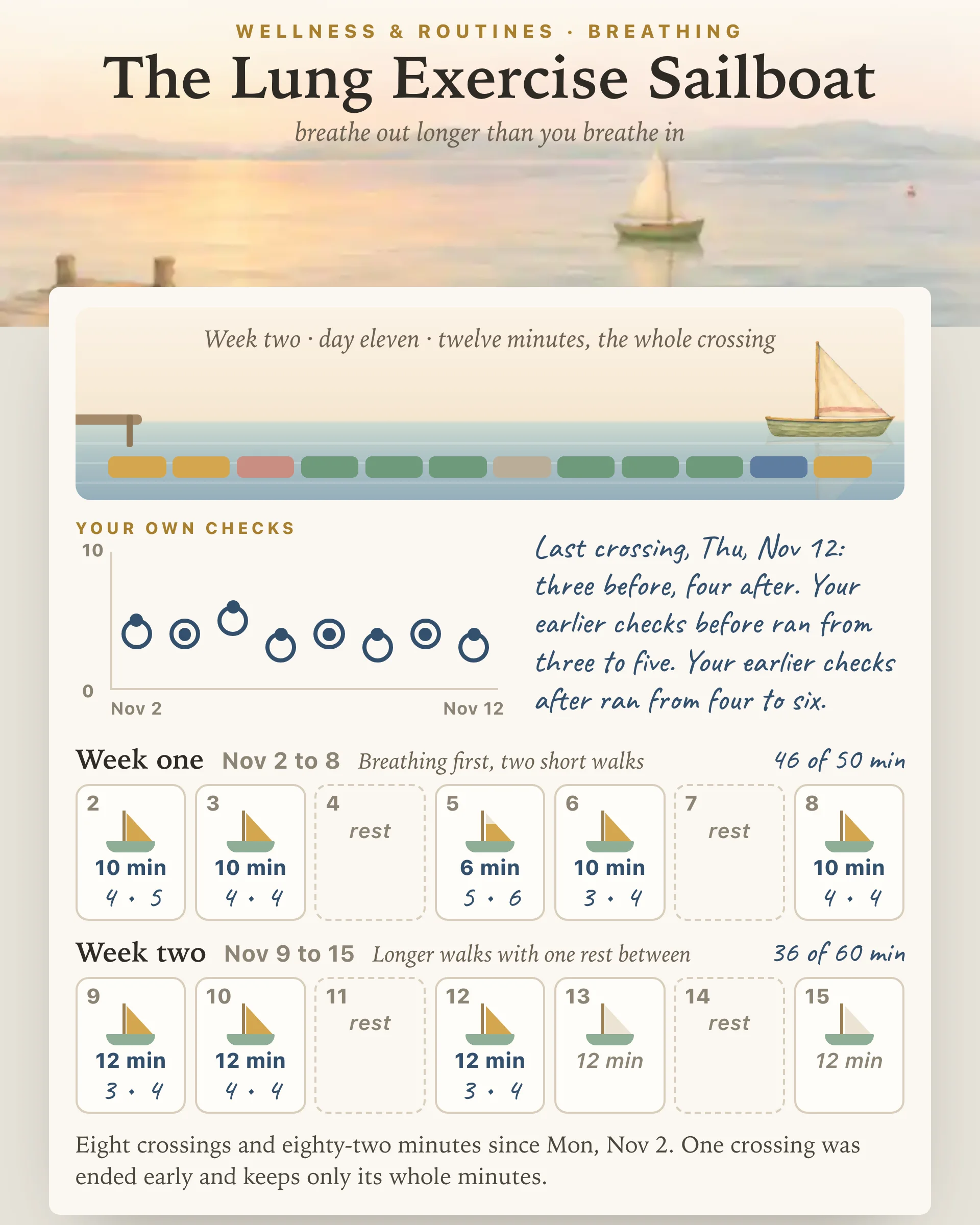
This page lays each session out as a small sailboat crossing a bay. Each minute is a cell under the water, and the boat rises with every breath in and settles through every slow breath out as it crosses. Before you set out you mark how breathless you feel, and again when you land.
If you have a lung or heart condition, start only once your care team has said these exercises suit you. Check with a doctor or physical therapist first, too, if you have had a fall, dizzy spells, a joint replacement, a blood pressure problem or new pain. Keep a sturdy chair or counter within reach, your reliever nearby, and any oxygen at exactly the flow your team prescribed.
Stop if anything hurts, and stop to rest for chest pain or tightness, dizziness, feeling unwell, or breathlessness that will not settle. Call 911 or your local emergency number for chest pain, blue or gray lips or fingertips, confusion, or breathing that will not ease with rest and the reliever your action plan names.
The American Lung Association's breathing exercise guide suggests learning these techniques while your breathing is calm, not for the first time when you are short of breath. The first sessions here are for learning.
Pursed-lip breathing. Sit tall with your shoulders loose. Breathe in through your nose for two counts, purse your lips as if to whistle softly, and let the air out for four counts. The guide above describes the same pattern: out for at least twice as long as in. If four feels too long, the page offers in two, out three. Never push the air out.
Belly breathing. Rest a hand on your belly, let it rise as you breathe in through your nose, and let it fall as you breathe out through pursed lips. Some people with COPD find it takes more effort than it sounds. If it leaves you more breathless, go back to pursed lips and ask your team about it.
Paced walking with rests. Walk at an easy pace on level ground, breathing in for two steps and out for four, or in for one and out for two. Then stop for a full minute: sit, or lean your forearms on a counter, and breathe out through pursed lips until it settles. If walking is not safe today, march in the chair instead. Pause whenever you need a longer rest; the clock waits.
Arm raises. Seated, raise both arms forward as you breathe out and lower them as you breathe in, only as high as is comfortable.
The pacer reads the real clock, minus any pause, so a locked phone still keeps true time. Only whole minutes go in the log: stop at 3:40 and three count, while under a minute saves nothing.
Your check runs from 0, not breathless at all, to 10, the most breathless you can imagine. The page never names a band or gives a verdict. It sets each crossing's two checks only beside your own earlier ones. If a check before a crossing is higher than any you have marked, the page asks you to follow your action plan or call your team before you go.
The plan runs four weeks, five days a week, from ten minutes up to twenty. A five-minute breathing-only crossing is there for rest days and harder days.
A Cochrane review of pulmonary rehabilitation for COPD pooled 65 trials with 3,822 people. Rehab relieved breathlessness and fatigue, improved mood and people's sense of control over their condition, and added about 44 meters (roughly 145 feet) to a six-minute walk. Those programs mostly ran eight or twelve weeks, many of them in hospitals, and the authors say it is still unclear which parts matter most, how long the benefits last, or how much supervision is needed. A page at home is not that program.
A Cochrane review of breathing exercises for COPD covered 16 trials with 1,233 people. Four to fifteen weeks of breathing exercises helped people walk farther than doing nothing, but changes in breathlessness and quality of life were inconsistent, few trials were blinded, and the authors saw them mainly as an option for people who cannot do exercise training.
For the arms, a Cochrane review of upper limb training found a small easing of breathlessness and no change in quality of life, across 15 small trials. None of these reviews tested a page like this one, and none shows that exercise repairs lung tissue.
Bring your log and both checks to your next appointment. If your team uses a walk test, The Six-Minute Hourglass times one with a course you measure at home. Once your team agrees you are ready for longer walks, the Walking Workout lays one out. On days when walking is hard, and with your team's okay, The Pedal Exerciser Ferris Wheel builds seated pedaling sessions by the minute.
Pursed-lip breathing and belly breathing are the two most often taught, along with walking and gentle arm work. The strongest evidence is for pulmonary rehabilitation, a structured program of exercise and education, so ask your doctor about a referral and treat home practice as support for it.
Sit with your shoulders relaxed. Breathe in slowly through your nose for about two counts, purse your lips as if to whistle, and let the air out gently for about four counts, at least twice as long as the breath in. Learn it while your breathing is calm, so it is familiar when you feel short of breath.
They do not repair lung tissue or change a diagnosis. In reviews of trials, people with COPD walked farther after several weeks of breathing exercises, with no steady change in breathlessness, while rehabilitation programs eased breathlessness and tiredness. Think of these as training how you breathe and move.
Many people do them at home once their care team agrees. Stop and rest for chest pain, dizziness, feeling unwell or breathlessness that does not settle, and call 911 or your local emergency number for chest pain, blue lips or breathing that will not ease with rest and your reliever. Use oxygen only as prescribed.
Short sessions on most days are a common place to begin. This page plans five days a week for four weeks, growing from ten minutes to twenty, with a five-minute breathing crossing for rest days. If your rehab team set a different plan, follow theirs.
By the team behind Fabulous, the science-based self-care app used by over 30 million people.


