
Leaves on a StreamEmotional Fitness · ~3 min
About this template · Updated September 2026
The idea on this page belongs to Julian B. Rotter, the social learning theorist who described locus of control and, in a 1966 monograph, published the Internal-External scale, a forced-choice questionnaire that turns your answers into a score. What you find here is an independent worksheet built on his idea. It has no connection to Rotter's estate or to the American Psychological Association, which published that monograph, and neither of them has reviewed or approved it.
Locus is Latin for place. Your locus of control is where you tend to locate the cause of what happens to you. If you mostly find it inside, in your effort, your choices and your skills, psychologists call that an internal locus. If you mostly find it outside, in luck, other people and circumstance, they call it external. Picture a failed driving test. One person replays the mirror check they skipped; another blames the examiner and the rain. Both of them have landed somewhere on the same line.
Rotter asked about beliefs in general. When you place the cause of one specific event, psychologists call that an attribution, and attributions come with a well-documented tilt: most of us claim more of the credit for our successes than of the blame for our failures. A meta-analysis of 266 studies found this self-serving pattern in nearly every group it examined, largest in children and older adults and smaller in Asian samples than in American ones.
A single number would hide the most useful thing about you: whether your locus moves depending on how things turned out. That is why the dial has two needles.
Log three or four things from the past week or two, some that went well and some that went wrong. Tap a suggestion or write a few words of your own. The log holds eight, enough to show a pattern without turning into a diary.
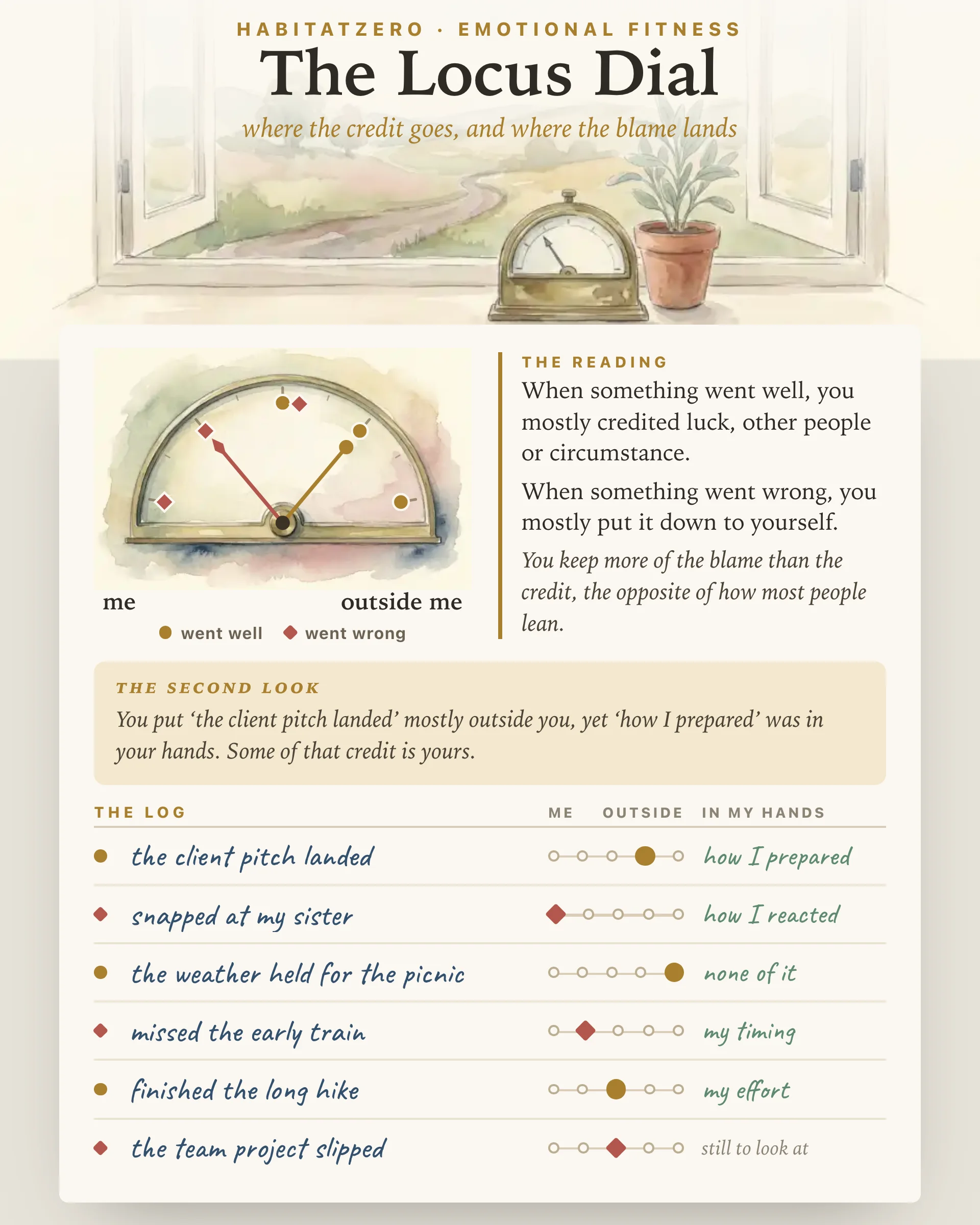
Then place each one. Every event has a five-stop scale from all me to all outside me, and wherever you tap, a dot lands on the matching spot of the painted dial. A gold needle settles at the average of your good events and a red needle at the average of your bad ones. Underneath, the reading says in plain words where each needle points and whether you keep more of the credit or more of the blame.
The second look is the part a printout cannot do for you. Once an event is placed, the worksheet asks which part of it was actually in your hands: your effort, your timing, how you prepared, what you said, or none of it. When that answer contradicts where you put the cause, the reading says so. A missed train you put all outside you, with your departure time in your hands, holds a part you could change next time. A layoff you put all on yourself, with none of it in your hands, is blame that may not be yours to carry.
A 2013 meta-analysis pooled 152 samples of adults from 18 cultural regions and found that a more external locus went with more symptoms of depression and anxiety, at correlations of about 0.30. At work, an internal locus is linked with greater job motivation and better task and social experiences.
Read those findings for what they are. They come from correlational studies, so they cannot show that shifting your locus will make you feel better, and the 2013 review found the link with anxiety weaker in collectivist cultures, where believing that outside forces shape your life carries fewer negative connotations. An external placement is sometimes simply correct. The storm that canceled your flight was not your doing, and a worksheet that trained you to take the blame for it would be doing you harm.
That is why this page never scores you. Rotter's scale yields a number; the dial gives you a picture of one stretch of your life, and the picture changes the moment you move a placement.
Use it at the end of an uneven week, or after a win or a setback you keep replaying. Come back in a month and log a fresh set. If the red needle keeps settling near all me while the gold one drifts outside, that pattern is worth your attention.
If a worry keeps circling and you want to sort what you can act on from what you cannot, The Circle of Control does for the days ahead what this dial does for the days behind you. If one bad outcome keeps landing entirely on you, The Responsibility Pie divides it among everyone and everything involved, and the Inner Critic Translator works on the voice that does the blaming.
This worksheet is a reflection, not therapy. If blaming yourself has become a constant weight, a therapist can help you examine it with some distance. And if the self-blame has turned into feeling worthless, or into thoughts of ending your life, call or text 988 in the US, or your local emergency number anywhere else, and tell someone today.
It is an exercise for noticing where you place the causes of what happens to you: inside, in your effort, choices and skills, or outside, in luck, other people and circumstance. This one starts from your own recent events rather than from abstract statements, so the pattern it shows is yours.
With an internal locus you tend to see outcomes as following from what you do, so a good exam grade reads as the reward for studying. With an external locus you tend to see them as set by forces around you, so the same grade reads as an easy test or a generous teacher. Most people mix the two, and the mix often shifts between good news and bad.
Not always. Large reviews link a more internal locus with fewer symptoms of depression and anxiety and with more motivation at work, but those studies measure associations, not causes. Some things really are out of your hands, and taking the blame for them is not a strength. The aim here is an accurate picture, not the most internal one.
No. Julian Rotter's scale is a published questionnaire of paired statements that produces a score. This page is an independent reflection built on his idea: it has not been validated as a measure, it gives no score, and it is not affiliated with or endorsed by Rotter's estate or by the American Psychological Association, which published the scale in 1966.
The filled-in example on this page is free to explore as it is. To log your own events, set them on the dial and keep the log from one week to the next, open it through Personalize in HabitatZero, which costs nothing.
By the team behind Fabulous, the science-based self-care app used by over 30 million people.


