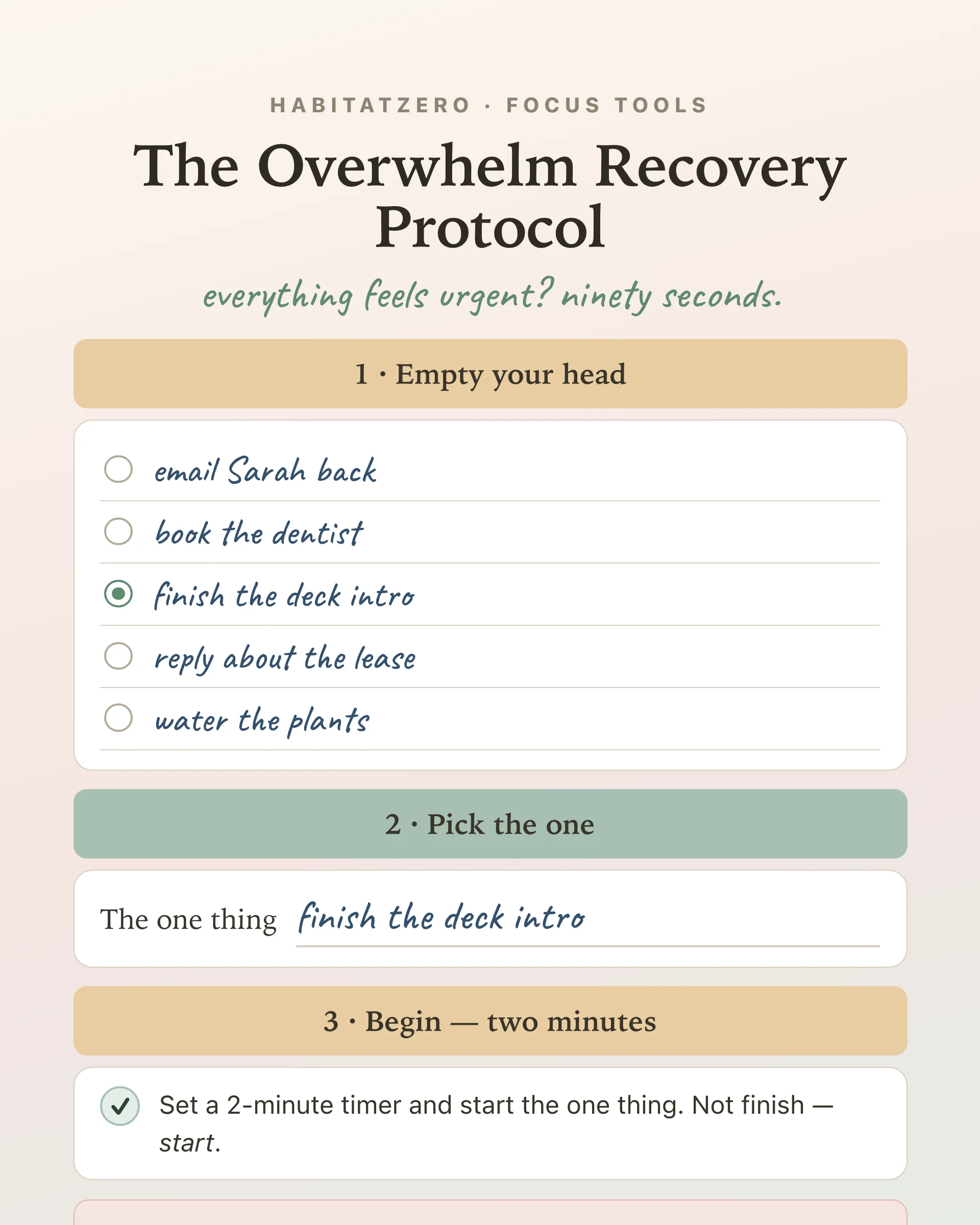
The Overwhelm Recovery ProtocolWellness & Routines · ~5 min
About this template · Updated September 2026
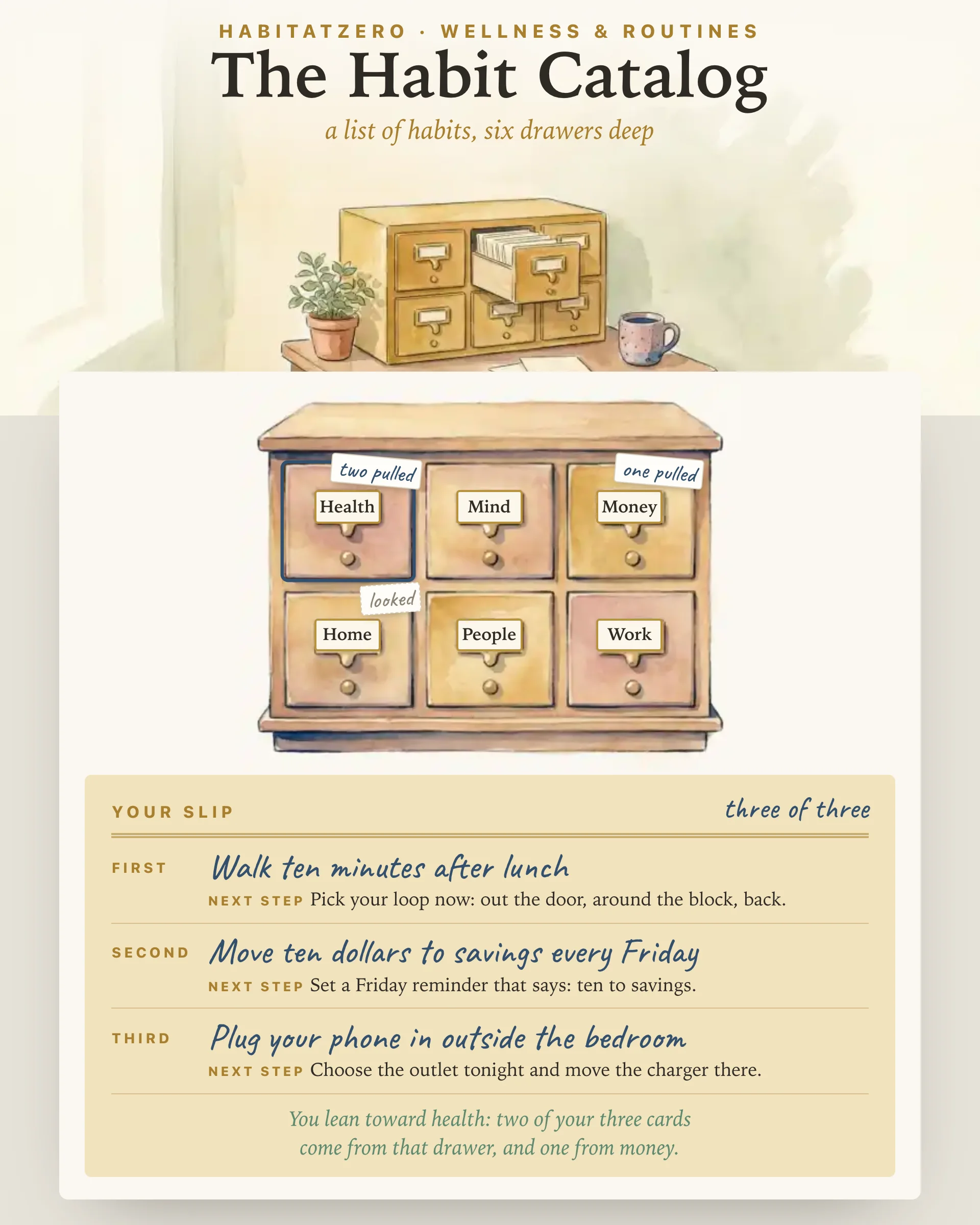
Most lists of habits are long, and that is the trouble with them: a hundred good ideas feel generous tonight and useless by morning, because nothing on the page says where to begin. This catalog adds the missing step, which is choosing. Forty-two small habits sit in six drawers, and you pull no more than three.
The cabinet has a drawer for each part of a life: health, mind, money, home, people and work. Open one and its seven cards spread out, each naming a single action, how long it takes, whether it is daily or weekly, and the habit it takes the place of. Missing the one you want? Write your own; every drawer has room for two.
Pull a card and it lands on your slip in handwriting, with one next step to do today and the tracker that suits its rhythm. The slip holds three. Once it is full, you return a card before pulling another; returning takes two taps, so nothing leaves by accident.
The cabinet keeps notes too: a drawer you pulled from gets a tag with the count, a drawer you opened and left says looked, and the rest stay bare. Under the slip, a short reading names the drawer you lean toward, the ones you passed over and the ones you never opened. It is not a score, just a way to notice that every card you chose is about your body, say, and none is about the people around you.
A habit forms when you repeat one action in the same setting until the setting starts it for you, which is why each card is a single action tied to a moment you already have: after lunch, before bed, when you park. Benjamin Gardner and colleagues note that simple actions like drinking water became automatic sooner than elaborate routines like 50 sit-ups, and they advise small, manageable changes because an early failure is discouraging.
The same paper explains the line on each card that begins with "in place of." Nobody can form a habit of not doing something, so the way out of a bad habit is a new action that takes over its moment. Scrolling in bed gives way to a charger in the hallway; lunch at the desk gives way to a walk.
Ambition says pull ten. In studies by Amy Dalton and Stephen Spiller, detailed plans that help with a single goal stopped helping once people made them for several goals: the planning drew attention to how hard the whole set would be, and commitment dropped. Three is a ceiling, not a target. One card kept most days is a real beginning.
Plan on weeks, not days. In the best-known study, volunteers needed anywhere from 18 to 254 days before a daily action felt automatic, and missing a single day did not knock the process off course. Gardner's summary puts the average plateau near 66 days, roughly ten weeks. The group was modest and chose simple eating, drinking and activity habits, so treat the figures as a range, not a promise.
Counting lets you watch the weeks add up. Every card on your slip names the tracker that fits it: the Daily Habit Tracker for everyday cards, the Weekly Habit Tracker for the Friday transfer or the Sunday call. If one habit keeps slipping, take it apart on the Habit Loop Worksheet to find the missing cue or reward.
Open the catalog when you want a change but not a particular one, or after a stretch when every routine fell away. Come back once one of your three runs without thinking, and pull the next card, perhaps from a drawer you left shut the first time.
Pick ones small enough for a bad day and tied to something you already do: a glass of water before coffee, ten pages before bed, a short walk after lunch, ten dollars to savings every Friday. This catalog holds forty-two of them across health, mind, money, home, people and work.
Familiar ones include scrolling in bed, eating lunch at the desk, avoiding the bank balance, leaving dishes for morning and half-listening with a phone in hand. Each card here names the bad habit it crowds out, since nobody can form a habit of not doing something; a new action has to take the old one's moment.
Fewer than you want to. Research on planning found that spelling out when and where to act helps with one goal, yet doing it for several goals at once made the set feel harder and weakened commitment. The slip on this page holds three, and a single card is a fine start.
Longer than the popular twenty-one days. When volunteers repeated one daily action in the same setting, it took from 18 to 254 days to feel automatic, with an average plateau near 66 days, about ten weeks. Skipping a single day did not undo the progress.
No. The article on this page lists every card in the catalog, drawer by drawer. Opening the drawers yourself, pulling three onto a slip and keeping it between visits happens in HabitatZero, which is free.
By the team behind Fabulous, the science-based self-care app used by over 30 million people.