
The Overwhelm Recovery ProtocolWellness & Routines · ~5 min
About this template · Updated November 2026
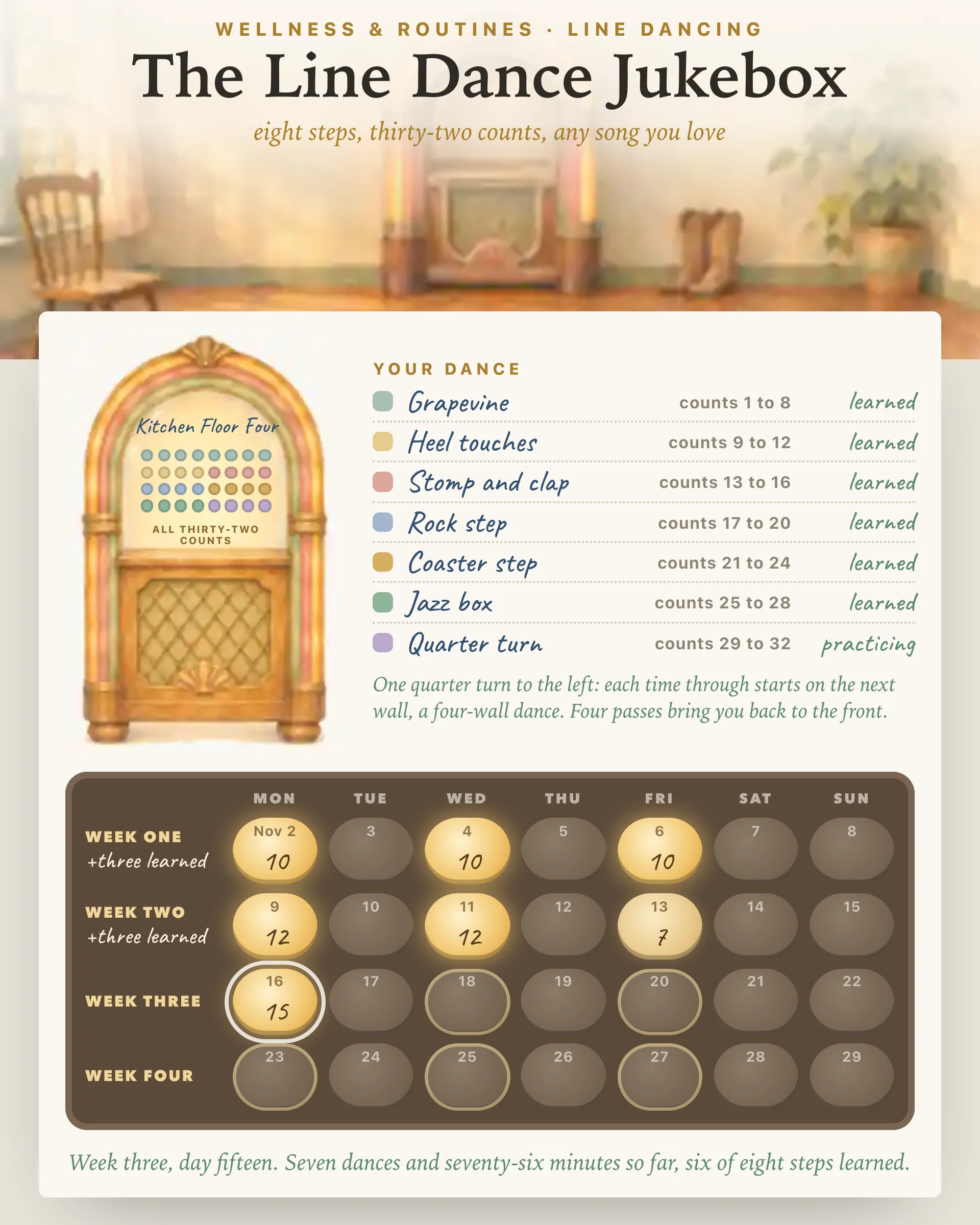
Line dancing asks for no partner and no experience. Everyone faces the same way, and a whole dance is usually a short pattern of thirty-two counts repeated until the song ends. If you can count to eight and shift your weight from foot to foot, you can learn it. This page treats your dance like a jukebox: eight classic steps sit on its title strips, you choose the ones you want, and it plays them back at a count slow enough to follow.
Line dances are written in sets of eight beats, which dancers call eights. A grapevine fills one eight on its own: step out to the right, cross the left foot behind, step out again, touch, then the same back to the left. Heel touches, stomp and clap, the rock step, the coaster step, the jazz box, kick ball change and the quarter turn each take four counts, so you practice them twice through to complete the set.
Tap any strip and its counts appear one to eight, each with a plain cue. Every step comes in three versions:
Every step here starts and finishes with your right foot free, so any step can follow any other.
Added steps fill a sheet of four rows, eight counts to a row, each step in its own color. The sheet refuses what will not fit, such as a grapevine in the last four counts, and says why. Between four and eight steps fill the thirty-two.
The sheet also reads your walls. With no turn you face the front every time through, a one-wall dance. Put in one quarter turn and each pass finishes facing the next wall, which is what instructors mean by a four-wall dance; four passes bring you back where you began. Two quarter turns make a two-wall dance. Seated, the turn lives in your arms and you keep facing the front.
Press dance and the jukebox runs the day's session: a minute of marching in place, your steps on a loop with each count's cue and the wall you face, then a minute of slow swaying. Pick slow, easy or brisk, which is sixty, eighty or a hundred counts a minute, and play whatever music you enjoy. The counts fit any song with a steady beat you can clap to, and once the steps feel automatic you can count with the song instead of the screen.
The timing comes from the clock, so a screen that dims does not lose your place. End early and only whole minutes are kept, and a time through counts only once all of its counts were danced.
The plan runs three short dances a week with a rest day between: ten minutes in week one, twelve in week two, fifteen in week three and twenty in week four. Learn a step or two each session for the first two weeks, fill all thirty-two counts in week three, and spend week four dancing the whole thing a little faster. Each dance lights a key on the jukebox. When your feet can do a step without reading the cue, mark it learned and that week shows it.
The line dancing evidence is small but encouraging. In a randomized trial of eight weeks of line dancing with twenty-three adults aged sixty-five to ninety-three who had mobility limits, the dancers improved on lower-body function, endurance and walking speed, and reported fewer limits, compared with a usual-care group. One small study is a promising sign, not proof.
A systematic review of dance in healthy older adults found positive effects on balance, gait and strength across seven studies, yet its authors could not confirm a benefit because the trials were small and varied. The largest test so far, a year-long trial of social dancing in retirement villages with more than five hundred residents, found no difference in the number of falls. Dance because it is enjoyable movement you may keep doing, not as a guarantee against falling.
Use this page when you want movement that feels like play, or before a class so the basics are already in your feet. For sessions that mix several dance styles, try the Living Room Dance Floor. For steady cardio planned week by week, the Aerobic Wreath fits beside it, and the Balance Ladder adds slow, supported balance practice.
Before your first dance, talk with a doctor or physical therapist if you have had a fall, dizzy spells, a joint replacement, a heart or blood pressure condition, or pain that lingers. Clear away rugs and cords, wear shoes with some grip, keep a sturdy chair or counter close, and switch to the low-impact or seated version whenever a step does not feel right. Stop if anything hurts.
Most beginner floors are built from a short list: the grapevine, heel touches, stomp and clap, the rock step, the coaster step, the jazz box, kick ball change and a quarter turn. Learn two of them at a slow count, add one more each session, and within a few weeks you can string thirty-two counts together.
It suits many older adults because nobody needs a partner, the steps repeat, and every move can be made smaller or done in a chair. A small eight-week trial in people aged sixty-five to ninety-three with mobility limits found better walking speed and endurance after line dancing. A larger year-long study of social dancing did not find fewer falls, so treat it as enjoyable exercise rather than a fall cure.
Yes. Every step here has a seated version where your arms carry the pattern: reaching out for a grapevine, patting your thighs for a stomp, sweeping both arms for the turn. Seated, you keep facing the front, and the count runs exactly as it does standing.
Line dances move in sets of eight beats, so any song with a steady beat you can clap to will carry them. Practice with the page counting slowly, then switch to brisk, and once the steps feel automatic, count along with the drum of your song instead.
It means one quarter turn sits somewhere in the routine, so each time through you start facing the next wall of the room, and the fourth pass brings you back to where you began. A dance with no turn is a one-wall dance, and a half turn makes it a two-wall dance.
By the team behind Fabulous, the science-based self-care app used by over 30 million people.


