
The Overwhelm Recovery ProtocolWellness & Routines · ~5 min
About this template · Updated November 2026
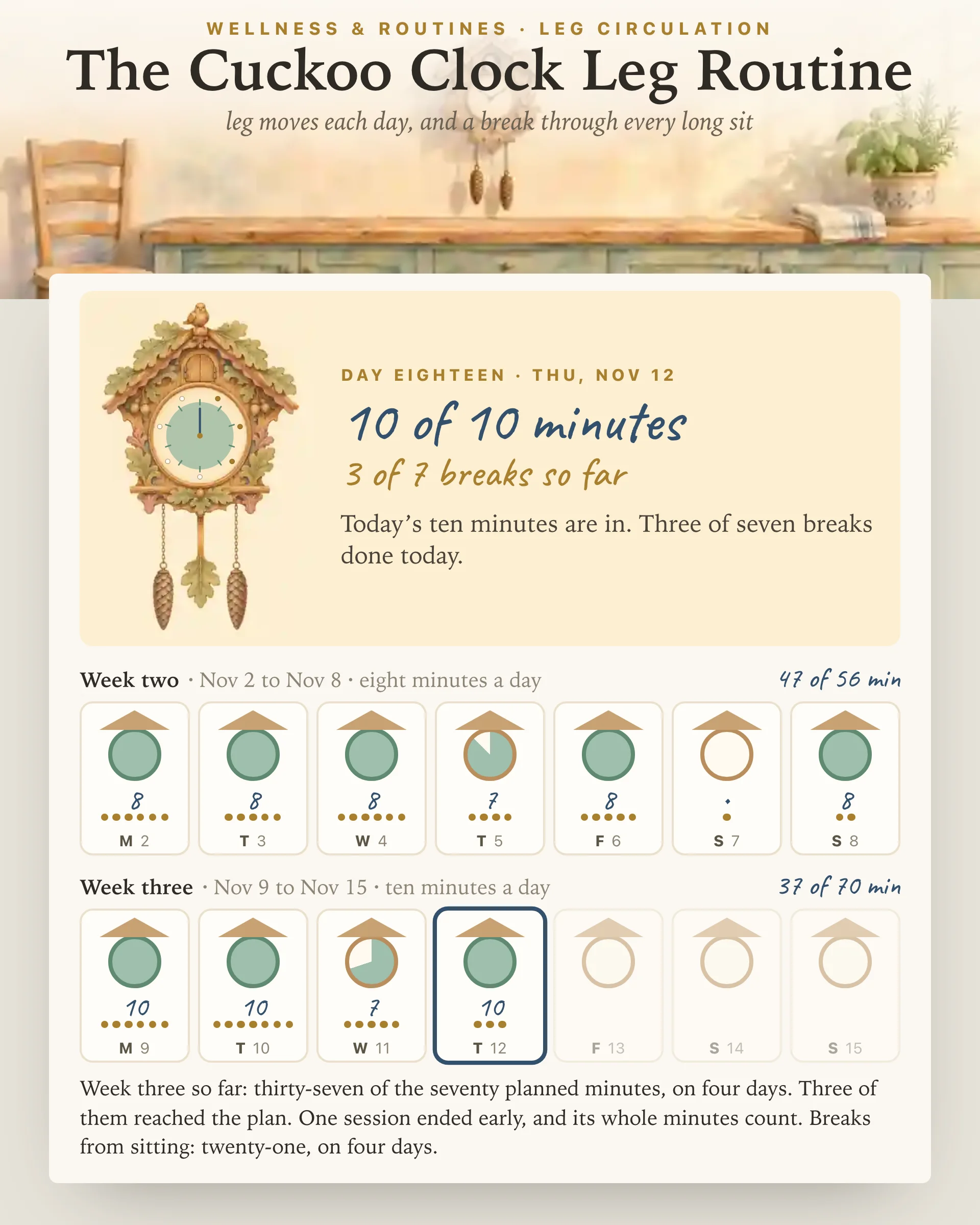
Your calf muscles work like a pump for the veins of your lower legs, helping push blood back toward your heart each time they tighten. Through a long sit at a desk, in a car or on a flight, they barely move. This page gives you two habits for those days: seven leg moves in a chair or at a kitchen counter, timed on a clock that keeps real time, and a sit-less plan that counts every short break you actually take.
If you are being treated for a clot, vein disease or artery disease, ask your doctor which moves suit you. Keep wearing compression stockings and taking your medicine as prescribed: nothing here replaces either one or is a reason to stop.
Sit near the front of a sturdy chair, feet on the floor; the first four moves always stay seated.
The plan runs four weeks with moves every day. Week one gives each move forty-five seconds and the walk ninety, six minutes in all; week four takes twelve. The clock reads real time, so a phone that locks mid-session still counts true minutes, and a pause never counts. Only what you did goes on the clock: a move is marked once its whole time runs, an early stop keeps whole minutes only, and time you skip never comes back.
Your sitting day sets the breaks: choose four to twelve hours and how often to get up, and the rim of the cuckoo clock shows a dot per break. A break is two minutes of walking or chair marching, then ankle pumps, and counts once it runs out. Each day becomes a little clock on a four-week shelf.
Calf work. In a small 2004 trial, 31 people with advanced vein disease, with skin changes or ulcers, all wore compression stockings. Those who also had six months of calf strengthening with a physical therapist showed better calf pump measurements, but their quality of life and symptom scores did not change. A 2018 review pooled five trials of 190 people with venous leg ulcers: adding exercise to compression went with about 14 more healed ulcers per 100 people at 12 weeks, an imprecise estimate, and the exercise always came on top of compression.
Breaking up sitting. In a lab study of 12 young, healthy men, three hours of still sitting dulled how well a main leg artery widened, while a five-minute walk once an hour kept it steady. It measured one afternoon in healthy young men, not clots or symptoms.
Walking programs. For leg pain on walking caused by narrowed arteries, a Cochrane review of 32 trials with 1,835 people found exercise programs let people walk about 80 meters farther before pain began, and 120 meters farther in all, than usual care. The ankle-to-arm blood pressure ratio did not improve, and the trials showed no effect on amputation or death. A second Cochrane review of 21 studies with 1,400 people found supervised programs beat plain walking advice by about 210 meters at three months, while home programs did no clearly better than advice. If walking hurts, ask your doctor about a supervised program; this page is not one.
None of these studies tested this routine, and none shows that leg moves prevent clots or cure vein or artery disease.
Run the routine once a day, and let the breaks carry you through desk days, long drives and flights. For trips over four hours, the CDC page above suggests walking every one to two hours and raising your heels and toes in your seat.
Talk to your doctor or a physical therapist first if you have had a fall, get dizzy, have a replaced joint, or live with a heart or blood pressure condition or ongoing pain. Stop any move that hurts, and have a sturdy chair or the counter close by whenever you stand up.
For more leg strength at a counter, try The Three-Step Leg Routine. The Chair Circuit works the whole body from a seat, and Turn Back the Covers suits slow mornings that start in bed.
Moves that work the calf muscles, such as ankle pumps, heel raises and walking, are where most advice starts, since the calf helps push blood back up the leg. Short, frequent movement through a long sit counts as much as one longer session. If you have a vein or artery condition, your doctor can tell you which moves suit you.
Seated ankle pumps, heel and toe raises and marching keep the leg muscles busy at a desk or on a flight, and getting up for a short walk every hour or two adds more. In a small lab study, hourly five-minute walks kept a leg artery working normally through three hours of sitting, though it measured no clots or symptoms.
No study has shown that a routine like this one prevents clots. The CDC suggests moving your legs and getting up to walk on long trips, which is sensible, but people at higher risk may also be given medicine or compression stockings by their doctor. Keep using whatever you were prescribed.
Get seen the same day for a leg that is suddenly swollen, red, warm or painful, and call 911 for chest pain or sudden breathlessness. Leg pain that comes on with walking and eases with rest, or a sore on a leg or foot that will not heal, also calls for a visit to your doctor.
No. In the trials of people with vein disease, exercise was added on top of compression and never used in its place. Keep wearing your stockings and taking any medicine as your doctor prescribed, and ask before changing either one.
By the team behind Fabulous, the science-based self-care app used by over 30 million people.


