
Leaves on a StreamEmotional Fitness · ~3 min
About this template · Updated September 2026
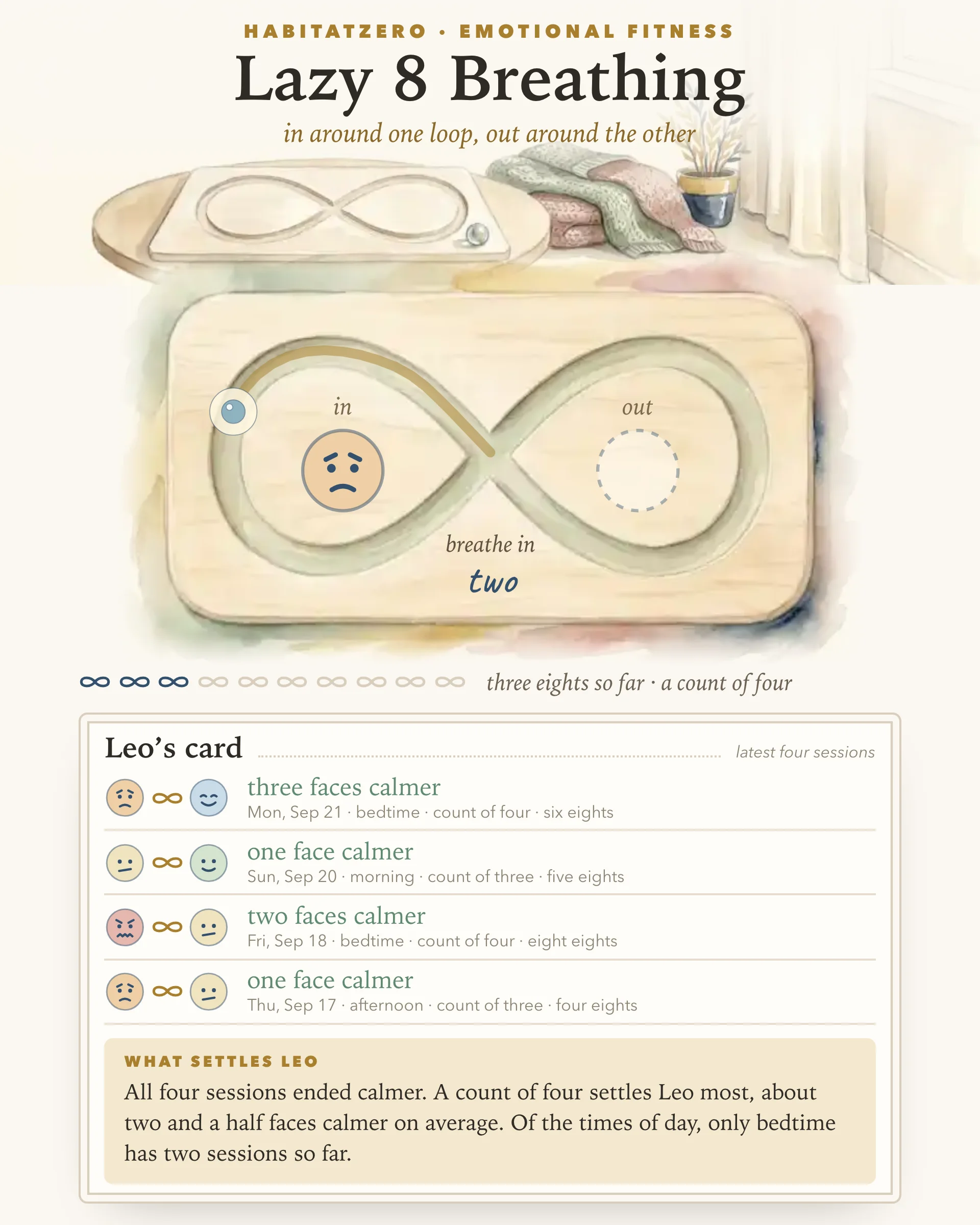
Many teachers and counselors know lazy 8 breathing from a reproducible card in The Zones of Regulation, the self-regulation curriculum created by occupational therapist Leah Kuypers. The tracing board on this page is our own interactive take on the exercise. It has no affiliation with Kuypers or The Zones of Regulation, and neither of them reviewed or endorsed it.
A figure eight lies on its side, the lazy 8, and your child traces it with one finger, breathing in around the left loop and out around the right, then around again. The shape has no corners, so the breath never has to stop and turn. A hand that is busy tracing is not fidgeting, grabbing or thumping the table.
Everything below is for the grown-up; the finger in the groove should be your child's.
Match the count to the child: a four-year-old breathes faster at rest than a ten-year-old, so start with a short count and let your child ask for a longer one.
A glass marble waits where the loops cross. Press start and it rolls through the carved groove at the count you picked, two to five for each loop, while a word under the crossing counts along. Your child traces a step behind it, on the screen or in the air. Each finished eight fills in one of the small eights under the board, and the marble rests after ten, a full session. Pause whenever you like: finished eights stay, and a loop cut short is not counted. If your device is set to reduce motion, the marble holds still and the loops light up in turn.
Before starting, tap the face that matches how your child feels, from stormy to calm, and tap another once the marble rests. The before face settles into the left loop and the after face into the right, so the board itself shows the change. Add the session and the card keeps the date, the time of day, the count, the eights and both faces. The time of day is guessed from the clock; tap it on the card if it was different. The card holds twelve sessions, so remove an old one to make room.
Once three sessions are on the card, it starts comparing. It averages how many faces calmer each count and each time of day left your child, and names a leader once one has two sessions behind it. If the calmest count and the calmest time of day come mostly from the same sessions, the card says so and suggests how to tell them apart. Changing the count partway through starts the eights over, so every session sticks to one count.
Nobody has studied lazy 8 breathing by name. The research is about slow, paced breathing in general, and most of it involves adults. One meta-analysis pooled twelve randomized trials with 785 adult participants and found that breathwork lowered self-reported stress by a small-to-medium amount compared with control conditions, with similar effects on anxiety. Its authors still urged caution, because most of those trials carried a moderate risk of bias.
The picture thins out for younger people. A 2025 review of yogic breathing in adolescents gathered eighteen studies and found a moderate average drop in stress, yet rated the certainty of that evidence very low. Studies with elementary-age children are fewer and smaller. One classroom study stands out: 122 fifth graders who took deep breaths before a timed math test felt less anxious, and scored higher, than a control group.
Slow breathing is a low-risk skill worth teaching, and it may take the edge off a hard minute. It is no substitute for care, though, and a calmer face after ten eights does not prove the eights did it: big feelings fade by themselves, and having you close by counts for a lot. Read the card as a set of hunches to test. If worry or anger keeps your child awake at night, out of class or apart from friends, talk it over with their pediatrician.
Bring out the board just before the moments your card flags, not at their peak: the wait before a test, the last minutes of screen time, the quiet after lights out. If bedtime keeps coming out on top, fold a few eights into The Path to Bed so they happen every night. A child who likes corners and points may prefer Star Breathing, and a cozy spot set up like a Calm Corner gives the board a place to live between sessions.
Stop at the first sign of strain. A child who feels light-headed should go back to ordinary breathing, and next time the marble can run on a shorter count.
It is a calming exercise in which a child traces a figure eight lying on its side, breathing in around one loop and out around the other. The shape has no corners, so the breath never has to stop and turn, and a finger that is busy tracing gives restless hands a job.
Yes. Lazy 8, lazy eight, figure 8 and infinity breathing all name one practice: trace the sideways eight, breathe in along one side and out along the other. Some cards start at the crossing and some at the top of a loop, and either works as long as each loop keeps its own half of the breath.
Trials in adults suggest slow breathing can ease stress and anxiety a little in the moment, but child studies are few and small, and none has tested the lazy 8 itself. Practice it together as a calming habit, and if worry keeps coming between your child and school, sleep or friends, raise it with their pediatrician.
No. Plenty of classrooms know the lazy 8 from a card in The Zones of Regulation, the curriculum occupational therapist Leah Kuypers created, but this tracing board was built on its own. Neither Kuypers nor The Zones of Regulation reviewed or endorsed it, and her curriculum is where to find the Zones version alongside the rest of its toolbox.
This page shows a sample card and how the board behaves. To trace with your own child and keep a card of their sessions that compares counts and times of day across the weeks, personalize it in HabitatZero, which is free.
By the team behind Fabulous, the science-based self-care app used by over 30 million people.


