
The Overwhelm Recovery ProtocolWellness & Routines · ~5 min
About this template · Updated November 2026
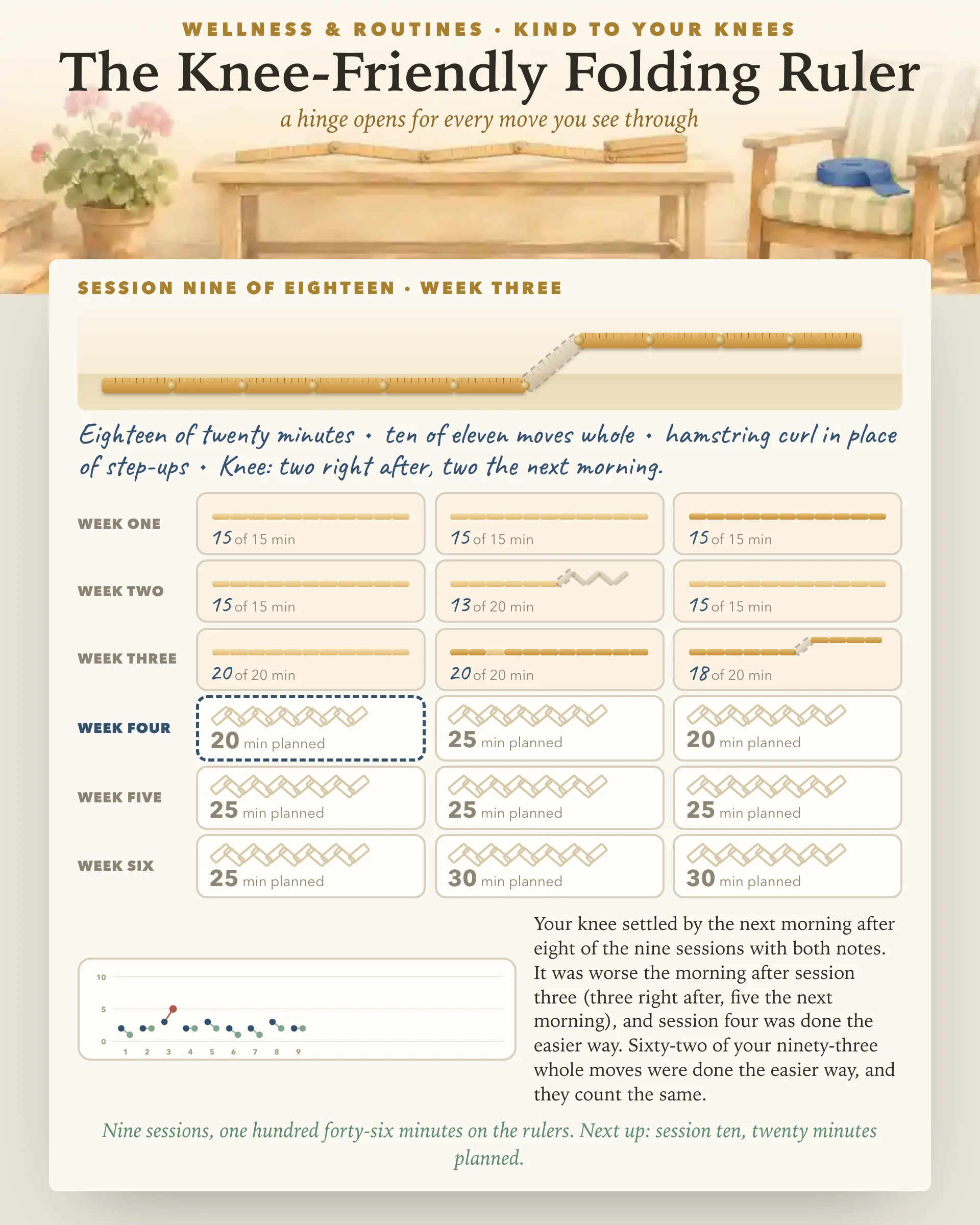
A knee friendly workout still works your whole body. It just leaves out what tends to bother a cranky knee: jumping and landing, squatting deep, and kneeling on the floor. This page gives you eleven moves that keep to those limits, each with an easier version, and a six-week plan of three sessions a week that grows from fifteen minutes to thirty. It suits knees that ache after stairs, knees with some osteoarthritis, and anyone being careful.
The page is built on three common rules of thumb.
Talk to a doctor or physical therapist before your first session if your knee is hot, red or very swollen, if it locks or gives way, or if it has hurt since a fall or an injury. Check in first, too, after knee surgery or a joint replacement, or with a heart or blood pressure condition, past falls or dizziness. Keep a sturdy chair or the kitchen counter within reach whenever you stand.
Five minutes of seated marching open each session. The other ten moves share the rest equally, a minute each in fifteen minutes and two and a half minutes each in thirty.
Each session is a wooden folding ruler of eleven sections, one per move. A quiet clock walks you through the moves in real time, even on a locked phone. As a move runs, its hinge opens, and a section lies flat only when its move ran its whole time. A paler section, done the easier way, counts the same. A skipped move stays folded and its time never counts, and an early end keeps only whole minutes.
A red button under the clock ends the session at once for sharp pain, catching or giving way. The stop is kept, and the next session waits until you tap that a doctor or physical therapist has cleared you.
After each session, tap how your knee feels from 0 to 10, and tap again the next morning. The two numbers are compared only with each other. A worse morning moves the next session to the easier way, and a step shorter if it was already the easier way. The usual way comes back after two whole sessions in a row that settled by morning.
A 2024 Cochrane review by physiotherapy researchers in Melbourne, Sydney, Amsterdam and Lund pooled 139 trials with 12,468 people who had knee osteoarthritis. Land-based exercise probably improves pain and physical function by the end of a program, by amounts whose importance to any one person is uncertain. Most people in those trials knew they were exercising, which may have colored what they reported, and low-certainty evidence suggested exercisers may have more side effects than people given no treatment.
For pain around the kneecap, a 2015 Cochrane review from Erasmus Medical Center in Rotterdam gathered 31 small trials with 1,690 people. Exercise may ease pain and help function, but the evidence was of very low quality and the best kind of exercise is unknown.
Should exercise hurt at all? A 2017 meta-analysis led by physiotherapists in Derby and Nottingham compared programs that allowed some pain with pain-free ones in seven trials of 385 adults with long-standing back, shoulder, heel or Achilles pain. Allowing pain gave a small short-term edge, then no clear difference. None of those trials involved knees, so the next-morning check here is common advice rather than something tested, and no trial has tested this page.
The Three-Basin Fountain is built for arthritis in any joint, with range of motion, pool or bike cardio and a two-hour pain check. The Low-Impact Stepping Stones is a four-week no-jumping plan you arrange around your week. The Three-Step Leg Routine works the legs alone, with a mini squat among its steps. This page keeps every knee bend shallow, works the whole body, and lets the next morning set how hard the next session is.
It keeps both feet near the ground and the knee bends shallow. That means no jumping or landing, no deep squats or lunges, and no kneeling, while the hips, thighs, calves, chest and back still get real work from moves such as a high-chair sit to stand, a hip hinge and a straight-leg raise.
People with sore knees are often told to go easy on jumping, running downhill, deep squats, lunges and long spells of kneeling, since those load the joint most. This is common advice rather than a fixed list, and a physical therapist can tell you which ones your own knee tolerates.
A mild ache that settles by the next morning is usually fine to work with. If the knee feels worse the next morning than it did right after, do less next time. Sharp pain, swelling, locking or the knee giving way are reasons to stop and get it checked.
Anyone whose knee is hot, red or very swollen, locks or gives way, or has hurt since a fall or injury, and anyone recovering from knee surgery or a joint replacement. A heart or blood pressure condition, past falls or dizzy spells are good reasons to check in first too.
A 2024 Cochrane review of 139 trials found that exercise probably eases pain and improves function a little by the end of a program, though the size of that benefit may or may not matter much to a given person. It does not show that exercise repairs the joint.
By the team behind Fabulous, the science-based self-care app used by over 30 million people.


