
The Overwhelm Recovery ProtocolWellness & Routines · ~5 min
About this template · Updated November 2026
These kettlebell exercises for seniors need one light bell, a sturdy chair and a counter, twice a week for eight weeks. Eight slow moves cover jobs that get harder with age: rising from a seat, reaching low, pulling, pressing overhead and carrying a bag.
Talk to a doctor or physical therapist first if you have fallen or had dizzy spells, had a joint replacement or recent surgery, live with a heart or blood pressure condition or osteoporosis, or have pain that keeps returning. Stop any move that hurts, and keep a chair or counter within reach for every standing move.
Choose the bell you can hold at your chest for ten slow sits to the chair, the last two hard but steady, and carry at your side for twenty steps without leaning. For many people starting after sixty that is near 5 to 10 lb. Light is fine: the page says when each move is ready for more.
The swing is fast: your hips throw the bell and your arms guide it. It is not off limits for older adults. In the BELL trial, university researchers in Australia taught swings, cleans, presses, goblet squats and an unweighted get-up from the floor to 32 adults aged 59 to 79, in group classes led by a physical therapist and a certified kettlebell coach, online after the first six weeks. Of the four non-serious problems they recorded, one rib-muscle strain began during swings and another during a one-rep maximum deadlift.
A fast bell is hard to stop halfway, and those classes had experts watching. At home, alone, every move here is slow enough to stop mid-rep.
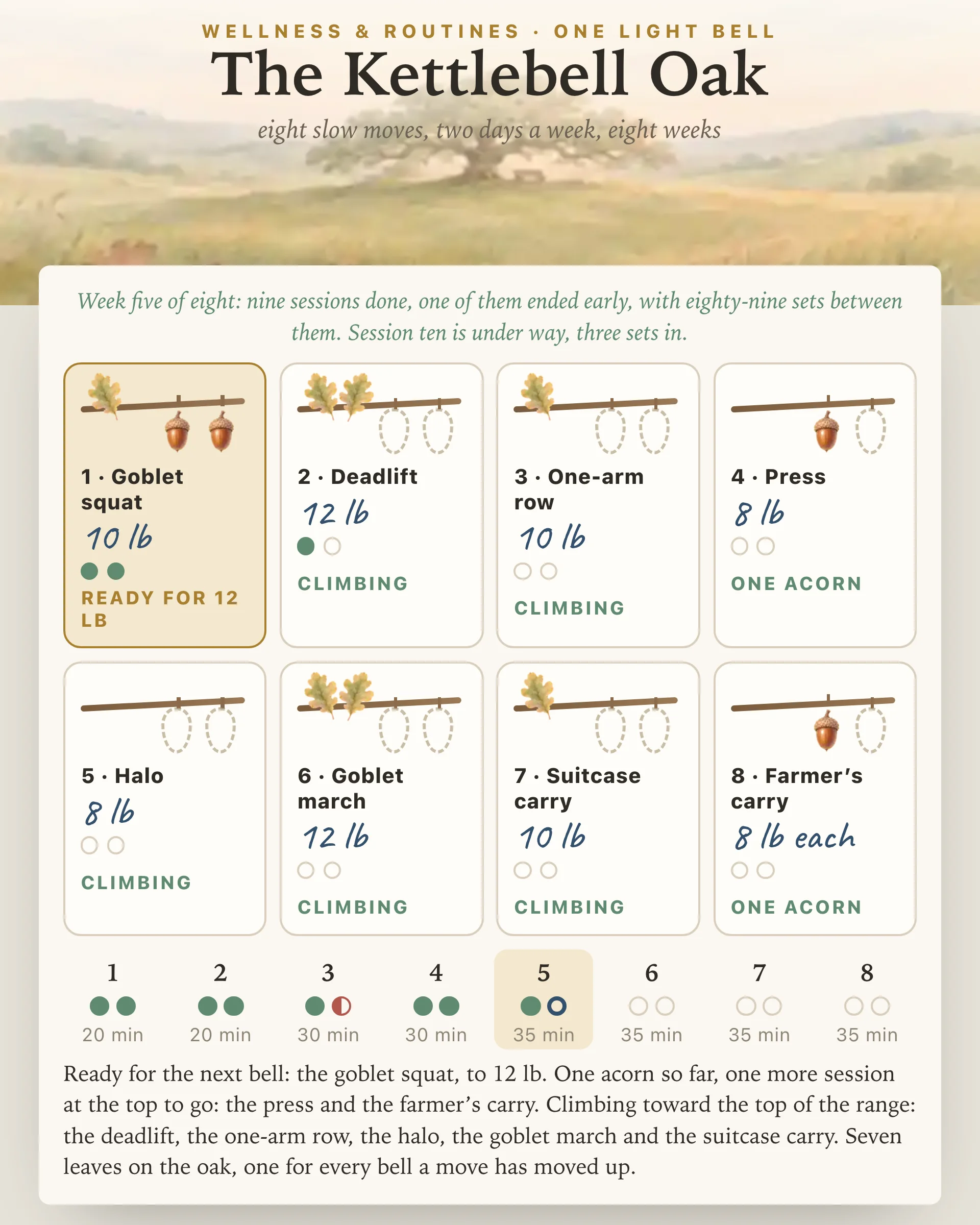
Pick your bell and every twig on the oak starts there. The card shows the next move, supported and standard versions side by side. Count me through gives you five seconds to get set, then paces each rep: three counts down to the chair, two to stand. Carries run on their own clock, and a minute of rest follows every set. You can also log a set done at your own pace.
The clocks read the real time since you pressed start, so a locked phone never bends them. A set stopped early keeps only its whole reps or seconds and never counts toward going heavier.
A twig earns an acorn for each whole session with every set at the top of its range, at the same bell and version. Two acorns in a row and the page offers the next bell. A session ended early, or a set cut short, breaks the row, and a set under the range suggests easing off. Each time a move climbs to a heavier bell, its twig grows a leaf.
A Cochrane review of 121 trials with about 6,700 older people found that progressive strength training, usually two or three times a week and pushed hard, had a large effect on muscle strength and a moderate to large one on getting up from a chair. Its effect on overall physical ability was small, and side effects were poorly recorded.
Kettlebell research in older people is thin. In a randomized trial run from a community center, 33 women aged 65 to 75 with low muscle mass and strength trained with kettlebells twice a week for eight weeks or carried on as usual. The training group finished with stronger backs and grips and more muscle than the women who did not train, and most of that difference remained four weeks after the classes stopped. It had no men, compared kettlebells only with doing nothing, and did not measure falls or daily tasks.
The BELL trial reported grip strength up about 6 to 7 kg in each hand, 42 more meters in a six-minute walk and three more chair stands in thirty seconds. But each person was compared with their own three months beforehand, with no separate control group, and most reported sore muscles at least once. This exact plan has not been tested in a trial, and nothing here promises fewer falls.
The Kettlebell Woodpile is a six-week beginner plan run minute by minute, and it teaches the two-hand swing. The Whole-House Strength Routine needs no bell, only your chair, stairs and grocery bags. The Six-Week Hay Wagon is carries only, three days a week. This page is one bell, eight slow moves and a support for every standing move.
Pick two days with rest between, such as Monday and Thursday, march in place for five minutes, and follow the card.
Slow moves that copy daily jobs: sitting to a chair and standing up, picking a weight up from a raised surface, rowing with one hand braced on a chair, pressing overhead, circling the bell around your head, marching in place, and carrying it at your side or with a weight in each hand. Each one here has a version with support.
Start with the bell you can hold at your chest for ten slow sits to a chair, the last two hard but steady, and carry at your side for twenty steps without leaning. Many people beginning after sixty land somewhere near 5 to 10 lb. A bell that feels light today is fine, because the plan tells you when a move is ready for more.
Swings move fast, and a fast bell is hard to stop partway through. In one trial, adults aged 59 to 79 learned them in small classes run by a physical therapist and a certified kettlebell coach, and one of the four minor injuries began during swings. This plan is done at home with nobody watching, so it keeps every move slow enough to stop mid-rep.
Two days a week with a day or two of rest between, such as Monday and Thursday. That matches the common advice of strength work on at least two days a week, and it leaves room for walking and balance practice on the other days.
Anyone who has had a fall or dizzy spells, a joint replacement or recent surgery, a heart or blood pressure condition, osteoporosis, or pain that keeps returning. Ask a doctor or physical therapist which moves and which bell suit you, and stop any move that hurts.
By the team behind Fabulous, the science-based self-care app used by over 30 million people.


