
The Overwhelm Recovery ProtocolWellness & Routines · ~5 min
About this template · Updated September 2026
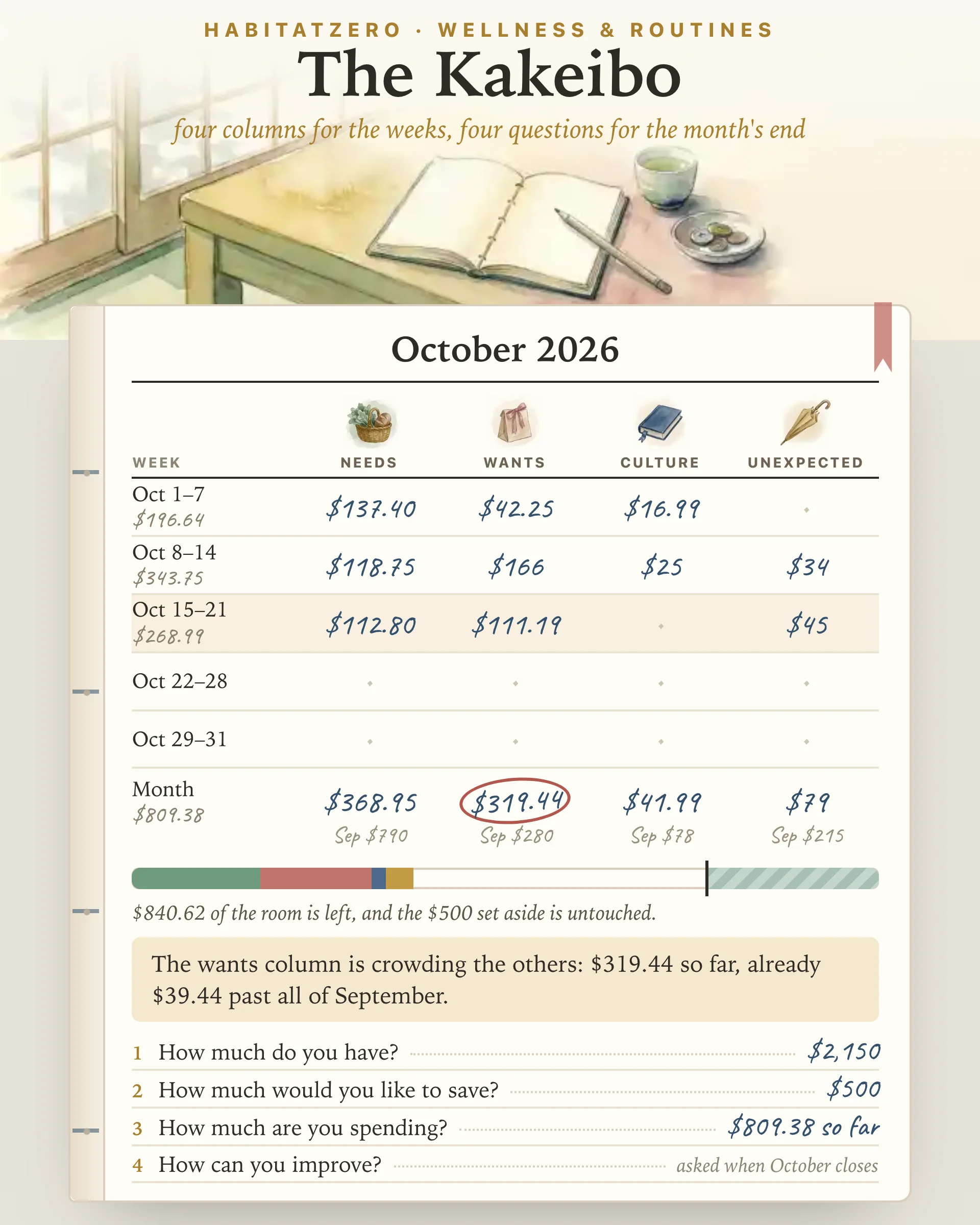
The kakeibo, a Japanese household account book, begins with Hani Motoko. She was a journalist who launched a women's magazine in 1903 and published her first account book the year after, and the publishing house she founded still issues a new edition every year (its site is in Japanese). This worksheet is an independent practice sheet built on her idea. Nobody at that publisher, and no kakeibo author, made it, reviewed it or vouches for it.
The method itself is plain. Before the month starts, you write down what will come in, what is already spoken for, and what you want to keep. As the month runs, you record what you spend. When it ends, you sit with the numbers and decide what to change. The work is the writing, and the pause it forces at both ends of the month.
Most English-language guides sort everyday spending into four columns:
Rent, utilities, insurance and loan payments stay out of the columns as fixed costs, subtracted on the first page.
Four questions frame the month: how much do you have, how much would you like to save, how much are you spending, and how can you improve. The first three are arithmetic. The fourth is the reason the book exists.
The first page takes three lines: what comes in, your fixed costs, and what you want to set aside. Take the last two from the first and you have the room, the amount you can spend across the four columns and still keep the goal.
Each spend takes a tap on its column, the amount, and a word for what it was. The table totals every week and every column in your handwriting, and a bar underneath fills toward the line where your savings begin.
The page reads two things back to you: whether the savings goal held, or how far spending ate into it, and which column is crowding the others. In a first month, that is the column taking the biggest share of the room. After that, each column total carries last month's figure in pencil, and the column that has grown furthest past it gets circled in red. Needs are often the biggest column, so the comparison with your own last month tells you more.
At the month's end, the first three questions are already answered from your figures. You write the fourth, then close the month. Closing seals the page against new lines and moves its totals to a shelf of closed months, and the next month opens with your fourth answer at the top. If you closed too soon, reopen the month to add a late receipt.
No controlled trial has tested the kakeibo itself. The papers that mention it are mostly write-ups of money workshops, so a promise that it will transform your finances outruns the evidence. What exists is research on its ingredients.
Writing progress down matters. A meta-analysis of 138 experiments found that interventions which got people to monitor their progress toward a goal helped them reach it, with larger effects when the progress was physically recorded (Harkin et al., 2016). It covers goals in general, so read it as support for recording, not as a result about money.
Putting the savings aside first has support too. In research with low-income households, people saved more when earmarked money was split into two accounts instead of pooled in one, and a visual reminder of the savings goal raised the savings rate further (Soman and Cheema, 2011). The first page and the goal line on the bar borrow from both findings.
The handwriting rests on a theory rather than a trial. Prelec and Loewenstein proposed that the pain of paying depends on how tightly a payment is coupled to what it buys, and that cards tend to loosen that coupling while cash keeps it tight (Prelec and Loewenstein, 1998). Writing each spend by hand may win back some of that link, a plausible reading rather than a tested one.
The page does sums, not financial advice, and it never connects to a bank. It cannot tell you whether your goal is realistic; if the month keeps ending short, talk it through with someone who can see your whole situation.
Fill in the first page on the first day of the month, or the evening before. Write spends in as they happen, or catch up from receipts on one evening a week. Close the book on the last day, while the month is still fresh.
If your fixed costs are a tangle of due dates, list them in The Bill Ledger first and carry the total onto the first page. December tends to fill the unexpected column with gifts, so plan that season alongside The Christmas Budget. And if the fourth question keeps pointing somewhere other than money, the Monthly Reset gives the rest of your month the same pause.
Kakeibo means household account book in Japanese. Hani Motoko introduced the idea in 1904: plan the month before it begins, write down what you spend as it happens, and look back at the end of the month with a handful of plain questions.
English-language versions sort everyday spending into needs such as groceries and gas, wants such as takeout and clothes, culture such as books, museums and classes, and unexpected costs such as repairs, gifts and copays. Rent and regular bills stay out of the columns as fixed costs, subtracted on the first page.
How much do you have, how much would you like to save, how much are you spending, and how can you improve. Here the first three fill themselves in from your figures, and the fourth is a single line you write before the month closes.
No. Hani Motoko's own account book is still printed every year by Fujin-no-Tomo-Sha, the Tokyo publishing house she founded with her husband. This page was made independently of that publisher and of every kakeibo author, and none of them has reviewed or backed it.
You can explore the filled example on this page without it. To keep a book of your own from month to month, with closed months on a shelf and each new month read against the last, personalize it in HabitatZero at no cost.
By the team behind Fabulous, the science-based self-care app used by over 30 million people.


