Leaves on a StreamEmotional Fitness · ~3 min
About this template · Updated September 2026
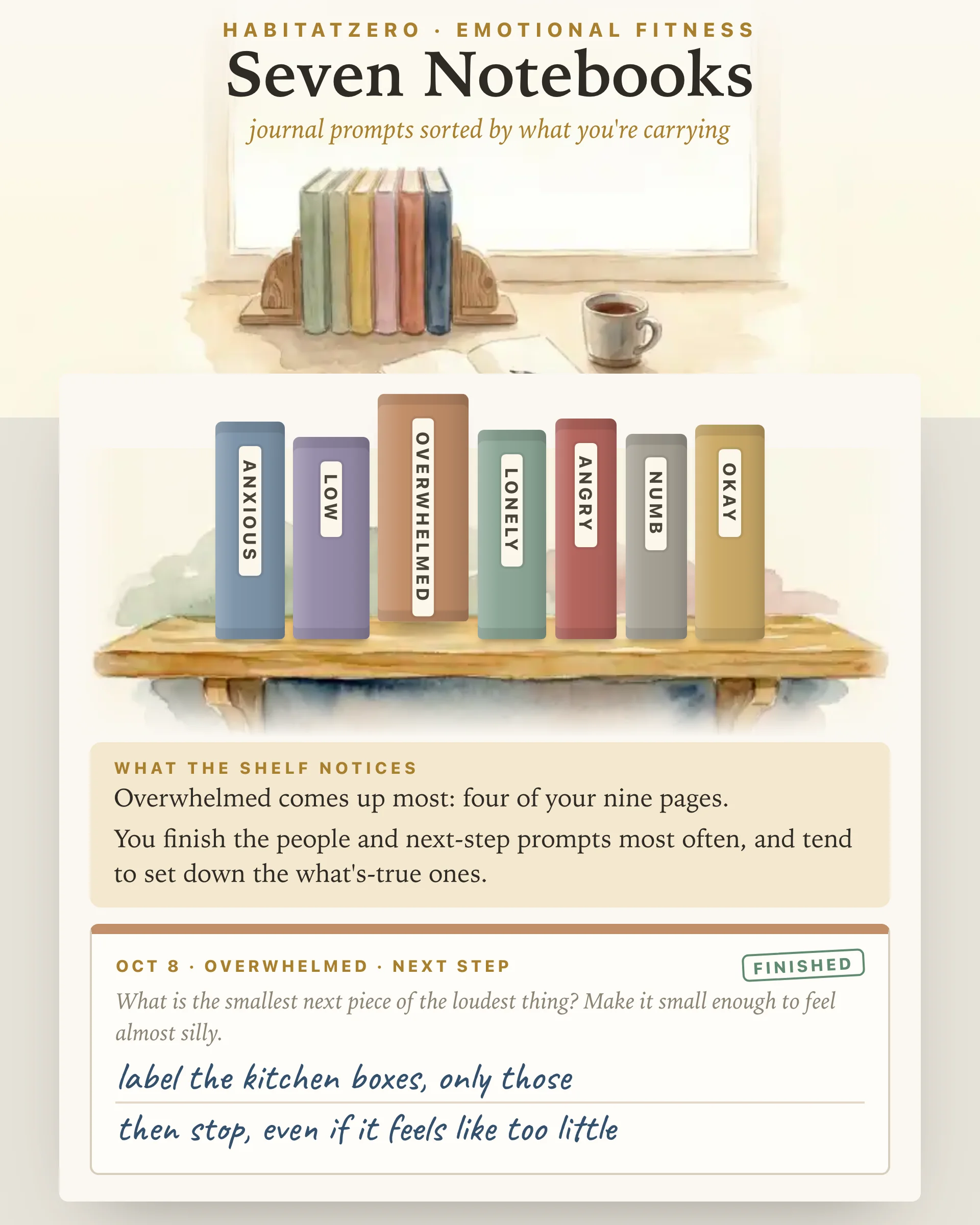
Most lists of journal prompts for mental health hand you fifty questions at once and leave the sorting to you, on the kind of day when sorting is the hard part. A question that helps on an anxious night can land badly on a numb afternoon. This page sorts first. It keeps seven slim notebooks on a shelf, one each for anxious, low, overwhelmed, lonely, angry, numb and okay, and asks you to take down the one closest to what you are carrying today.
Each notebook holds five prompts, always in the same order, because each one does a different job:
Because the five kinds repeat in every notebook, you slowly learn which kind of question works for you.
To start on paper, try one from each:
Each prompt opens onto three short lines in your own hand, with sentence starters such as The smallest version is for when starting is hard. One honest line is enough to mark a page finished, and a page set down halfway is kept too, labeled as set down.
Every page thickens the spine of its notebook, so the shelf becomes a picture of your weeks. Under it, two plain sentences say what it notices: which notebook you take down most, and which kinds of prompt you tend to see through or set down. You might find that overwhelmed is your thickest notebook, or that you finish next-step prompts and drop the what's-true ones.
In the first expressive-writing study, James Pennebaker and Sandra Beall asked college students to write for fifteen minutes on four days in a row about the most upsetting experiences of their lives. Writing about those experiences left students more stirred up right after the sessions, yet the ones who wrote about both the facts and their feelings went to the campus health center less often over the following months.
The benefit holds up, but it is small. When Joanne Frattaroli pooled 146 randomized studies of this kind of disclosure, writing and talking about feelings came out ahead on average by a modest margin. For low mood the picture is plainer still: a 2018 meta-analysis of thirty-nine trials found that brief, self-guided expressive writing did not reduce depressive symptoms over the long run, though effects were larger when people wrote more sessions and on more specific topics. A notebook, in other words, is not a treatment.
Ed Watkins's review of repetitive thinking found that turning something painful over in abstract terms (why me, what does this say about my life) tends to keep people stuck, while concrete thinking about what happened and what to do next is the more constructive kind. That is why no prompt on this shelf asks why you feel the way you do, and why every notebook ends on a next step.
These notebooks are practice at noticing what you carry and putting it into words. They can sit alongside therapy, and if one notebook keeps thickening for weeks, especially low or numb, that pattern is worth bringing to a doctor or therapist. If a low stretch ever turns into thoughts of not wanting to be alive, close the notebook and call or text 988 if you are in the US, or your local emergency number anywhere else, and tell someone near you tonight.
Take a notebook down when something sits heavy and you want words for it, and on steady days too, so okay gets pages of its own. If you cannot tell which notebook fits, the Feelings Wheel helps you find the word first. When a what's-true prompt turns into an argument with one loud thought, the Thought Record Journal gives that thought a proper hearing. On days when nothing in particular weighs on you, the open-ended Journal Prompts deck asks broader questions.
Concrete, answerable ones: where a feeling sits in your body, what you know for sure versus what you are guessing, who you could text tonight, and what the smallest next step would be. Questions that ask why you feel this way tend to send a low mood in circles, so every prompt here asks what or how and points somewhere you can go next.
It can help you notice patterns and put a feeling into words, but the measured effects are modest. A 2018 meta-analysis of thirty-nine trials found that brief, self-guided expressive writing did not lower depressive symptoms over the long run. Treat these notebooks as practice alongside real support, and if anxiety or low mood is shaping most of your weeks, bring it to a doctor or therapist.
Short and regular beats long and rare. A page on this shelf takes about five minutes, and the first expressive-writing study asked for fifteen minutes on four days in a row, not a lifelong habit. Write on steady days as well as heavy ones, so the okay notebook fills too and the shelf shows the whole picture.
A short dip right after writing about something painful is common in the research, and it usually passes. If a page starts pulling you under, set it down, which is allowed and still counts, then try a people or next-step prompt or talk to someone. Should a page ever leave you feeling unsafe, put the notebook away and call or text 988 in the US, or the local emergency number where you live.
No. This page lists one prompt from each notebook that you can try on paper today, and the filled example shows a shelf after nine days of pages. The full set of thirty-five prompts, your saved pages and the shelf's readings open when you personalize the template in HabitatZero, where signing in costs nothing.
By the team behind Fabulous, the science-based self-care app used by over 30 million people.