
The Overwhelm Recovery ProtocolWellness & Routines · ~5 min
About this template · Updated November 2026
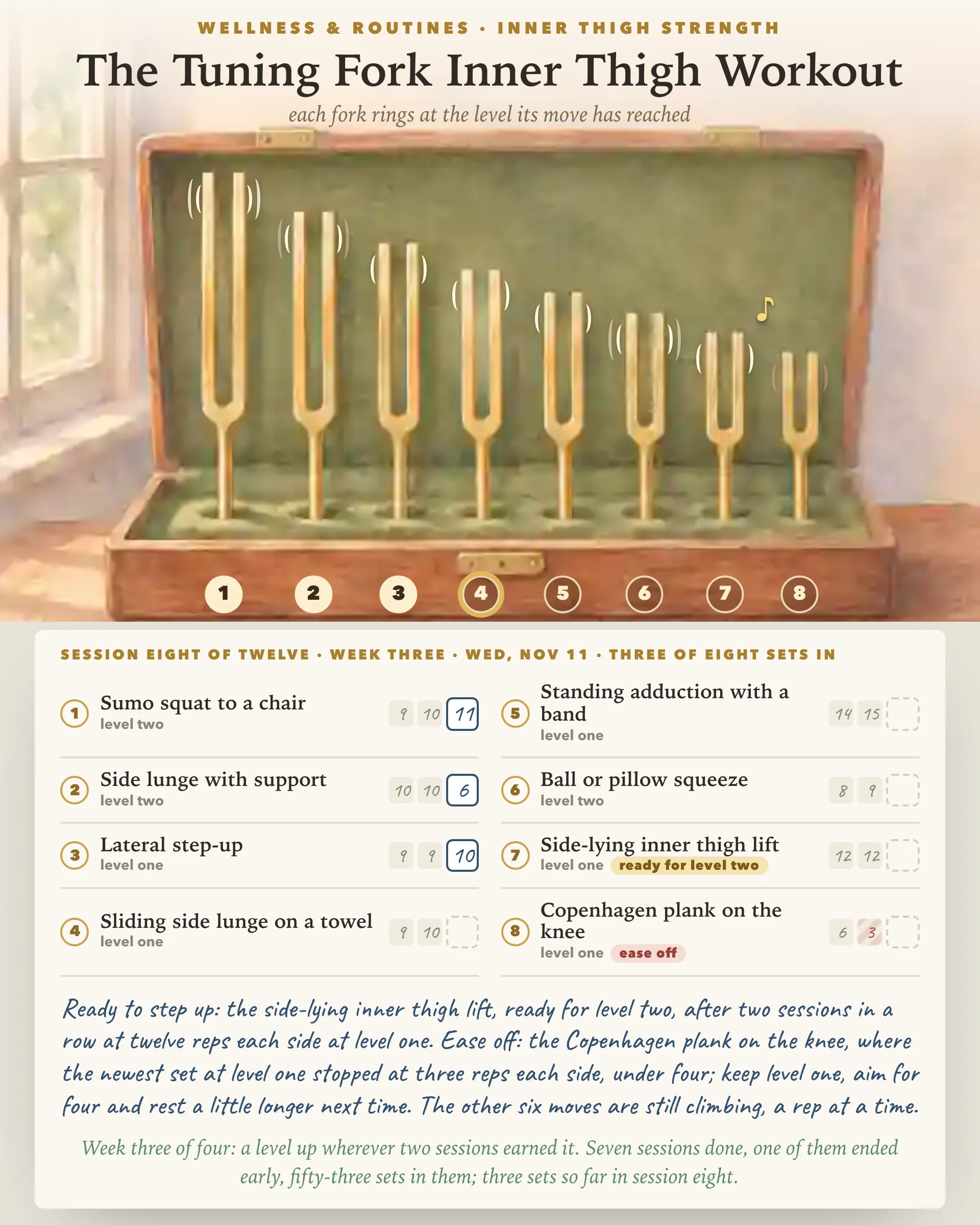
The muscles along your inner thigh, the adductors, draw your legs toward each other. You use them to step sideways, catch a sliding foot, stand on one leg to pull on a sock and rise from a wide squat, and they help keep your pelvis level whenever your weight moves onto one foot. This inner thigh workout trains those jobs with a chair, the counter, the bottom stair, a towel and a pillow, three days a week.
Many people look for an exercise to lose thigh fat. The honest answer: working a muscle does not burn the fat over it. In one small trial, eleven young adults trained a single leg on a leg press for twelve weeks. They lost fat, but from their arms and trunk, not from the trained leg (Ramírez-Campillo and colleagues, 2013). A later review pooled thirteen studies, with 1,158 people aged 14 to 71, that trained one limb and compared it with the other, and found no extra fat loss on the trained side (Ramírez-Campillo and colleagues, 2021). The trial was small and its volunteers young, and the review looked at one-limb training in general rather than this routine, but both found no special fat loss in the working limb. Body fat changes slowly across your whole body, with eating, sleep, everyday movement and time. This page makes no slimming or shaping promise; it is about strength.
A session runs from standing to the chair to the floor, so you go down once, at the end.
Each has three levels and a support option. Begin everything at level one. If the floor is hard to reach, do the side-lying move on a bed and end before the plank.
Eight painted tuning forks stand in a case at the top, one per move. Pick a level and your support, set the reps and start the set. The page counts you in and names each part of every rep. Its clock reads the real time, so a phone that locks mid-set still counts true. Stop partway and only whole reps go in, marked as stopped early. A minute of rest follows each set; cutting it short records nothing.
As sets go in, each fork rings with a pair of arcs per level, the outer pair stronger as your reps climb. When a move's two latest sessions, in order, both held a whole set at the top of its range at the same level, a gold note appears over its fork: that move is ready to step up. A session that ended before the move, a set at another level or a set stopped early breaks the run, and a set under the range turns the arcs rose to suggest easing off.
Twelve sessions, three a week with a rest day between. Each is three minutes of marching in place, one set of each move and a minute's rest between sets: about eighteen minutes at first, a little longer as reps and levels climb. The page works out each session's length from its parts.
In a randomized trial with 52 women soccer players in Norway, eight weeks of an adductor program built on the Copenhagen adduction exercise, the side plank done here on the knee, raised hip adduction strength, and a lower-volume version did as well as one with nearly twice the reps (Thorarinsdottir and colleagues, 2025). They were trained athletes with no group that skipped the program, so it shows a modest dose building strength in fit women, not what these moves do for a beginner. For older adults, a Cochrane review of 121 trials with 6,700 participants found that progressive strength training raised strength a good deal and made rising from a chair easier, with a smaller gain in walking speed (Liu and Latham, 2009). Most programs ran two or three times a week at high effort and side effects were poorly recorded, so it backs strength work in general, not these eight moves.
Ask a doctor or physical therapist first if you have groin or hip pain, a hernia, a recent hip replacement or a pregnancy, or if you have had a fall, dizzy spells, or a heart or blood pressure condition. Stop any move that hurts, breathe out on the effort and never hold your breath through a squeeze. Keep a sturdy chair or the counter within reach whenever you stand.
The Balloon Glute Workout trains the back and outer hip with a similar set-by-set plan, The Ten-Cup Band Board works the whole leg with bands, and The Hip Lanterns offer a gentler timed session for days when the floor is out of reach.
Start with moves where you control the effort: a pillow squeeze in a chair, a sumo squat to a chair and the side-lying move on a firm bed. Each has an easier first level, and the Copenhagen plank begins with your bottom knee resting on the floor.
All eight on this page use what most homes already have: a sturdy chair, the kitchen counter, the bottom stair, a towel on a smooth floor, a pillow and, from level two of one move, a resistance band looped around a heavy table leg.
No exercise burns the fat over the muscle it works. A 2021 review of thirteen studies that trained one arm or leg found the trained limb lost no more fat than the other one. Body fat shifts slowly across your whole body with eating, sleep, everyday movement and time. These moves build strength for knees, hips and balance.
Three days a week with a rest day between suits a beginner, and that is how the four weeks are laid out. Each session is one set of each move, about twenty minutes once you count the warm-up and the rests.
Ask a doctor or physical therapist first if you have groin or hip pain, a hernia, a recent hip replacement or a pregnancy, or if you have had a fall, dizzy spells, or a heart or blood pressure condition. Stop any move that hurts.
By the team behind Fabulous, the science-based self-care app used by over 30 million people.


