
The Overwhelm Recovery ProtocolWellness & Routines · ~5 min
About this template · Updated November 2026
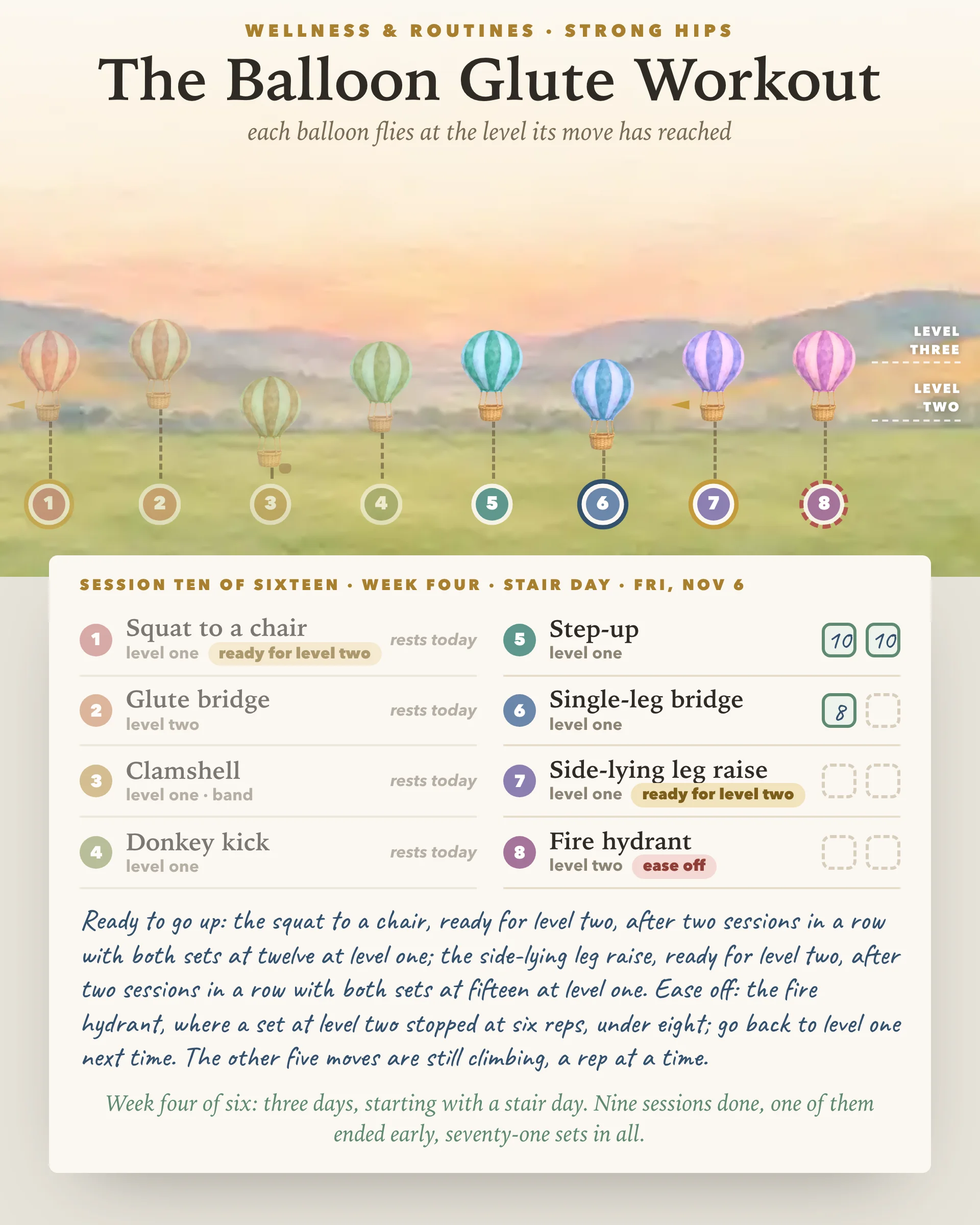
Your glutes are the muscles you rise with. They straighten your hips when you stand up from a chair, push you up each stair, hold your pelvis level while one foot is off the ground, and keep you steady as you carry a bag of groceries across the parking lot. This glute workout at home is built around those everyday jobs. It asks for a sturdy chair, the bottom stair, a patch of floor and about twenty minutes.
The plan alternates two short sessions. Chair day opens with a squat to a chair, then a glute bridge on your back, a clamshell on your side and a donkey kick, done either standing at the counter or on hands and knees. Stair day opens with a step-up on the bottom stair, then a single-leg bridge, a side-lying leg raise and a fire hydrant. Each day starts with its standing move, then goes down to the floor once, so you get up and down as little as possible. If the floor is hard to reach, the bridges, clamshells and leg raises all work on a firm bed.
For the first two weeks you train twice a week. From week three it becomes three days, with a rest day between sessions: sixteen sessions in all, two sets of every move.
Every move has three levels. The squat starts with your hands on your thighs to help you stand, moves on to arms reaching forward with no hands, and ends with a slow three-count lowering that only brushes the seat. A loop band just above the knees adds resistance at any level when you want it. The standing moves also let you choose your support: both hands on the counter or the stair rail, or a lighter touch with something steady close by.
Pick the move's level and press start. After a three-second count-in, the page counts each rep with you, two seconds up and two or three down depending on the move, and one-sided moves pause so you can change sides. A set goes into the log only when its last rep is done; stop partway and it records nothing. If you would rather keep your own pace, log the set yourself with the reps you did.
Between sets, a one-minute rest runs on the real clock. It measures from the moment the rest began, so a locked phone never stretches or shrinks it.
Across the top of the page, eight balloons wait on a meadow, one for each move. As a move gets stronger, its balloon climbs: one band of sky for each level, and within that band, as high as your reps have reached toward the top of the range. A glance shows which moves are climbing and which have stalled.
The rule is strict on purpose. A move is ready for its next level only after its two latest sessions, taken in order, both had every set at the top of the rep range at the same level and band. A session that ended before you reached the move breaks the run, and so does one done at a different level. When a move qualifies, its balloon flies a small gold pennant. At level three the next step is the band, and after that you slow every lowering. Stepping back is quicker than stepping up: a single set below the range is enough for the page to suggest easing off.
When researchers recorded muscle activity in 21 healthy, active adults doing twelve exercises, side-lying hip abduction, the leg raise here, drew the strongest signal from the gluteus medius on the side of the hip, while clamshells drew about half as much. Single-leg squats and single-leg deadlifts led for the gluteus maximus. That tells you which moves load which muscle in young, fit people. It cannot tell you what six weeks of training will change for you.
For training effects, a Cochrane review of 121 trials with 6,700 older adults found that progressive strength training, usually two or three times a week, had a large effect on strength and a moderate to large effect on getting out of a chair, with a smaller gain in walking speed. Its authors add that harms were poorly recorded, though joint pain and muscle soreness came up in many trials that watched for them, one more reason to begin at level one. The World Health Organization's 2020 guidelines ask adults to strengthen every major muscle group on two or more days a week, so these eight moves cover only part of that.
Check with a doctor or physical therapist first if you have had a fall or dizzy spells, a hip or knee replacement, recent surgery, a heart or blood pressure condition, or pain that lingers. Stop any move that hurts, and keep a sturdy chair or the counter within reach for every standing move.
For more than the hips, the resistance band workout takes a loop band through the whole body, squats for seniors goes deeper on the chair squat, and strength training for women over 50 brings in arms, back and core.
Squats to a chair, glute bridges, clamshells and side-lying leg raises make a sound start. They need only a chair and some floor, they reach the back and the sides of the hips, and each has a gentler version for the first weeks.
Yes, both train the three gluteal muscles of your seat. This page names them by the jobs they do for you every day: standing up from a chair, climbing stairs, carrying bags and keeping your stride steady.
The same eight moves work for anyone at a level that suits them. Bridges and clamshells go easy on the knees, the chair squat and step-up build the strength you use for chairs and stairs, and a hand on the counter keeps standing moves steady.
Two or three, with a rest day between, which is how this six-week plan is laid out. World Health Organization guidance asks adults to strengthen every major muscle group on two or more days a week, so your arms, back and core deserve a turn too.
No. Every move works without one, and level three stays challenging for weeks. A loop band just above the knees adds resistance once the top level feels easy, and the page suggests it only after two sessions in a row at the top of the range.
By the team behind Fabulous, the science-based self-care app used by over 30 million people.


