
The Overwhelm Recovery ProtocolWellness & Routines · ~5 min
About this template · Updated November 2026
Hunchback is the word many people type when the top of their back has started to curve forward. This page says rounded upper back instead (the medical word is kyphosis), and it gives you six weeks of slow exercises for the muscles that hold that part of your spine up. It cannot promise a straighter back. It gives you a steady practice and an honest way to watch what changes.
A rounded upper back is linked with low bone mass, compression fractures of the vertebrae and worn discs, as a review of age-related hyperkyphosis sets out. So see a doctor before you start if the rounding came on suddenly, if it hurts, or if you have osteoporosis or have had a spine fracture. Ask a doctor or physical therapist first, too, if you have had a fall, dizziness, a joint replacement, or a heart or blood pressure condition. Stop any move that hurts, and keep a sturdy chair or counter within reach whenever you stand.
Each has an easier and a standard version, and each starts easier.
None of them bends you forward. That matters if your bones are thin: a UK consensus statement on exercise for osteoporosis recommends spinal extension exercise for posture and advises against a high degree of forward bending, in exercise and in daily life. With osteoporosis, leave out any forward bend that carries a load, such as lifting a full basket from the floor with a rounded back.
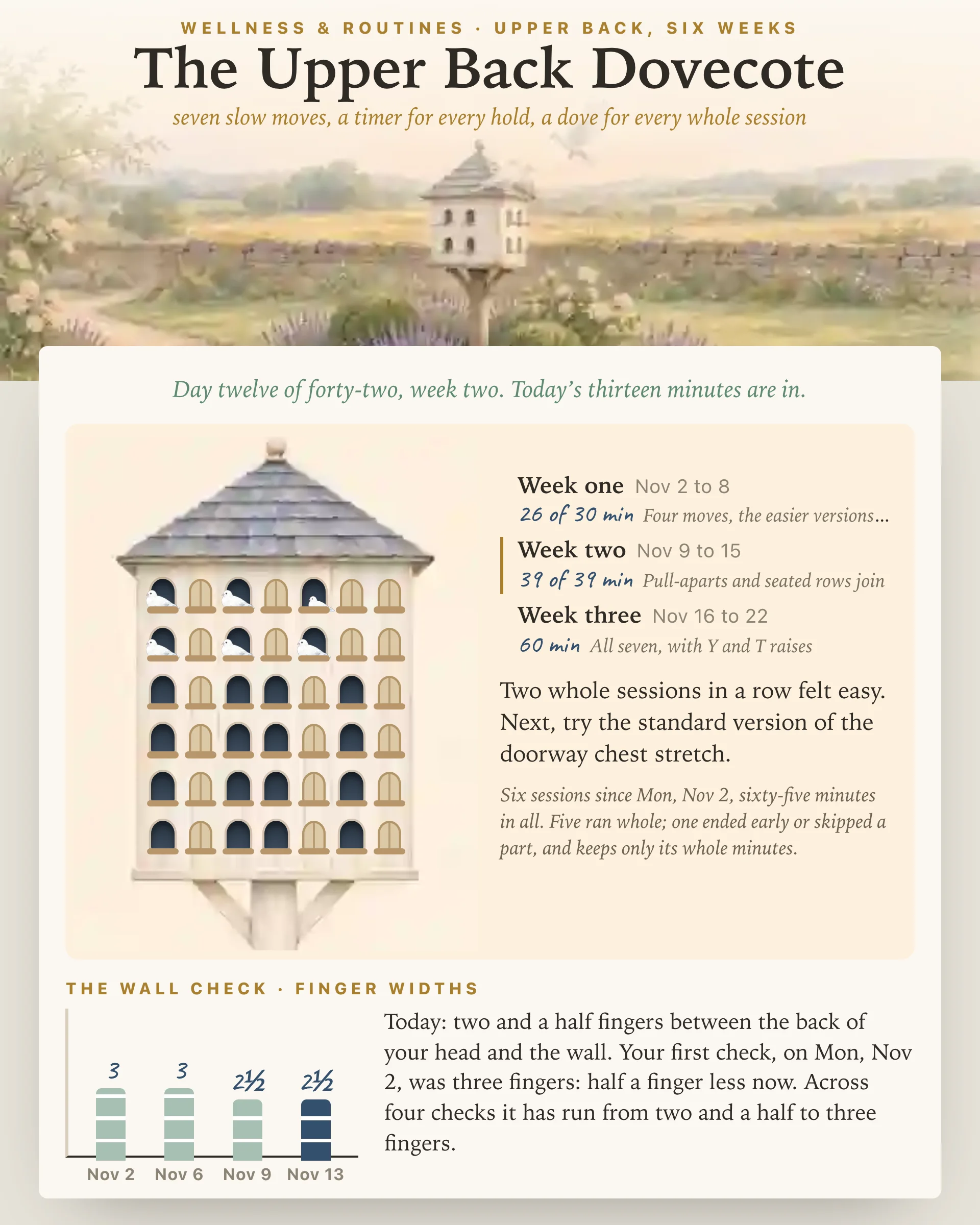
Week one is four moves for ten minutes, three days a week. Pull-aparts and seated rows join in week two, Y and T raises in week three, and from then on you practice four days a week. Holds lengthen and the slow moves gain a set; week six runs twenty minutes.
Press begin and the timer runs a minute of warm-up, then each move: a moment to get set, then holds with a countdown or slow reps paced beat by beat. A hold or set counts only once it has run its full time. Stop early and you keep your whole minutes and the holds you finished; under a minute keeps nothing. Skipped seconds never come back as time done.
The six weeks are drawn as a dovecote, one tier a week with seven openings each. A whole session brings a dove home to that day's opening; one that ended early or skipped a part leaves its dove on the perch. Rest days stay shuttered.
After each session, tap how it felt. Two whole sessions in a row that feel easy are the sign to try one move's standard version, and a hard session points you back to the easier ones.
Stand with your heels, hips and upper back against a wall, knees soft and eyes level. Let your head settle back without lifting your chin, and if it does not reach, count the finger widths in the gap. Each check is compared only with your own earlier ones, with no norm and no verdict, because the gap moves with the hour, your sleep and how long you sat. If it widens by a finger or more, or the rounding came on quickly or with pain, show a doctor.
The clearest trial is SHEAF: 99 adults aged 60 to 88 with a pronounced curve took hour-long classes of spine strengthening and posture training, led by a physical therapist, three times a week for six months. On X-ray their curve came out about three degrees smaller than in a group who attended health education meetings. Their walking speed and other tests of physical function did not differ.
A systematic review of thirteen exercise studies in adults over 45 found that eight improved at least one measure of posture, but the studies were too few and too uneven to pool into one estimate. So targeted exercise can shift a rounded upper back a little, over months, with far more practice than this plan asks. Treat these six weeks as a start you can keep up.
The Plumb Line Posture Plan is a lighter daily habit for general posture: five moves, ten minutes a day for four weeks, and a wall check of how your head, shoulders and hips meet the wall. This page is the six-week program for the upper back alone, with an easier version of every move and a wall check counted in finger widths. On tight desk days, The Neck and Shoulder Yoke pairs well with it, and for a whole-body routine at a wall, the Marble Run circuit has eight moves at three levels.
They can help some people a little. In a six-month trial of 99 adults aged 60 to 88 with a pronounced curve, classes led by a physical therapist left the curve about three degrees smaller on X-ray than in a comparison group. Nobody can promise that result, and six weeks of short sessions is a far smaller dose.
The studies that measured a change ran for months, with hour-long classes several times a week. Six weeks is enough to learn the seven moves, settle on the right versions and find out whether the habit fits your days. Your wall check may shift a little or not at all.
Usually several things at once. A rounded upper back is linked with weaker muscles along the spine, worn discs between the vertebrae and, in some people, small compression fractures that go with low bone mass. That last cause is why rounding that appears quickly or hurts should be seen by a doctor first.
Stand with your heels, hips and upper back on a wall, knees soft, eyes level and a chair within reach. Let your head settle back without lifting your chin, then slide your fingers, side by side, into any gap behind it. Compare the count only with your own earlier checks, never with anyone else.
None of the seven moves bends you forward, and spine extension work is what an expert consensus on osteoporosis recommends for posture. Even so, ask your doctor or a physical therapist before you begin, leave out any forward bend that carries a load, and stop any move that hurts.
By the team behind Fabulous, the science-based self-care app used by over 30 million people.


