
The Overwhelm Recovery ProtocolWellness & Routines · ~5 min
About this template · Updated November 2026
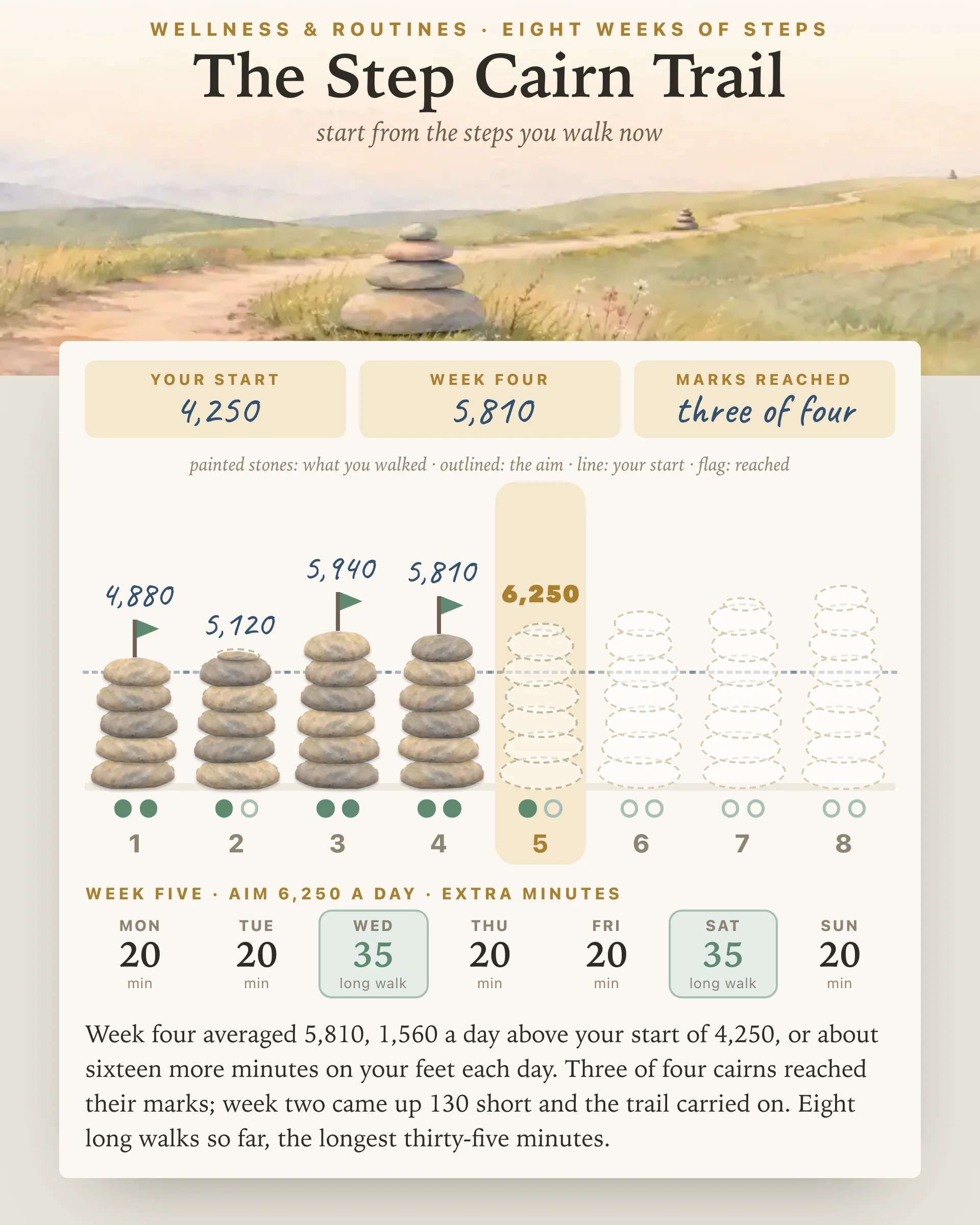
How many steps does it take to lose weight? The honest answer is that no step count guarantees a change on the scale. Weight answers to what you eat, how you sleep, your medications, your age and plain time, and steps are one part of that picture. What steps can give you is a target you fully control, starting from the number you already walk rather than a round figure picked for everybody.
Most phones keep a step history, and the weekly view shows a daily average. That average is your start. Someone who walks 3,000 steps on an ordinary day and someone who walks 8,000 need different plans: one fixed target is out of reach for the first and means nothing to the second.
From your start, the trail adds a little each week. On the gentle pace the daily aim rises by about five hundred steps a week. On the steady pace it rises by a thousand a week for three weeks, then by five hundred. Week four holds still on both, so the new amount can settle. The aim stops rising at ten thousand a day; if you already walk more than that, the daily number stays put and only the long walks grow.
To turn steps into time, the page uses one rule. At a moderate pace most adults take around a hundred steps a minute, a figure a review of walking cadence studies found to be a consistent marker of moderate intensity. So a thousand extra steps is roughly ten more minutes on your feet.
Walking on its own helps less than headlines suggest. A meta-analysis of nine pedometer-based walking programs with no diet change found modest weight loss on average, and longer programs did better than short ones. The authors note that people who walk more tend to weigh less, but that link on its own cannot show which causes which.
A Cochrane review of forty-three trials on exercise for people with overweight or obesity landed in a similar place. Exercise by itself produced small losses, exercise together with changes in eating did better than eating changes alone, and blood pressure, triglycerides and fasting blood sugar improved even when weight barely moved. A week when the scale stays where it was can still be a good week for your body.
How much walking, then? The American College of Sports Medicine's position stand on activity for weight loss found that 150 to 250 minutes a week of moderate activity brings only modest loss, that more than 250 minutes was linked with larger changes, and that the moderate amounts helped most alongside moderate changes in eating. By week eight the gentle pace asks for about thirty-five extra minutes a day, near that 250-minute line if the minutes are brisk. The steady pace goes past it.
None of this research can tell you what you personally will lose. Two people taking the same steps can see very different results, which is why this page never shows a weight or calorie figure. It tracks the walking, the part that is yours to decide.
Tap the number nearest your daily average, or nudge it, then choose a pace and one or two long walks. Eight cairns appear in dashed outline up to each week's aim, with a dashed line marking your start. Tap each long walk once you have taken it. At the end of the week, copy your phone's daily average into the box and stack it: painted stones rise to your number, one for each thousand steps and a smaller one for the rest, and a little flag goes up when a cairn reaches its aim.
A stacked week keeps the aim it was walked against, so changing pace partway through only reshapes the weeks ahead. Your start locks once the first week is stacked, so every cairn measures from the same line. The note under the trail does the arithmetic for you.
Two ten-minute walks after meals cover the week-three aim on the gentle pace with room to spare. Phone calls on foot and a loop of the block add up too. Put the long walks where your week has room and move them freely, since the cairn measures the weekly average, not the day.
Short weeks happen. A cold or a week of travel will leave a cairn under its mark, and the trail simply carries on. If two weeks in a row come up short, switch to the gentle pace or walk the next week at the last aim you reached.
If you have had a fall, dizziness, a joint replacement, a heart or blood pressure condition, or pain that keeps coming back, ask a doctor or physical therapist how quickly to add steps before you begin. Stop any walk that hurts, and while your footing feels unsure, choose routes with a railing to hold or a bench to rest on.
If you would rather plan in minutes than in steps, a four-week plan strung as cords of beads fits you better. The pocket pedometer dial turns your steps into miles, and a ribbon of four kinds of walk adds brisk stretches and gentle hills to the walks themselves.
No single count works for everyone, because the scale also answers to food, sleep, medication and time. A more useful aim is a few thousand steps a day above what you walk now, built up over weeks, which is roughly what this plan reaches by week eight.
It can help, though usually by a modest amount on its own. Reviews of exercise trials find bigger changes when more movement comes together with changes in eating, and walking improves blood pressure and blood sugar even when weight barely moves.
Nobody can honestly put a number on that. Two people taking the same steps can see very different results, so this plan tracks the walking itself, the part you control, and leaves weight to the bigger picture of eating, sleep and time.
It calculates a walking plan rather than a weight figure. From your current daily average and a pace, it works out each week's step aim, how many extra minutes that means on each day at about a hundred steps a minute, and how long the long walks run.
For most people, adding steps slowly is one of the safest changes there is. If you have had a fall, dizziness, a joint replacement, a heart or blood pressure condition, or ongoing pain, ask a doctor or physical therapist how fast to build up, and stop if anything hurts.
By the team behind Fabulous, the science-based self-care app used by over 30 million people.


