
The Overwhelm Recovery ProtocolWellness & Routines · ~5 min
About this template · Updated November 2026
Many hourglass workouts promise a smaller waist and wider hips. This one makes a smaller promise and keeps it: eight weeks of strength work for your upper back, shoulders and hips, three days a week, with every set written down. Your outline is mostly set by things no workout reaches, so here is the plain version first.
Start with bone. The width of your pelvis and the span of your shoulders come from your skeleton, which stops growing in early adulthood. No exercise widens a pelvis or lengthens a collarbone.
Next come genes. A genome-wide study of up to 224,459 people, by an international consortium with its first author at Umeå University in Sweden, found 49 regions of DNA tied to waist-to-hip ratio after allowing for body size, and of the 20 that acted differently by sex, 19 had a stronger effect in women. It shows that where fat settles is partly inherited; it cannot tell you how much of any one person's shape comes from those genes.
Then age and hormones. A UCLA team following women through midlife in the Study of Women's Health Across the Nation found that fat gain doubled in pace at the start of the menopause transition while lean mass began to fall, with both changes leveling off about two years after the final period. That study tracked women; it did not test an exercise plan. It helps explain a waistline that changes in your forties while your routine stays the same.
Exercise cannot pick which fat you lose. In a small trial at a university in Illinois, 24 inactive adults (14 men and 10 women) did seven abdominal exercises five days a week for six weeks; they gained endurance, yet their belly fat, waist measurement and skinfolds did not change more than a group that did nothing. Six weeks is short and the group was tiny, so it settles little alone, but it gives no sign that a waist answers to the moves aimed at it.
Muscle is the part you can build. A 2020 meta-analysis led by a researcher at the University of Alabama at Birmingham pooled studies where men and women followed the same program and found that women grew muscle at a similar rate to men, relative to where they started, and gained relatively more upper-body strength. The studies were short and mostly in younger adults, so take it as encouragement, not a forecast. Months of training the muscles across your upper back, the caps of your shoulders and your glutes can shift your proportions a little. What you can count on is getting stronger at lifting, carrying and climbing.
Four moves train the back and shoulders: a row, an overhead press, a lateral raise and a reverse fly. Three train the hips and legs: a hip thrust or glute bridge, a goblet squat and a side lunge. The eighth, a side plank on the knee, works the muscles along your sides and the outside of your hips. Each has an easier version and a full one, such as a squat to a chair before the free goblet squat.
A session takes thirty-five minutes: a five-minute warm-up, twenty-six minutes for two sets of each move with a rest after every set, and a four-minute cool-down. The upper-body moves take dumbbells or a resistance band; the lower-body moves can start with no weight.
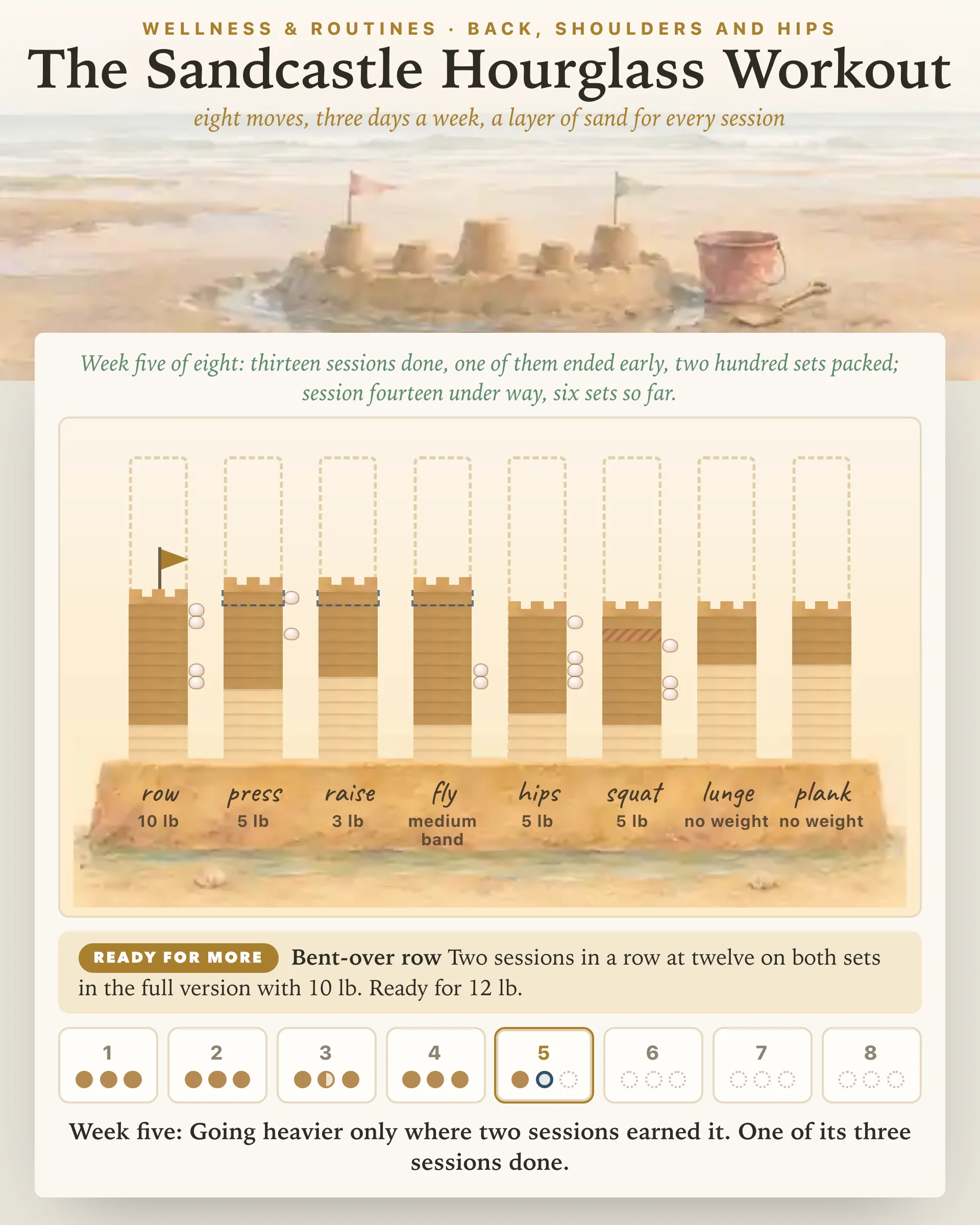
Every move is a sand tower on a castle wall. Pick a tower, choose its version and load, tap the reps you did, and pack the set. Each session you finish adds a layer to every tower you worked: darker sand for the full version, paler for the easier one. A set you stop early still goes in, hatched in red, and a session you end early keeps whatever it holds.
After a set, a rest dial counts down in real time, so a locked phone still shows the right time. A move earns a heavier load only after two whole sessions in a row at the top of its range in the full version, with nothing stopped early; then its tower raises a gold pennant. Sets done the easier way build the tower but never count toward going heavier. Two sessions in a row that fall short suggest easing off instead.
The page tracks what you did and lifted. It never asks for a measurement, a photo or your weight.
The Balloon Glute Workout is a fuller lower-body session built around rising and climbing. The Dumbbell Bookshelf is a shorter whole-body circuit for one pair of dumbbells. The Strength Doorframe is a twelve-week beginner plan built on six whole-body movement patterns. This castle splits its work between back, shoulders and hips, and says plainly what that can and cannot do.
Talk with a doctor or physical therapist before week one if you are pregnant or gave birth in the past year, live with a heart or blood pressure condition, are recovering from an injury or surgery, or have joint pain that lingers. Muscles that feel warm and tired are working; a sharp or pinching pain means stop that move for the day. Keep a sturdy chair within reach for the side lunge.
Not on its own. The width of your hips and shoulders is bone, and where your body stores fat depends largely on genes, age and hormones. Training your upper back, shoulders and glutes builds muscle there over months, which can change your proportions a little, and it makes you stronger whatever shape you are.
No move burns fat from one chosen spot. In a six-week trial, adults who did abdominal exercises five days a week gained endurance but lost no more belly fat than a group that did nothing. Overall fat loss comes from eating, sleep, activity and time together, and where it comes off first is not up to you.
This plan uses eight: a row, an overhead press, a lateral raise and a reverse fly for the back and shoulders, then a hip thrust or glute bridge, a goblet squat, a side lunge and a side plank on the knee. Each has an easier version and a full one.
Three sessions a week of about thirty-five minutes, with a day off between, is enough. Most people feel stronger within a few weeks, as the weights they lift climb. Any visible change in muscle takes months, and it varies a great deal from person to person.
For the upper-body moves, a pair of light dumbbells or a resistance band will do, and the page logs either one. The squat, side lunge and hip thrust can start with no weight, and the side plank never needs any.
By the team behind Fabulous, the science-based self-care app used by over 30 million people.


