Leaves on a StreamEmotional Fitness · ~3 min
About this template · Updated September 2026
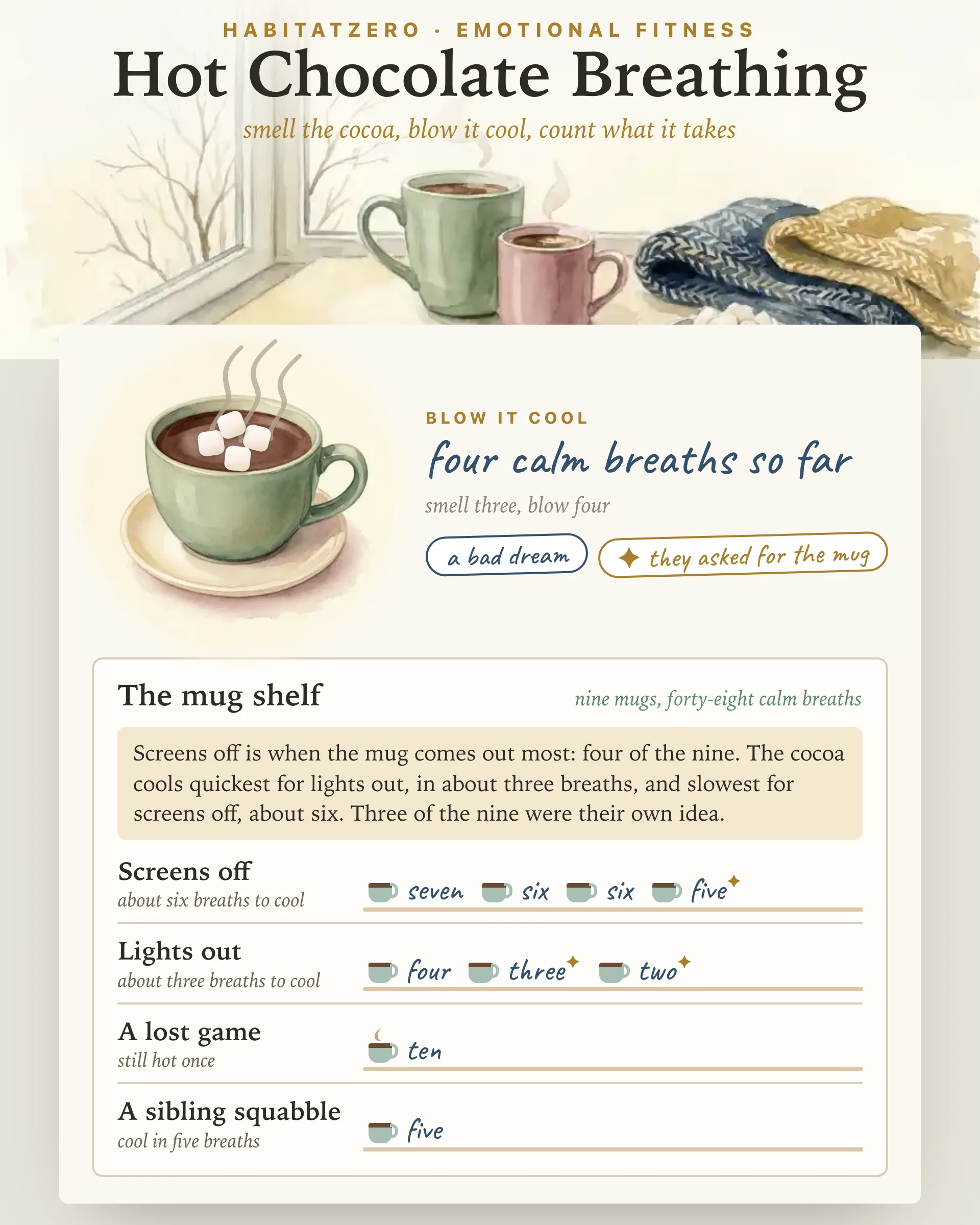
Picture your child with both hands around a mug of cocoa that is still too hot to drink. They lean in for a long sniff, then blow across the top so gently that nothing splashes. That is the whole exercise. Hot chocolate breathing turns a calm breath into a small piece of pretend play: in through the nose to smell the cocoa, out through the mouth to cool it. University of Illinois Extension describes it as an easy deep-breathing practice for any age and suggests five breaths in a row.
The instructions here are for the adult. The mug belongs to your child.
"Take a deep breath" is abstract to a small child, and it often comes out fast and loud. The mug splits the breath into two things children already know how to do. Smelling something lovely is slow by nature and happens through the nose. Blowing on a hot drink is soft by nature, since a hard blow would slop it over the rim. So the breath out stretches past the breath in without anyone counting aloud.
Practice on easy afternoons first. A mug sniffed and blown a dozen times on quiet days is far easier to pick up in a hard minute.
A painted mug sits under three curls of live steam. Press pick up the mug and the steam rises while your child smells, then bends away while they blow. Each full breath drops a marshmallow into the cocoa, and the count shows in words. Pick the shorter count for younger children and the longer one for older kids.
You and your child decide when the feeling has eased, not the page; then tap cool enough to sip. A mug holds ten marshmallows at most, and a child still boiling after ten slow breaths needs something else, like a hug, a glass of water or a walk to another room.
Then tap the moment it came out, such as screens off or a bad dream, mark it if your child asked for the mug, and shelve it. From the third mug, the shelf reads back which moments bring the mug out most and roughly how many breaths each one takes to cool. If lights out settles in about three breaths while screens off takes six, offer the mug before the tablet goes away. More mugs marked as their idea means the skill is becoming theirs.
No study tests hot chocolate breathing by name, and the research on slow breathing in children is encouraging but modest. In a preregistered field experiment, 342 children averaging about seven and a half watched either a one-minute animated video that guided a few slow, deep breaths or a look-alike informational video. Heart rates fell only with the breathing video, mostly in its second half, where the breathing happened. That is the body calming in the moment, not a lasting change.
A study following 171 children aged nine to thirteen through fifteen ordinary days is more sobering. On a typical day, a guided slow breathing exercise made no difference to how relaxed or upset they felt, compared with watching another video or doing nothing. The exception came on the more anxious days: when a child's worry ran above their own usual level, breathing beat doing nothing for relaxation, though it was not more relaxing than the other video. Context matters, the authors concluded, which is why this page files each mug under its moment instead of one score.
Playful breathing has been tried at the dentist too. In a randomized trial with 66 children aged seven to eleven, those taught a bubble-breath exercise before a numbing injection had lower pain scores by their own ratings and an observer's, while their anxiety and behavior did not differ significantly from the comparison group's.
The shelf can't prove the cocoa did the calming, since feelings also pass on their own and a patient adult helps; it records patterns worth acting on. Think of the mug as a coping skill to practice, not a treatment for anxiety. When worries or meltdowns start costing your child sleep, school days or friendships, that is a conversation for their pediatrician.
Offer the mug just before the moments your shelf flags, not at their peak. It fits the wait before a shot, the last minutes of screen time and the wind-down before lights out. For a child who likes to watch a shape, Star Breathing moves at a steady pace around five points, and Bubble Breathing trains the same long, soft blow with a painted wand. A cozy spot set up like a Calm Corner gives the mug a regular home.
Slow breathing should never feel like a strain. If your child gets light-headed, drop the counting and let them breathe however feels comfortable.
It is a slow breathing exercise for children that runs on pretend play. Your child holds an imaginary mug of hot cocoa, breathes in through the nose to smell it, then breathes out gently through the mouth as though cooling it down. Smelling keeps the breath in slow, and blowing on a drink you do not want to spill keeps the breath out soft and long.
Practice on a calm afternoon first, ideally with a real mug of warm cocoa so the smell and the blowing make sense. Sit together, sniff slowly, blow softly, and move straight from each blow into the next sniff without holding the breath. Once the pretend mug feels familiar, offer it a little before the moments that usually boil over.
There is no set number. Many versions suggest about five. This page lets your child keep going until the feeling settles and stops at ten, because a child who is still upset after ten slow breaths usually needs something more, such as a cuddle, a drink of water or a change of room.
It can help a child settle in the moment, which is not the same as treating anxiety. In children, a few guided slow breaths have lowered heart rate, and a study that followed kids through their days found breathing helped mainly on days they were more worried than usual. If worries keep getting in the way of school or sleep, talk with your pediatrician.
Anyone can read this page and look over the sample mug and shelf. Breathing along with the painted steam and keeping a shelf of your own child's mugs happens in HabitatZero, which is free to open.
By the team behind Fabulous, the science-based self-care app used by over 30 million people.