Leaves on a StreamEmotional Fitness · ~3 min
About this template · Updated September 2026
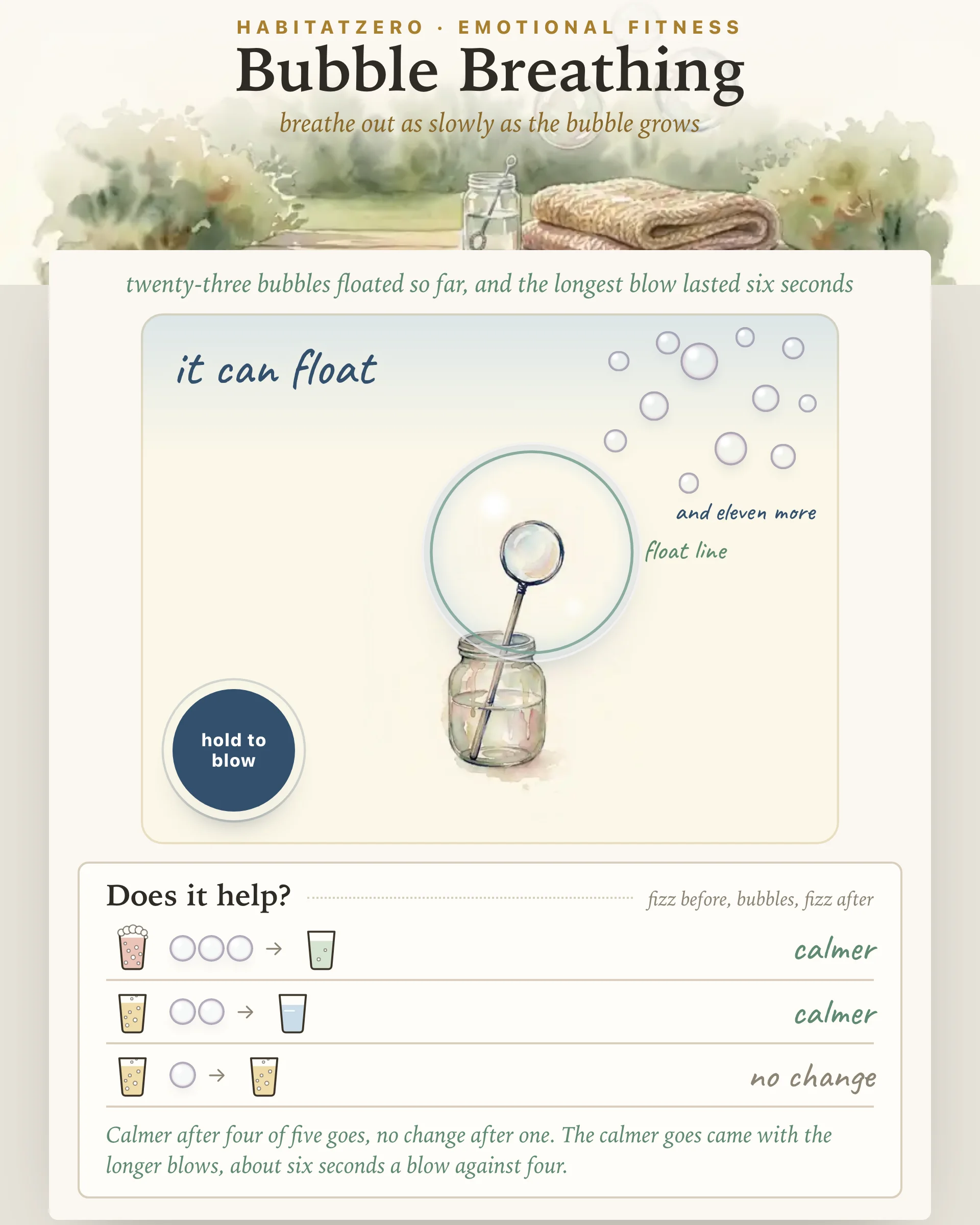
Most children already know the trick behind this exercise from a wand and a pot of soap. Blow hard and the film bursts. Blow slowly and steadily and a bubble swells, wobbles free and sails away. Bubble breathing borrows that motion: breathe in through the nose, then out through rounded lips as gently as you would to grow the biggest bubble you can. You read this page; your child gets the wand.
Ask a worked-up child to take a deep breath and you often get a gulp: a fast, noisy breath in with the shoulders up by the ears. The breath in is hard to slow on request. The breath out is different. Children practice controlling it with birthday candles, whistles and bubbles, and they can feel when they are pushing too hard. Stretch the exhale and the whole breath slows with it. So the page gives the bubble one job: to make a long, gentle breath out visible, and to reward it.
Your child breathes in first, then presses and holds the round button, or the wand itself, and blows. The bubble grows only while the press lasts. The page cannot hear breathing, so it trusts the finger: a steady hold stands in for a steady blow, which is why it helps to try it together once.
A dotted ring around the wand shows how big the bubble has to get. Once the bubble passes it, the ring turns solid green. Let go then and the bubble drifts up and settles in the sky, filling one of five dotted slots that make a full go. Let go before the ring and the bubble pops, gently, which only means the next blow can be slower. A ten-second blow floats off on its own.
The starting size is yours to set: a small bubble floats after three seconds of blowing, a middle one after four, a big one after six. Resting breathing slows as children grow, and a review pooling measurements from nearly four thousand healthy children charted the rate falling from birth into early adolescence, so three seconds is already a long breath out for a four-year-old. After three easy floats in a row, each well past the ring, the page suggests the next size up. After three pops in a row, it suggests a smaller bubble for today. It counts every float, remembers the longest blow, and answers to a held space bar as well as a finger.
Below the wand sit four optional glasses, from fizzing over to still. To learn whether bubble breathing settles your child, let them tap the glass that matches how fizzy they feel inside before the first bubble, and again after a few. Each go lands on a small chart with its bubbles between the two glasses. Once there are a few, the page says in plain words how often the fizz settled and whether the calmer goes came with longer blows. None of it measures anything clinical; it helps you notice, over a week or two, whether this tool suits this child.
No study we could find tests bubble breathing itself, so the evidence comes from slow breathing in general. In a small laboratory study of thirty adults, breathing with a long breath out relative to the breath in left people feeling more relaxed and less stressed than the same breathing rate with the proportions reversed. A larger trial then followed a hundred adults through twelve weeks of slow breathing practice. Their anxiety scores fell, but the group given the longer exhale did not do significantly better than the group breathing evenly. Taken together, the long out-breath looks like an easy way into slow breathing rather than a special formula.
With children, the clearest evidence concerns the moment itself. Researchers showed more than three hundred and forty children, with an average age of seven and a half, either a one-minute cartoon that coached a few slow breaths or a similar cartoon with no breathing in it. Only the breathing cartoon brought heart rates down and lifted a heart rhythm tied to rest. That is settling in the moment, a long way from treating anxiety. If worries or meltdowns come often and linger, talk to your child's doctor. The wand is a small tool, not a plan.
Teach it on an easy day, ideally with a real pot of bubbles first. After that it fits the small gaps in a day: the minute after a tumble, the wait before a new class, the last thing before lights out. A few bubbles is plenty; the five slots are a finish line, not a quota.
If your child already knows Rainbow Breathing, the two sit well together: the rainbow sets an even rhythm of in and out, while the bubble trains the long breath out. Both belong in a Calm Corner, and for your own evenings, Box Breathing is the grown-up cousin, with four even sides instead of a wand.
If a long blow ever leaves your child light-headed, stop, let them breathe normally for a minute, and choose a smaller bubble next time.
It is a slow breathing exercise for children that borrows the motion of blowing soap bubbles. You breathe in through the nose, then out through rounded lips as gently as you would to grow a big bubble on a wand without bursting it. The long, even breath out is the heart of it.
Begin with a real pot of bubbles on a calm day. A hard puff bursts the film and a slow, steady blow grows a bubble, so the wand teaches the pace without any explaining. Next time, try it with an imaginary wand, and bring out the painted one here when the real pot is out of reach.
Children as young as three can usually do it once they can blow out on purpose, and older children and adults use it too. The part that grows with age is the length of a comfortable slow breath out, so the smallest bubble here floats after three seconds and the biggest after six.
A child can slow a breath out far more easily than a breath in, and a long exhale pulls the whole breath down to a calmer pace. In adults, a longer out-breath has been linked to feeling more relaxed, though a larger trial found that once breathing was slow, making the exhale longer added little.
It can take the edge off in the moment, which is not the same as treating anxiety. In one study, a short cartoon that coached children through a few slow breaths lowered their heart rates while they watched it. If worries come often and linger, bring them up with your child's doctor.
By the team behind Fabulous, the science-based self-care app used by over 30 million people.