Leaves on a StreamEmotional Fitness · ~3 min
About this template · Updated September 2026
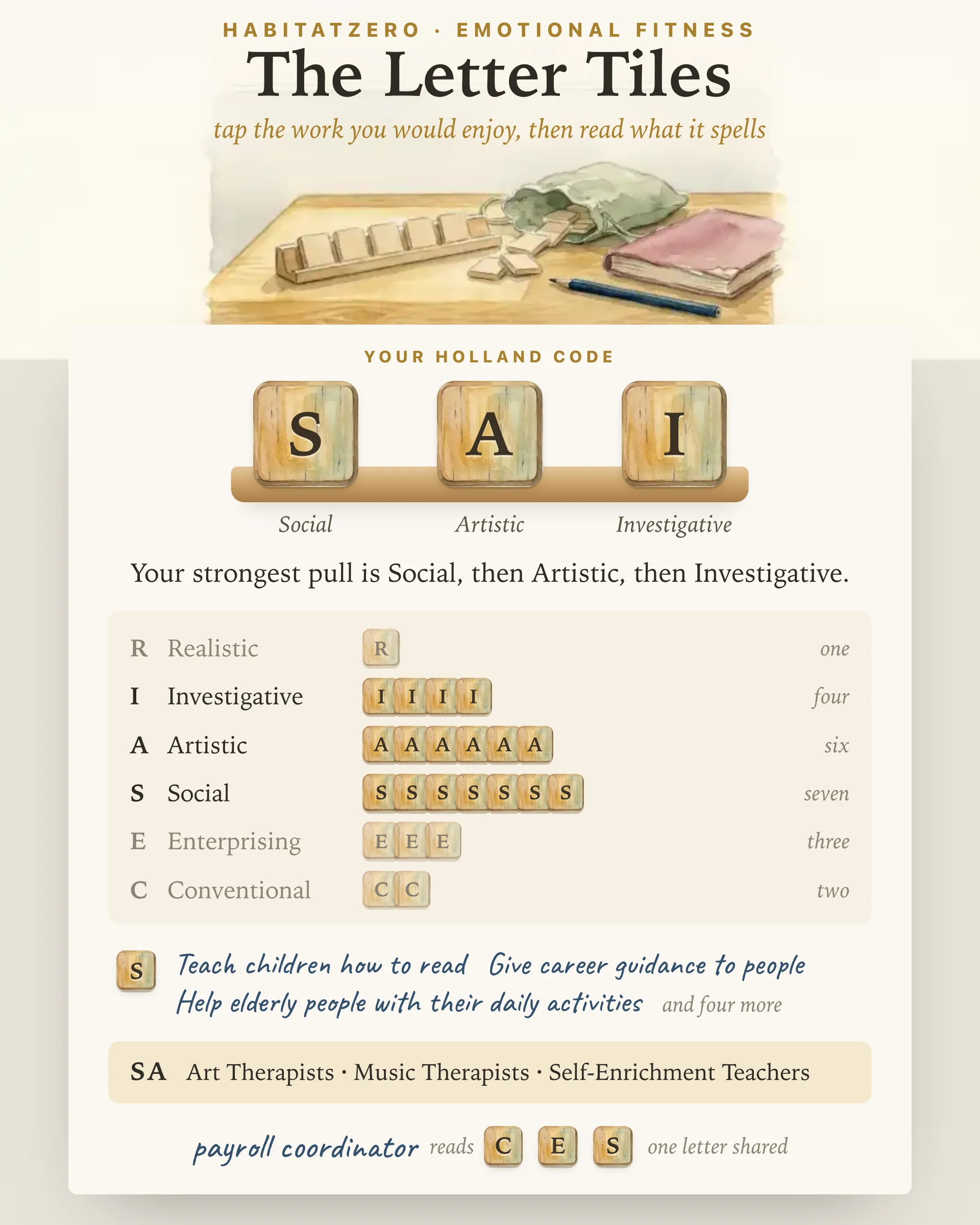
The six letters on this page belong to John L. Holland, who set out a theory of vocational choice in 1959 and refined it for decades around one idea: people and workplaces can be described with the same six types, Realistic, Investigative, Artistic, Social, Enterprising and Conventional. The three you resemble most, in order, are your Holland code. The Letter Tiles is an independent HabitatZero worksheet built on that published model, and nobody connected to Holland's work, to the commercial inventories that use it, or to the U.S. Department of Labor made, reviewed or endorsed it.
You get eight spreads of six activities, forty-eight in all, with one activity from each area per spread in shuffled seats. Tap every one you would enjoy doing. Leave out pay, training and whether you could do it today; ask only whether an afternoon of it sounds good. If nothing in a spread appeals, say so and move on.
Each tap lays a wooden tile face down on the tray. The tiles stay hidden until the eighth spread because a running tally would tempt you to keep feeding whichever letters were already ahead. When you tip them out, the tiles turn over and sort into six rows, one per letter, and the three longest rows spell your code on the rack.
The activities are the public-domain RIASEC markers that Patrick Armstrong, Wyndolyn Allison and James Rounds published in 2008 as a free alternative to commercial interest inventories, drawn from the item pool of the original O*NET® Interest Profiler. Tapping to pick them is this page's own quicker format, which has not been validated on its own, so treat a one-tile gap between rows as noise.
Your first letter is the strongest pull; the second and third shade it. When rows tie, the page spells out what the tie leaves open, and a letter tied for last place sits on the rack as a small "or" tile. The page also flags a third letter that beats the fourth by a single tile; hold that one loosely.
Holland arranged the six letters in a ring that runs R, I, A, S, E, C and back to R. Neighbors resemble each other most and opposite letters least, and when Terence Tracey and James Rounds pooled published correlations between interest scales, Holland's circular order held up well against a rival three-group model. If your first two letters are neighbors, plenty of jobs ask for both. If they sit across the ring, the mix is rarer, and people often meet one side at work and the other elsewhere.
Under your code, the page lists example occupations filed under your first two letters in ONET data and quotes back the activities behind each row. To see every occupation that shares your code, ONET OnLine lets you browse occupations by interest type.
Here the code earns its keep for adults. Write your job in a few words and place up to three letters for what it asks of you most. The page shows which letters the two racks share, how far apart their lead letters sit on the ring, and one small way to feed your strongest missing letter in the job you have, such as redesigning a form nobody likes when Artistic is missing.
A wide gap between the racks is common, and it is not a verdict. Some people keep the missing letter alive outside work, some reshape the role over a year, and some plan a slower move into a field that fits. If you mostly end a workday drained rather than mismatched, look at rest and workload first; a change of scene will not refill an empty tank. Ready to test a direction? The Odyssey Plan sketches three five-year lives side by side, and one can lean hard into your top letter.
A meta-analysis of seventy-four studies found that interest scores were linked to job performance and to whether people stayed in their jobs, modestly overall and more strongly when the interests fit the work being done. That is a real but small signal about groups of people, not a forecast of your next move.
A code also says nothing about ability, pay, or what a workplace feels like on a Tuesday. Forty-eight taps in one sitting give a rough picture that a hard week can tilt, so retake it in a few months and see which letters hold. The O*NET Interest Profiler from the Department of Labor, which has its own published validation reports, is free online in thirty questions.
Reach for it before a meeting with a career counselor, while you weigh a new field, or a year into a role you chose. Interests say what you would enjoy doing and values say what the work has to give back, so pair this with the Values Card Sort. For a teenager, the Career Quiz for Teens covers the same six areas in quick would-you-rather forks.
Occupation examples on this page include information from the O*NET 31.0 Database by the U.S. Department of Labor, Employment and Training Administration (USDOL/ETA), used under the CC BY 4.0 license. O*NET® is a trademark of USDOL/ETA.
It is a short interest inventory built on the six types John Holland used to describe people and workplaces, known together as RIASEC: Realistic, Investigative, Artistic, Social, Enterprising and Conventional. You react to everyday work activities, and the three areas you favor most, in order, become your three-letter Holland code, such as SAI or RCE.
R stands for hands-on work with tools, machines, plants or animals. I is research and working out how things work. A is creating with words, images, sound or design. S is teaching, helping and caring for people. E is leading, persuading and selling. C is keeping data, records and procedures in order. Your code lists the three you lean toward most, strongest first.
Treat the result as a sketch. This page uses forty-eight public-domain activity items from published RIASEC research, in a quicker tap-to-pick format that has not been validated on its own, so a gap of one or two picks between letters can flip on another day. Retake it in a few months, or compare it with the free O*NET® Interest Profiler from the US Department of Labor, which has its own published validation reports.
Start with occupations that share your first two letters and use the third as a tiebreaker. This page lists examples from the O*NET® 31.0 Database, and O*NET OnLine lets you browse every occupation by interest type. A match on paper is a lead worth investigating, not a ruling on where you belong.
Not quite. Aptitude tests measure what you can already do, while a Holland code describes what you would enjoy doing. For a career change the enjoyment side is easy to overlook, so after your code appears the page asks which letters your current job leans on and shows where the two line up. Skills, pay, values and timing still weigh as much as interest.
By the team behind Fabulous, the science-based self-care app used by over 30 million people.